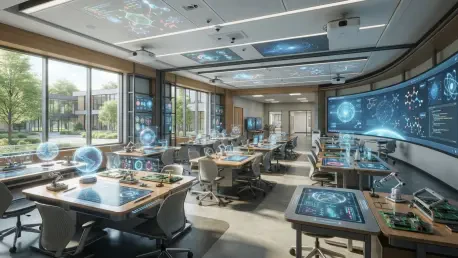

The TN SPARK initiative aims to move students beyond basic digital literacy by introducing a progressive curriculum that covers everything from foundational logic to professional-grade Python coding. As the 2026 academic cycle unfolds, the Government of Tamil Nadu has embarked on a radical overhaul of its public schooling system through the strategic integration of Artificial Intelligence and advanced Information and Communication Technology. Managed by the State Council of Educational Research and Training, this comprehensive strategy shifts from a traditional, centralized content delivery model to a more flexible, decentralized framework. By prioritizing the role of educators as primary content creators, the state is effectively democratizing the production of high-end pedagogical tools. This systemic transformation ensures that government high schools are no longer just passive consumers of digital media but are active hubs for technological innovation and academic excellence tailored to modern needs.
Empowering Educators as Digital Content Architects
The core of this educational evolution lies in the democratization of content creation, moving away from a rigid, top-down structure. Previously, the state relied on a centralized team to produce generic lesson videos, which were then distributed to all schools regardless of local context. Starting in 2026, the new paradigm emphasizes teacher autonomy, providing them with the necessary skills to develop customized digital resources. By empowering individual educators to create bespoke pedagogical tools—such as tailored animated videos, interactive puzzles, and specialized audio recordings—the state acknowledges that those on the front lines are best equipped to identify unique learning gaps. This decentralized approach ensures that materials are not only academically rigorous but also culturally and contextually relevant to the diverse student populations across various districts. This strategy fosters a culture of innovation among faculty and improves overall school engagement.
To support this ambitious shift, the State Council of Educational Research and Training has initiated specialized training for postgraduate teachers specializing in Physics, Chemistry, and Mathematics. These educators are now being transformed into digital architects who can visualize complex scientific and mathematical processes that are often difficult to grasp through traditional textbooks alone. By utilizing high-end animation and interactive design, teachers can break down abstract theoretical concepts into digestible, visual modules. This specialized training allows for a more nuanced delivery of the curriculum, where teachers can iterate on their digital materials based on real-time feedback from their classrooms. Furthermore, the state is prioritizing the integration of these teacher-generated tools into high-tech laboratories and smart classrooms, ensuring that the transition from theory to digital practice is seamless. This professional development is critical for long-term success.
Integrating Generative AI and Interactive Simulations
The technological backbone of this initiative involves a sophisticated suite of Generative AI and Large Language Models, which are being utilized to enhance both teaching and research. Educators are being trained to use advanced platforms like ChatGPT, Claude, and Google Gemini to conduct deep content research and generate comprehensive teaching aids. A key component of this training is “prompt engineering,” which allows teachers to interact effectively with AI models without needing a background in computer programming. By mastering these digital interfaces, teachers can quickly synthesize complex information and create structured lesson plans that are both innovative and efficient. Additionally, tools like Google Vids and Adobe Express are being leveraged to produce professional-quality educational videos and illustrations. This integration of high-level technology into the daily workflow represents a significant leap forward in bridging the digital divide across the entire state.
The successful rollout of these programs relied on a phased approach that balanced rapid deployment with rigorous quality control, such as the TN SPARK curriculum for Classes 6 through 9. This program introduced foundational logic via Blockly before advancing to Python, ensuring students developed a robust understanding of computational thinking. Central to this implementation was the “human-in-the-loop” model, which necessitated that all AI-generated content be strictly vetted by educators for accuracy before reaching classrooms. Moving forward, the focus must shift toward maintaining consistent infrastructure, including high-speed internet and functional hardware in all rural areas. The state should also establish ongoing feedback loops between teachers and policymakers to refine these digital tools based on real-time outcomes. By fostering a sustainable ecosystem of digital literacy, Tamil Nadu has effectively set a high standard for modern public education systems.