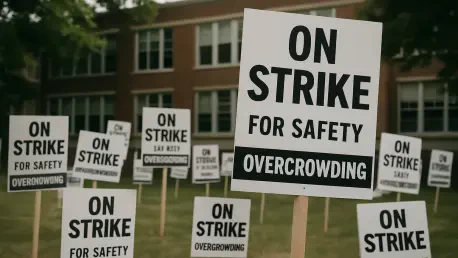

The silence surrounding the hallways of Orchard School was shattered early Tuesday morning as hundreds of faculty members and support staff established picket lines to protest deteriorating conditions. For months, the local school board has faced mounting criticism regarding the rapid influx of new students without a corresponding increase in facilities or personnel. This surge has forced educators to transform storage closets and common areas into makeshift instructional spaces, significantly compromising the quality of the learning environment. The decision to strike did not occur in a vacuum; rather, it was the culmination of failed negotiations that began earlier this year in 2026. Educators argued that the current student-to-teacher ratio has exceeded sustainable levels, making it nearly impossible to provide individualized attention or maintain order during transitions. As the picket lines grew, the community remained divided on the best path forward while the district struggled to implement contingency plans.
Physical Space: The Crisis of Infrastructure Capacity
The physical layout of the facility was originally designed to accommodate approximately eight hundred students, yet the current enrollment figures have surged well past twelve hundred this academic year. This discrepancy has created a domino effect of operational failures, ranging from overwhelmed ventilation systems to hallways that become impassable during passing periods. Teachers have reported that the lack of space directly interferes with modern pedagogical methods, as there is simply no room for collaborative group work or specialized equipment. In science laboratories, the overcrowding has reached a critical point where conducting experiments poses a genuine physical risk to both students and staff. The administration’s reliance on portable classrooms has been criticized as a temporary bandage that fails to address the underlying structural deficit. Meanwhile, the noise levels in these packed environments have contributed to a significant decline in focus and academic performance for the student body.
Physical Space: The Impact on Instructional Quality
Beyond the academic hurdles, the overcrowding has placed an immense strain on the school’s daily logistical operations and the mental well-being of the staff members involved. Every shared space, from the cafeteria to the library, operates at double its intended capacity, leading to staggered lunch schedules that begin as early as ten in the morning. Support staff, including custodial and maintenance workers, find themselves unable to keep up with the wear and tear caused by such high foot traffic. Consequently, the building has seen a rapid degradation of its interior surfaces and mechanical systems, leading to more frequent equipment failures. Staff morale has plummeted as educators feel their professional concerns are being ignored by a board focused more on budget constraints than on student safety. The labor union emphasizes that the strike is a necessary measure to protect the dignity of the teaching profession and to ensure that the district prioritizes long-term facility planning over short-term savings.
Safety Standards: The Failure of Emergency Protocols
Security experts have raised significant alarms regarding the feasibility of emergency evacuation procedures within a building that is housing fifty percent more occupants than its legal limit. During routine fire drills, the time required to clear the building has nearly doubled, a statistic that local fire marshals have identified as a major violation of safety codes. The dense crowding in stairwells creates a hazardous bottleneck that could prove catastrophic in a real emergency, such as a fire or a localized structural failure. Furthermore, the ability of security personnel to monitor the entire campus has been severely hindered by the sheer volume of individuals moving through the facility. This lack of visibility increases the risk of unauthorized entries and makes it difficult to manage interpersonal conflicts before they escalate. Parents have become increasingly vocal about these risks, noting that the district’s failure to address the overcrowding is a direct dereliction of its duty to keep all children safe.
Strategic Resolutions: The Path toward Sustainable Reform
The resolution of the strike provided a critical blueprint for how growing districts handled the intersection of infrastructure and safety in a high-demand era. Officials ultimately committed to a bond measure that funded the immediate acquisition of modular units with superior safety ratings and the long-term development of a secondary campus. They also established a joint oversight committee, composed of both teachers and administrators, to monitor building capacity and safety benchmarks on a monthly basis. This proactive approach replaced the previous reactive stance, ensuring that facility upgrades were no longer delayed until a crisis point was reached. Districts across the state looked to this agreement as a model for maintaining instructional integrity while managing significant demographic shifts. Educators shifted their focus toward integrating new safety technologies, while the administration prioritized transparency. These steps ensured that the school environment remained conducive to excellence and physical security for every student.