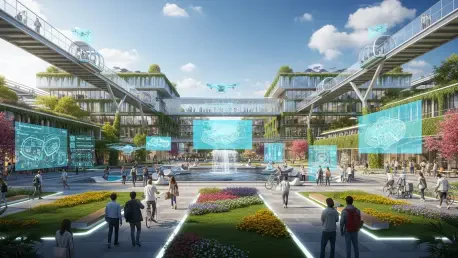

The traditional boundaries between digital interfaces and physical academic spaces have blurred significantly as higher education institutions transition toward fully autonomous operational models. Chitkara University recently introduced its comprehensive smart campus framework, designed to redefine the educational experience for the current academic session starting this month. This transformation represents more than a simple technological upgrade; it is a fundamental shift in how knowledge is disseminated, consumed, and applied within a high-tech ecosystem. By integrating advanced machine learning algorithms with physical infrastructure, the university aims to create a responsive environment that anticipates the needs of students and faculty alike. This initiative reflects a broader global trend where data-driven insights govern everything from campus safety to individual learning trajectories. As the 2026 academic term commences, the implementation of this system serves as a benchmark for academic excellence and innovation.
Technological Foundations: Building the Intelligent Ecosystem
Central to this initiative is the deployment of a sophisticated Internet of Things network that blankets the entire campus, connecting thousands of smart devices into a unified operational hub. This network manages resource allocation with surgical precision, utilizing occupancy sensors and ambient intelligence to regulate climate control and lighting systems based on real-time population density. Beyond energy efficiency, the infrastructure incorporates biometric security protocols and autonomous navigation aids that ensure a safe and accessible environment for every visitor. The integration of high-fidelity wireless connectivity ensures that the digital divide is eliminated, allowing for seamless transitions between indoor learning spaces and outdoor collaborative zones. These technical enhancements are underpinned by a private 6G backbone, which provides the low-latency communication necessary for augmented reality applications and high-bandwidth research projects.
Building on the physical layer, the smart campus employs an advanced artificial intelligence engine that serves as a personal academic concierge for the diverse student population. This system analyzes individual learning patterns to suggest customized study schedules, elective courses, and even extracurricular activities that align with specific career objectives. Faculty members utilize this data to identify students who may require additional support, enabling proactive intervention before academic challenges become significant obstacles. Furthermore, the AI-driven administrative portal automates traditional bureaucratic processes, such as registration and financial aid tracking, thereby freeing up staff to focus on more complex mentorship roles. By utilizing predictive analytics, the university can forecast trends in global industry demands, ensuring that the curriculum remains relevant and agile in a rapidly changing economic landscape.
The successful rollout of the smart campus protocols offered several critical lessons for the future of global higher education. It became clear that the primary hurdle was not the hardware itself but the necessity for cultural adaptation among the academic community. Strategic stakeholders focused on training initiatives that empowered faculty to leverage AI tools effectively, ensuring that technology served as an enhancer rather than a replacement for human-centric instruction. Organizations that looked to replicate this model found that starting with a scalable data architecture was the most effective way to manage long-term growth. The integration of feedback loops allowed for continuous refinements, proving that a flexible mindset was just as important as technical proficiency. Moving forward, the emphasis shifted toward expanding these intelligent networks beyond campus borders to create interconnected educational hubs. These steps paved the way for a more resilient academic environment.