
An analysis of learning outcomes revealed that students achieved an average accuracy of seventy-six percent on titration theory before they even began their practical training. This high baseline suggests that modern chemistry students entering university programs in 2026 often arrive with a robust theoretical foundation, making the challenge for educators less about introducing new concepts and more about refining practical application. A recent pilot study conducted by a collaborative team from the Centre de Formation Professionnelle Neuchâtelois and the University of Applied Sciences and Arts Northwestern Switzerland investigated whether immersive technology could bridge this gap. Published in the journal Frontiers in Virtual Reality, the research scrutinized the pedagogical efficacy of sequencing Virtual Reality (VR) training alongside traditional hands-on laboratory work. The experiment specifically focused on titration, which remains a fundamental yet technically demanding analytical technique. By tracking ninety-one first-semester Life Sciences students, the researchers aimed to determine if the order of instruction—starting in a virtual environment versus a physical one—exerted any measurable influence on the final mastery of the subject matter.
The implementation of VR in science education is often touted as a revolutionary step toward democratizing high-stakes laboratory experiences. In this study, the participant group was notably diverse, consisting of fifty-seven female, thirty-three male, and one non-binary student, with an average age of nearly twenty-two. Perhaps most interestingly, the vast majority of these students had very little to no prior experience with VR hardware, with only two participants identifying as frequent users. This lack of familiarity was a crucial element of the research design, as it allowed the team to observe how a general student population interacts with immersive technology without the bias of existing technical proficiency. One student did experience physical discomfort during the VR session, a reminder that “cybersickness” remains a hurdle for a small percentage of users even as hardware improves. However, for the rest of the cohort, the transition into the digital workspace was largely seamless, providing a clear window into the future of blended learning models where physical and virtual spaces are used interchangeably to maximize student throughput and safety.
Replicating the Laboratory: The Virtual Environment Architecture
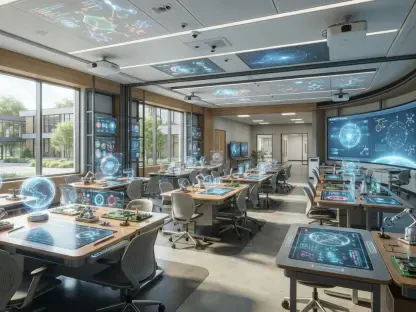
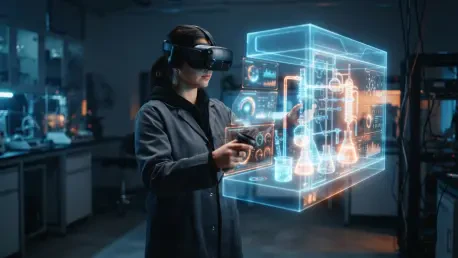
The technical core of the simulation utilized Meta Quest 2 headsets running a bespoke environment developed in the Unity engine. This digital space was not merely a stylized representation but a meticulous digital twin of a standard laboratory fume hood. Students were presented with virtual versions of every piece of equipment they would find in a real-world setting, including burettes, magnetic stirrers, measuring cylinders, beakers, and various chemical solutions. To ensure the experience was educationally sound, the simulation followed a structured three-phase pedagogical trajectory. It began with an orientation phase where students could acclimate to the controls and the spatial layout of the virtual lab at their own pace. This was followed by a guided titration phase, which used intuitive visual cues like flashing indicators and yellow outlines to direct the student through the correct sequence of steps. Finally, a test phase required the students to perform a complete titration on an unknown solution without any assistance, recording their final data through an integrated interface.
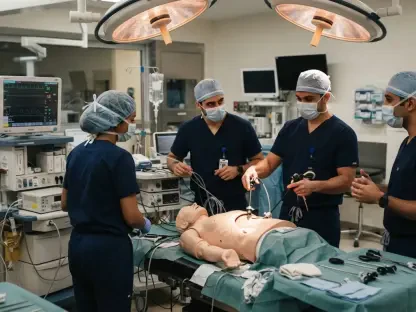
To maintain the integrity of the experiment, the physical laboratory condition was designed to be an exact mirror of the virtual experience. Students worked in pairs within a real lab, utilizing the same equipment configuration and following the same printed instructions they would encounter in the virtual tutorial. This symmetry was essential for isolating the learning modality as the primary variable. Before the main study commenced, the research team conducted rigorous usability testing with a smaller focus group. Initial feedback led to several crucial refinements, such as the addition of visual cues for removing container lids and a reset function for virtual objects that might be dropped or lost in the environment. These iterative improvements significantly raised the System Usability Scale scores, moving the platform into a “good” or “acceptable” range for educational software. The inclusion of a remote instructor dashboard further enhanced the experience, allowing staff to manage audio levels and reset student environments from a central computer, thereby simulating a managed classroom environment.
Assessing Knowledge: Quantitative Gains and Learning Trajectories
The researchers developed a comprehensive thirteen-item multiple-choice test to evaluate learning outcomes across three distinct domains: declarative knowledge, procedural knowledge, and problem-solving skills. Declarative knowledge involved identifying the correct chemicals and the chemical endpoint of the reaction, while procedural knowledge assessed the student’s understanding of the sequence of operations, such as how to fill a burette properly. Problem-solving questions required the application of stoichiometry to calculate the final concentration of the unknown substance. Using an option-level scoring metric, where points were awarded for correctly identifying both true statements and false distractors, the researchers established a maximum possible score of fifty-two. The fact that students started with a mean score of nearly forty points highlighted the aforementioned high baseline, indicating that the students were already well-versed in the textbook theory of titration before the sessions began.
Statistical analysis of the results showed a rapid acquisition of knowledge that leveled off quickly after the first training session. Regardless of whether a student started in the VR environment or the physical lab, their scores rose significantly after the initial activity, but the second session provided almost no additional gain. The study found no statistically significant difference in final outcomes between the group that underwent VR training first and the group that started with hands-on work. Specifically, the “VR-first” group showed a slightly lower mean score after the first period, but this difference was within the margin of error and likely attributable to chance. This finding is significant because it suggests that VR is just as effective as traditional lab work for conveying procedural and declarative information. It supports the idea that virtual simulations can be integrated into the curriculum without a loss of educational quality, potentially serving as a pre-lab requirement to ensure all students reach a certain competency level before using physical resources.
Psychological Dimensions: The Impact of Presence and Load
Beyond purely academic scores, the research team employed the Cognitive Affective Model of Immersive Learning (CAMIL) to investigate the psychological experience of the students. They focused on “presence,” which is defined as the subjective sensation of being physically located within the virtual world, and its relationship with cognitive load and motivation. The data revealed a strong negative correlation between presence and cognitive load. This implies that when students felt more immersed and comfortable in the virtual environment, they perceived the mental effort required to complete the tasks as lower. In contrast, students who struggled with the interface or felt less “present” reported higher levels of mental strain. This relationship suggests that high-quality immersion is not just a novelty but a functional tool for reducing the cognitive barriers to learning complex scientific procedures.
Despite the clear link between immersion and ease of use, these psychological factors did not act as strong predictors of the students’ actual test scores. The researchers noted that the model’s ability to explain variations in knowledge gains was quite low, suggesting that external factors—such as a student’s prior academic performance or general aptitude—were far more influential than the specific technological medium. This highlights a critical insight for the educational landscape of 2026: while VR can make the learning process feel more intuitive and engaging, it does not automatically translate into higher test scores if the students are already reaching the ceiling of the curriculum’s difficulty. The immersive nature of the technology improves the experience and reduces perceived effort, but the core pedagogical content remains the primary driver of academic success. This nuance is vital for institutions looking to invest in VR, as it suggests the technology should be viewed as a facilitator rather than a replacement for rigorous content.
Navigating Methodological Constraints: A Critical Perspective
The researchers were highly transparent regarding the limitations of this pilot study, which provide important context for the findings. One of the primary caveats was the non-randomized allocation of students, as they were assigned to groups based on their existing class schedules. This makes the study observational and prevents a definitive claim of causality. Furthermore, the “ceiling effect” caused by the high initial knowledge of the students meant there was very little room for either the VR or the physical lab to show a dramatic improvement in scores. If the study had focused on a more obscure or complex technique where students had zero prior knowledge, the differences between the two modalities might have been more pronounced. Additionally, the written test used to measure outcomes had relatively low internal consistency, which may have masked subtle differences in how the two groups processed the information.
Another significant limitation was the lack of a direct assessment of manual dexterity and physical technique. While the written test could measure what a student knew about titration, it could not measure how well they could actually perform it with their hands. It remains an open question whether a student who trained in VR would exhibit the same level of fine motor control during their first physical lab session as a student who had already practiced with real glassware. The study also had to account for the “retest effect,” as students took the same test three times throughout the process. Familiarity with the questions could have contributed to the score increases observed after the first session. These factors collectively suggest that while the current results are promising, they represent only the first step in a broader effort to validate VR as a replacement or supplement for physical laboratory hours in higher education.
Educational Strategic Planning: Recommendations for Implementation
The researchers established that Virtual Reality is a functional, stable, and highly usable tool for modern chemistry education, even if it is not a “silver bullet” that dramatically outperforms traditional methods. The study concluded that the sequence of learning does not fundamentally change the knowledge outcome, which provides educators with the flexibility to deploy VR simulations whenever they are most convenient within a course schedule. For instance, VR could be used as a high-throughput orientation tool to familiarize students with safety protocols and equipment layouts before they ever step foot in a physical lab. This would not only reduce the risk of accidents but also ensure that physical lab time is spent on refining manual skills rather than learning basic procedures. The focus was placed on the potential for VR to serve as a cost-effective alternative to building and maintaining expensive physical laboratory space for every introductory course.
Looking ahead from 2026, the study suggested that future research must prioritize the development of validated instruments to measure the transfer of procedural skills from the virtual world to the real one. The next phase of development should involve observing students in the physical lab after they have completed VR training to quantify any improvements in technique, speed, or accuracy. There was also a strong recommendation to establish “non-inferiority margins” to determine if VR can officially replace a portion of required lab hours without compromising the certification of Life Sciences professionals. By treating VR as a specialized tool for reducing cognitive load and increasing engagement, institutions can create a more resilient and scalable educational framework. The transition toward immersive learning was viewed as a long-term evolution where the value of the technology lies in its ability to provide repeatable, low-cost practice that complements the irreplaceable tactile experience of the physical laboratory.