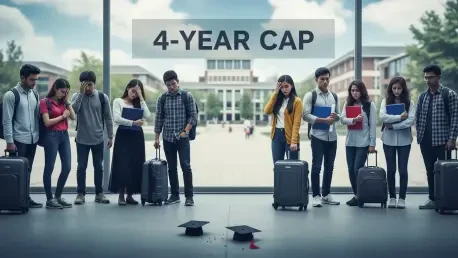

Camille Faivre is a seasoned strategist in education management, widely recognized for her expertise in helping institutions navigate the complexities of international student integration and digital learning transitions. In the wake of shifting global policies, her work has become essential for universities striving to maintain their competitive edge while supporting a diverse, international cohort. Today, she joins us to discuss the profound implications of recent federal regulations that cap the duration of international student visas. We will explore how these mandatory four-year limits challenge the traditional structure of American degrees, the administrative burdens placed on both students and federal agencies, and the broader impact on the United States’ reputation as a premier destination for global scholars.
The following discussion examines the shift from “duration of status” to fixed-term visas, the specific vulnerabilities of doctoral and research programs, and the tension between national security narratives and the statistical reality of international student enrollment.
How do you anticipate the mandatory four-year cap on F and J visas will reshape the academic journey for doctoral candidates whose research naturally extends well beyond that timeframe?
The implementation of a rigid four-year cap is a fundamental misalignment with the reality of advanced research in the United States. When you consider that a Ph.D. typically requires at least five years to complete—and often longer depending on the complexity of the dissertation or lab-based experiments—this rule creates a persistent state of legal anxiety for our most dedicated scholars. Students will now have to navigate a secondary, high-stakes application process with the Department of Homeland Security just to finish the degree they were originally invited to pursue. This doesn’t just add paperwork; it introduces a sensory layer of instability, where the “ticking clock” of a visa expiration date might take precedence over the pursuit of scientific or academic breakthroughs. We are essentially telling researchers who have committed years of their lives to American innovation that their presence is contingent on an overburdened immigration system’s ability to process extensions in a timely manner.
With the new restrictions on changing educational objectives or transferring institutions, what impact do you foresee on the flexibility that defines the American higher education experience?
The American university system has always been prized for its fluidity, allowing students to discover their true passions and pivot their focus, but these new restrictions effectively trap students in their initial choices. Under these rules, graduate students and even first-year undergraduates face significant hurdles if they wish to change majors or move to a different campus, requiring them to prove “extenuating circumstances” to federal officials. This moves the power of academic decision-making away from educators and places it firmly in the hands of government bureaucrats who may not understand the nuances of a student’s intellectual growth. It is a disheartening shift that ignores the fact that many students enter college to explore, and forcing them into a rigid path under the threat of visa revocation is a solution in search of a problem. The emotional toll on a twenty-year-old student who feels legally bound to a major they no longer wish to pursue is a heavy burden that will undoubtedly stifle the very creativity we aim to foster.
The administration cited a need to mitigate risks of fraud and abuse, but how do you reconcile that rationale with the actual scale of students remaining in the country long-term?
The rhetoric regarding “rampant fraud” and students staying for decades simply does not hold up when you look at the concrete data provided by the government itself. While the Department of Homeland Security pointed to 2,100 international students who entered between 2000 and 2010 and still hold active visas, that number is statistically minuscule when compared to the 1.6 million international students who entered the U.S. in 2024 alone. We are talking about a tiny fraction of a percent of the total population, yet the policy response is a sweeping, restrictive rule that affects every single foreign student. It feels like a massive overreach that penalizes the vast majority of law-abiding scholars to catch a few outliers who are already being tracked through existing, highly monitored systems. This “one-size-fits-all” approach ignores the sophisticated monitoring already in place and instead adds a redundant layer of oversight that provides very little in the way of actual security.
Given that students already in the U.S. might lose their eligibility to stay if they travel abroad during their remaining four years, how does this affect the global connectivity of the international student community?
This specific clause creates a “gilded cage” effect where students are physically present in the country but are effectively terrified to leave, even for family emergencies or international research conferences. If an eligible student currently studying in the U.S. leaves the country, they risk losing the ability to stay for the remainder of their program under the four-year rule, which is a devastating prospect for those in the middle of their studies. This isolation contradicts the very essence of the J visa, which is designed for exchange and visitor programs meant to foster global cultural and academic ties. We are essentially telling these individuals that if they want to finish their education, they must sacrifice their connection to their home countries and their ability to participate in the global academic community. It creates a palpable sense of isolation and fear, as students must weigh the risk of a trip home against the possibility of being barred from completing their degrees.
How does the requirement for “periodic assessments” by federal agencies shift the balance of power between academic institutions and the government?
This rule represents an unprecedented government intrusion into the internal academic decision-making processes of our universities. Traditionally, institutions like the University of Michigan have had their own rigorous procedures to ensure students are making appropriate academic progress, but now, the government is inserting itself as the final arbiter of what constitutes “sufficient advancement.” By requiring students to seek federal approval for extensions or major changes, the government is overriding the expertise of educators who are actually in the classrooms and labs with these students. This change was lambasted by advocates because it places life-changing decisions in an immigration system that received nearly 22,000 public comments—the majority of which were critical—yet chose to move forward with almost no changes. It signals a move toward a more transactional and suspicious relationship between the state and the international scholar, where the university’s endorsement of a student is no longer considered sufficient proof of their legitimacy.
What is your forecast for the future of international student enrollment in the U.S.?
I forecast a period of significant cooling in international enrollment as students increasingly look toward more welcoming destinations like Canada, the UK, or Australia. The United States has long enjoyed a reputation as the gold standard for higher education, but when you combine these new visa caps with the administrative “extenuating circumstances” hurdles, the value proposition begins to shift for many families abroad. We will likely see a decline in the number of high-achieving Ph.D. candidates specifically, as they are the ones most impacted by the four-year limit and the inability to easily transfer or pivot research focus. If the U.S. continues to prioritize restrictive “periodic assessments” over the flexibility and autonomy that built its university system, it risks losing a generation of global talent to countries that view international students as assets rather than risks. The long-term health of American research and innovation depends on our ability to remain an open, predictable, and supportive environment for the world’s best minds.