
Camille Faivre is a distinguished education expert who has spent years navigating the complex intersection of education management and student welfare. As a specialist in supporting institutions through the post-pandemic transition to digital learning, she possesses a deep understanding of how federal policy shifts trickle down to affect the financial stability of individual students. In our conversation today, we examine the looming “tax bomb” facing millions of borrowers as pandemic-era protections expire, exploring the heavy financial toll on low-income families and the regional disparities that define this crisis in 2026.
Since tax exemptions for discharged student loans expired at the end of last year, how are borrowers seeing their financial obligations change as they navigate this first tax season of 2026?
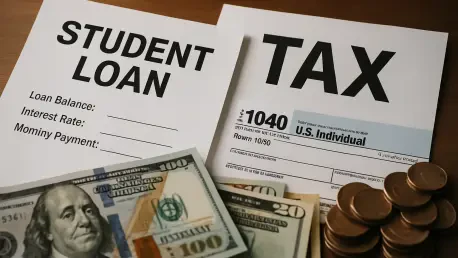
The shift in the tax landscape has been incredibly jarring for those who expected a fresh financial start after decades of faithful payments. Under the pandemic-era American Rescue Plan Act, student debt canceled through income-driven repayment was exempt from federal taxation, but that vital protection vanished on December 31. Now, borrowers with discharged IDR loans are seeing their federal tax bills jump by roughly $6,000 to $12,000, according to recent analysis from legal advocacy groups like Protect Borrowers. For many individuals, this means their tax liability for the year could suddenly double or triple, turning what should have been a moment of financial freedom into a stressful encounter with the Internal Revenue Service. It is a crushing weight to drop on someone who finally felt they could breathe after twenty years of debt, only to find a new five-figure bill waiting in their mailbox.
The financial impact seems particularly severe for families; could you break down what this “tax bomb” actually looks like for a middle-income household with children?
The numbers for a household of four are particularly sobering because the tax code now treats the discharge not just as income, but as a disqualifier for other forms of critical support. A married borrower with two dependents will owe an average of $7,206 in additional taxes on their canceled IDR debt, which more than triples their expected total liability. For a family earning $40,000 annually, the total impact reaches a staggering $10,558, which is a combination of $1,704 in actual new taxes and a massive loss of $8,854 in valuable tax credits. This forces many parents to essentially replace their debt to the Department of Education with a high-priority debt to the IRS, leaving them in an impossible financial position. It feels like being handed the key to a new home only to find the locks have already been changed by the tax collector, as their take-home income is effectively cut in half.
Many people are surprised to learn that someone can pay on their loans for decades and still owe an average of $50,000 at the time of discharge—why is that balance so high?
The math behind income-driven repayment plans often works against the borrower because of how interest accumulates when monthly payments are tied to income rather than the principal balance. Because these payments are frequently too low to cover the monthly interest, the remaining balance balloons significantly over the twenty to twenty-five years required for discharge. It is common to see a borrower’s final discharged amount reach that $50,000 mark, a sum that often far exceeds what they originally borrowed when they were students. By the time they qualify for discharge, they have usually endured significant financial hardship for the majority of their adult lives, and now the tax code treats that phantom interest as a liquid asset they can pay taxes on. This cycle ensures that even after the Department of Education wipes the slate clean, the financial ghost of the original loan continues to haunt the borrower’s bank account.
There has been significant discussion about regional disparities; why is this tax change expected to have such a disproportionate impact on borrowers living in the Southern United States?
The Southern region of the country presents a perfect storm of lower-than-average incomes and higher-than-average loan balances, making its residents uniquely vulnerable to this policy shift. When you combine those factors with the fact that half of the borrowers who received IDR discharges recently didn’t even have a non-retirement savings account, you realize how few resources they have to absorb this blow. These individuals are essentially being asked to pay thousands of dollars they simply do not have, often without any basic bank account to draw from, according to data from the Consumer Financial Protection Bureau. For a single borrower in this region earning $80,000, the tax on a discharged loan can reach nearly $20,000, which is an overwhelming sum that can erase years of careful budgeting. It creates a regional economic drag where the relief promised to the most vulnerable citizens is immediately reclaimed by the federal government.
What is your forecast for the legislative response to this issue given the current political climate and the recent shift in Congressional control?
The legislative landscape is currently in a state of high tension, as the recent midterms have given Democrats control of both chambers, which theoretically improves the odds of a permanent fix during the next budget reconciliation process. There is a strong coalition of Senators calling on the administration to permanently exempt these discharges, arguing that treating canceled debt as income is a regressive policy that targets the middle class. However, the political reality is complex because any legislative fix would still need to survive a potential veto from the White House, making the path forward anything but guaranteed. My forecast is that while we will see a major push for a permanent exemption, many borrowers will remain caught in this political tug-of-war for the duration of the current tax cycle. For now, the “tax bomb” remains a very real threat to the financial stability of millions of Americans who are just trying to move on with their lives.