
The halls of James Rickards High School currently stand as a silent witness to a growing educational divide that threatens the future of its student body. Education experts warn that the long-term consequences of high absenteeism include a reduced likelihood of college enrollment and an increased risk of future involvement with the legal system. This sobering reality is reflected in the most recent data from the 2024-25 academic year, which indicates that nearly 67% of the school’s population missed 21 days or more of instruction. While state averages for high absenteeism typically hover around 18.1%, Rickards has emerged as a severe outlier, with over 1,239 students falling into the category of being absent for a significant portion of the year. This shift suggests a breakdown in the fundamental connection between the classroom and the community, leaving administrators and teachers to grapple with an environment where more than eight out of ten students are considered chronically absent.
Regional Disparities and Local Comparisons
While student absenteeism is a pervasive concern across the Leon County School District, Rickards High School has become the epicenter of a much deeper struggle that distinguishes it from neighboring institutions. When comparing local figures, the gap between Rickards and other traditional public high schools is both striking and alarming. For instance, Godby High School and Lincoln High School reported absence rates in the low 40% range, which, while high, are significantly lower than the figures seen at Rickards. Meanwhile, schools like Leon High School and Chiles High School maintained much lower levels of chronic absenteeism, sitting at 29.6% and 24.3% respectively. This disparity of more than 20 percentage points between Rickards and its closest peers indicates that the challenges faced by this specific campus are unique and cannot be fully explained by broad district-wide trends or simple administrative policies.
The concentration of these attendance issues within a single campus suggests that localized socioeconomic factors are driving the crisis more than general academic disinterest. While other area schools have managed to stabilize their attendance post-pandemic, Rickards continues to struggle with a level of student absence that is nearly four times the state average. This suggests that the school is dealing with a specific set of community pressures that have not been adequately addressed by existing support systems. The fact that the school remains such an outlier within its own district points to a need for a more specialized approach that considers the demographic and economic realities of the neighborhood. Without a focused effort to understand why these disparities exist, the school risks becoming a permanent outlier in a district that is otherwise seeing more consistent engagement levels across its secondary education landscape.
Socioeconomic Barriers and the Title I Reality
A nuanced understanding of the attendance crisis requires an examination of the Title I status of James Rickards High School, which serves a high concentration of students from low-income families. School officials within Leon County note that many students are not simply skipping school out of apathy but are instead responding to the heavy weight of family responsibilities. In many households, older students are forced to stay home to provide childcare for younger siblings because their parents work hourly jobs that do not offer leave benefits or the flexibility to cover unexpected gaps in care. These students are effectively acting as secondary caregivers, a role that forces them to choose between their own academic progress and the immediate economic survival of their families. This survival-based choice is a primary driver of the multifaceted absenteeism that board members argue is distinct from traditional truancy.
Beyond childcare obligations, students at Rickards face systemic hurdles such as a lack of access to healthcare and food insecurity that further erode consistent attendance. Families living in poverty often lack the resources for regular medical and dental checkups, meaning that minor health issues that could be resolved quickly often turn into prolonged absences. Furthermore, specific challenges like the lack of stable transportation or the inability to access basic hygiene products can create significant psychological and physical barriers to attending school. These factors combine to create a culture where missing school is a logical, if unfortunate, response to overwhelming external pressures. When basic needs like nutrition and health are not met, the motivation to attend a six-period school day is often superseded by more pressing concerns, highlighting the fact that the absenteeism crisis is as much a social issue as it is an academic one.
The Graduation Rate Paradox
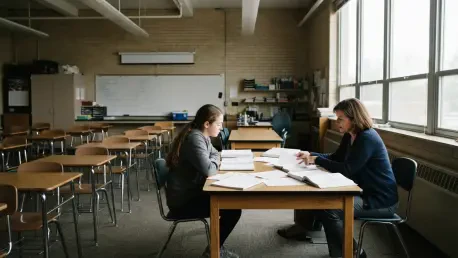
Despite the staggering data regarding student absences, Rickards High School presents a surprising academic contradiction through its high graduation figures. During the preceding academic year, the school maintained a 91% graduation rate, a figure that seems almost impossible when viewed alongside a 66.8% chronic absenteeism rate. This paradox is largely attributed to the aggressive and tireless efforts of the teaching staff, who have developed sophisticated systems for tracking absent students and ensuring they complete their coursework through alternative means. Teachers frequently go above and beyond their standard duties to provide makeup packets, digital assignments, and one-on-one remediation to keep students on track for a diploma. This commitment ensures that even those who miss significant instructional time are given every opportunity to satisfy state graduation requirements before their senior year concludes.
However, the disconnect between physical attendance and graduation status raises critical questions about the long-term depth of student learning and professional readiness. While students may be technically qualifying for a diploma, missing twenty or more days of face-to-face instruction inevitably impacts the rigor and quality of their education. Academic experts worry that the emphasis on graduation metrics may inadvertently mask a widening gap in actual knowledge and skill acquisition. Face-to-face interaction with educators and peers is a vital component of the learning process that cannot be fully replaced by independent makeup work or digital modules. As these students transition into higher education or the workforce, the lack of consistent classroom engagement may manifest as a deficit in critical thinking and collaborative skills, suggesting that the diploma itself may not be a complete indicator of a student’s preparedness for the future.
Post-Pandemic Shifts and Instructional Challenges
The current attendance climate at Rickards is also a reflection of a national shift in the “cultural contract” between families and the educational system following the global pandemic. Research from institutions like the University of Florida suggests that the pandemic fundamentally altered how parents and students view the necessity of daily physical presence in a classroom. Before the disruptions of the early 2020s, chronic absenteeism rates in Florida were significantly lower, but the habits formed during periods of remote learning have proven difficult to reverse. Many families have become more comfortable with the idea of keeping children home for reasons that might have been dismissed in the past, and the sense of school as a mandatory daily destination has been weakened. This shift has left schools like Rickards struggling to re-establish the routine of consistent attendance.
The impact of this high absenteeism extends beyond the individual student who is missing and affects the instructional environment for the entire class. When a large percentage of students are frequently absent, teachers must constantly pivot between introducing new material and remediating returning students who have missed previous lessons. This cycle of remediation slows the overall pace of instruction and can decrease the academic performance of students who are present every day. The constant turnover in the classroom creates a fragmented learning environment where it is difficult to build cumulative knowledge or maintain a cohesive instructional flow. This “remediation lag” places an additional burden on educators, who are forced to manage two separate tracks of progress within a single classroom, further straining the limited resources of a Title I school already dealing with high-pressure academic requirements.
Community-Driven Solutions and Actionable Pathways
Stakeholders recognized that the attendance crisis was not an isolated educational failing but a reflection of the economic pressures facing the community. They determined that the path forward required a radical departure from traditional disciplinary measures, opting instead for a model that integrated social services directly into the school environment. From 2026 to 2028, the district envisioned a more holistic support structure aimed at eliminating the specific barriers identified by families. These proposed steps included the expansion of mobile health units and the implementation of more flexible scheduling for students with unavoidable domestic obligations. Educators also identified that building stronger partnerships with local food banks and dental clinics was essential to reducing the number of health-related absences that plagued the student population during the recent academic year.
In the final assessment, community leadership prioritized direct outreach and personalized needs assessments to bridge the gap between the school and the home. They identified that a one-size-fits-all approach to truancy was ineffective in a Title I context and instead focused on identifying the unique stressors for each family. By shifting the focus from punishment to partnership, the district sought to restore the school’s role as a stable anchor in a volatile environment. These efforts reflected a deeper understanding that academic success is inextricably linked to the physical and social well-being of the student body. Ultimately, the collective response focused on ensuring that the promise of education remained accessible and relevant to all students, regardless of their socioeconomic background, by directly addressing the root causes of their absence from the classroom.