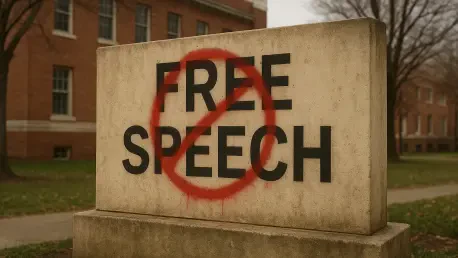

Surveys involving over 50,000 students suggest that the threat to free speech is not a centralized force but a complex ecosystem of social pressure and technological surveillance. While the university has historically served as a laboratory for intellectual exploration, the modern campus in 2026 is increasingly characterized by a profound hesitation among its inhabitants to engage with controversial or divergent viewpoints. This trend reflects a broader societal shift where the traditional defense of expressive liberty is being weighed against the immediate concerns of psychological safety and social cohesion. The data reveals that this is not merely a legal crisis involving constitutional interpretations of the First Amendment, but a cultural phenomenon where the informal mechanisms of peer-led censorship often carry more weight than formal administrative policies. As students navigate an environment saturated with digital monitoring and heightened political sensitivity, the cost of public dissent has risen to a level that many find prohibitive for their academic and social success.
The investigation into these shifting dynamics highlights a fundamental paradox within higher education. Universities are theoretically designed as sanctuaries for the rigorous contestation of ideas, yet the actual experience of students suggests a narrowing of the permissible range of discourse. This analysis synthesizes findings from diverse demographic groups to explain why a growing majority of the student body perceives the environment for open inquiry to be under significant threat. It is essential to understand that this pressure is multifaceted, involving a transition from hard censorship—actions taken by authorities to ban specific speech—to soft censorship, which is enforced through social ostracization and reputational risk. By examining the interplay between institutional policies, peer dynamics, and the pervasive nature of modern social technology, a clearer picture emerges of how the marketplace of ideas is being transformed into a more restrictive and risk-averse space.
The Dominance of Self-Censorship
The Psychological Impact of Social Ostracization
A primary finding in recent data is the staggering prevalence of self-censorship among the student body, reaching levels that suggest a systemic withdrawal from public debate. Most students report that they frequently withhold their true opinions on sensitive topics like politics, religion, or gender. This behavior is rarely driven by a direct fear of official university sanctions or legal prosecution; instead, it stems from a deep-seated fear of peer-led social consequences that can be devastating in a closed academic community. The psychological toll of potentially being ostracized by one’s social circle or being labeled with a socially toxic epithet creates a powerful incentive for students to align their public statements with the perceived majority opinion. In the current climate of 2026, the speed at which a student can be socially isolated makes the prospect of challenging a popular narrative seem like an act of social suicide rather than an exercise in intellectual bravery.
The chilling effect is most pronounced in digital spaces and classroom settings where a single incorrect statement can lead to immediate social canceling. This environment creates a spiral of silence, where individuals hide their views because they believe they are in the minority, even if those views are actually shared by a significant portion of their peers. When students observe others being targeted for expressing dissent, they internalize the risk and adjust their behavior accordingly, leading to an ossification of public discourse. This self-editing process does not just limit the variety of opinions expressed; it fundamentally alters the educational experience by preventing the natural evolution of ideas through critique and counter-argument. As a result, the campus atmosphere becomes one of tactical silence, where students prioritize social survival over the authentic pursuit of knowledge and the development of their own intellectual voice.
The Rise of the Heckler’s Veto
Another recurring theme in the examination of campus speech is the growing acceptance of the heckler’s veto, where a minority of protestors effectively silences a speaker by creating a disturbance. A significant portion of the student population now views the active disruption of controversial speakers as a legitimate form of expression rather than an infringement on the rights of others. This represents a fundamental departure from traditional understandings of the First Amendment, which protects the right of a speaker to be heard and the right of an audience to listen. When students believe that causing enough offense or logistical chaos justifies the termination of an event, the university’s role as a neutral platform for diverse views is fundamentally compromised. This trend suggests that many students no longer view the university as a place to engage with challenging or uncomfortable ideas but as a space that must be curated to protect a specific set of ideological values.
The practical result of this shift is a notable increase in speaker disinvitations and the preemptive cancellation of events by administrators who fear the cost of providing security or the potential for negative publicity. When the right to hear a speaker is subordinated to the right of the audience to prevent that speaker from being heard, the educational mission of the institution suffers an irreparable blow. Students are deprived of the opportunity to witness a robust debate or to practice the critical skills required to refute arguments they find objectionable. This curation of the intellectual environment fosters a sense of intellectual fragility, where students become less capable of navigating the messy and often offensive discourse of the broader world. By normalizing the disruption of speech, the university environment inadvertently trains future leaders to solve ideological disagreements through suppression rather than through the force of better arguments.
Academic Performance and Expressive Integrity
Students also express deep concern that voicing dissenting views might negatively impact their grades or their professional standing within their departments. There is a widespread perception among the student body of a lack of objectivity among faculty members, particularly in the humanities and social sciences. This belief leads many students to conclude that compliance with the professor’s ideological leanings is a safer strategy than taking an intellectual risk that could result in a lower GPA. Whether this perception is grounded in empirical reality or is a byproduct of the overall political climate, the effect on the classroom is the same: students prioritize their future career prospects over their intellectual integrity. This creates a transactional approach to education where the goal is to mirror the instructor’s perspectives rather than to engage in a genuine inquiry that might lead to a disagreement.
This fear of academic retribution extends beyond the classroom and into the broader professional development of the student. Many students worry that their participation in controversial clubs or their signatures on certain petitions could be used against them during graduate school applications or job interviews. In the competitive environment of 2026, where academic records are scrutinized more closely than ever, the risk of being labeled as a troublemaker or as ideologically impure is seen as a significant hurdle. Consequently, the university loses its character as a space for experimentation and growth, becoming instead a high-stakes arena where the path of least resistance is the most common choice. The long-term impact of this trend is a generation of graduates who are adept at following institutional scripts but who lack the experience of defending a principled, yet unpopular, stance in the face of authority.
Overarching Trends and Institutional Roles
Bipartisan Concerns and Disproportionate Impacts
While both liberal and conservative students express concerns about the state of free speech, the data consistently shows that conservative-leaning students feel significantly more threatened in the current environment. They often perceive the campus culture as being monolithically aligned with progressive values, which makes the expression of traditional or right-of-center viewpoints feel inherently dangerous. This discrepancy highlights a growing ideological divide in how different segments of the student population experience the marketplace of ideas. Conservative students are more likely to report that they feel they must self-censor during every class session and that they have fewer peers with whom they can speak openly. This sense of being an embattled minority can lead to a defensive posture, where students further withdraw into ideological silos, reinforcing the very polarization that the university is supposed to help mitigate.
However, it is a mistake to view the crisis of free speech as a strictly partisan issue, as students across the political spectrum report feeling the pressure to conform. Progressive students often find themselves navigating a different but equally intense set of social demands regarding the purity of their arguments and the specific terminology they use. The fear of being called out for not being sufficiently committed to a cause or for using outdated language creates a high-stress environment where even those in the ideological majority feel the need to watch their words carefully. This suggests that the problem is not merely the dominance of one political party over another, but a broader institutional failure to foster an atmosphere where disagreement is treated as a healthy part of the learning process. When the middle ground disappears, the university ceases to be a place of synthesis and becomes a theater for ideological combat where the objective is victory rather than understanding.
The Conflict Between Safety and Speech
There is a growing trend among the modern student body to prioritize inclusivity and emotional safety over the abstract principle of absolute free speech. Many students now believe that certain ideas are inherently harmful—categorizing them as verbal violence—and that the university has a moral and institutional obligation to protect marginalized groups from being exposed to them. This viewpoint often directly conflicts with traditional legal standards that protect even offensive or hateful speech from administrative suppression. The tension between these two competing values creates a significant challenge for university leaders who must balance their constitutional obligations with the demands of their primary stakeholders. As the definition of harm expands to include psychological discomfort, the space for permissible speech naturally contracts, leading to a more regulated and restricted intellectual environment.
This demand for safety often manifests in the creation of safe spaces and the implementation of trigger warnings, which are intended to provide a buffer against traumatic or distressing content. While these tools are often introduced with the best of intentions to support student well-being, their cumulative effect can be the stigmatization of challenging material. When students are conditioned to view certain topics as off-limits or as inherently dangerous, their ability to develop cognitive resilience is undermined. The shift from an educational model based on exposure and critique to one based on protection and insulation represents a fundamental change in the mission of higher education. This focus on emotional safety can inadvertently create a culture where the merit of an idea is judged not by its logic or evidence, but by its potential to cause offense, further chilling the discourse on essential social and scientific issues.
Administrative Inconsistency and Policy Vague
University administrations are frequently criticized for their inconsistent application of speech policies, which often appears to be driven by political expediency rather than principled conviction. Many students feel that institutional leaders cave to whichever group is loudest or most politically influential at a given moment, rather than standing by a coherent defense of expressive freedom. This perceived lack of courage from the administration undermines the credibility of the university as a neutral arbiter of academic freedom. When policies are applied selectively—protecting one group’s protest while punishing another’s speech—students lose trust in the fairness of the system. This inconsistency creates a vacuum where social pressure becomes the primary determinant of what can and cannot be said on campus, leading to a chaotic environment where the rules of engagement are constantly shifting based on the current social climate.
The problem is exacerbated by the maintenance of speech codes that are legally vague or overbroad, giving administrators significant discretion in how they define prohibited conduct. Terms like harassment, bullying, or incivility are often used in ways that allow for the sanctioning of speech that would otherwise be protected under the First Amendment. This lack of clarity forces students to err on the side of extreme caution, as they cannot be certain where the line for disciplinary action actually lies. In the absence of clear and consistently applied rules, students naturally gravitate toward the most conservative and non-controversial forms of expression to avoid any potential conflict with authority. This administrative ambiguity functions as a passive form of censorship, ensuring that the campus remains a safe place for the institution’s brand while sacrificing the intellectual vitality that comes from genuine, unregulated debate.
The Influence of Bias Response Teams
The rise of Bias Response Teams on campuses across the country has been identified as a major factor in the decline of expressive freedom. These committees are designed to receive reports of biased incidents that may not rise to the level of a crime or a formal policy violation, often focusing on subjective feelings of offense. The mere existence of a reporting mechanism for protected speech creates an environment of pervasive surveillance, where every interaction is a potential subject of administrative review. Students who are reported to these teams may be invited to educational meetings with administrators, which, while not officially disciplinary, carry a heavy weight of institutional disapproval. This process can be profoundly intimidating for a young person, effectively discouraging them from expressing potentially controversial or unpopular thoughts in the future.
The presence of these teams encourages a culture of tattling, where students are invited to monitor and report on their peers’ and professors’ private and public speech. This surveillance state within the university ruins the trust necessary for a healthy educational community and turns every classroom discussion into a potential liability. Even if a Bias Response Team never takes formal action against a student, the reputational damage and the anxiety associated with being investigated are sufficient to silence most people. By institutionalizing the reporting of subjective offense, universities have created a powerful tool for social control that bypasses traditional due process and First Amendment protections. This systemic approach to managing bias often results in a sanitized campus culture where students are more concerned with avoiding a report than with engaging in the difficult conversations that lead to personal and societal growth.
Political Polarization and Modern Technology
The Conservative Experience and Echo Chambers
Surveys consistently find that students who identify as Republican or conservative feel the most marginalized within the modern university structure. They frequently report that their professors use the classroom as a platform for political indoctrination rather than for objective instruction, and that their peers are often openly intolerant of their worldviews. This perception of systemic bias often leads to the formation of underground or isolated social groups where these students feel safe to speak their minds away from the prying eyes of the broader campus community. This balkanization of the student body prevents the cross-pollination of ideas that is essential for a functioning democracy and for a comprehensive education. When conservative students feel that their perspectives are unwelcome in the public square, they stop contributing to the collective discourse, which ultimately diminishes the quality of the academic environment for everyone.
The creation of these ideological echo chambers is a natural response to a perceived hostile environment, but it carries significant long-term risks. When students only engage with those who share their viewpoints, their ideas are never subjected to the rigorous testing that leads to intellectual maturity. This isolation can lead to radicalization and to a complete breakdown in the ability to understand or empathize with opposing arguments. In the context of 2026, where political polarization is at an all-time high, the university’s failure to integrate diverse viewpoints into a common conversation is a missed opportunity to bridge social divides. Instead of being a place where students learn to navigate difference, the campus becomes a series of disconnected silos where students’ existing biases are reinforced rather than challenged. This failure to foster viewpoint diversity is not just a problem for the marginalized groups; it is a structural failure that weakens the very foundation of the university as a place of universal inquiry.
The Digital Panopticon of Social Media
The digital age has fundamentally altered the stakes of public expression on campus, turning every student’s statement into a potentially permanent and global record. In previous generations, a controversial comment made in a dorm room or during a seminar remained local and was eventually forgotten, but today, every word can be recorded, screenshotted, and shared across social media platforms instantly. Students are acutely aware of this digital panopticon and the high probability that their speech will be taken out of context and used against them in the future. The fear of going viral for the wrong reasons is a powerful deterrent to open speech, leading students to perform for a potential audience of critics rather than engaging in the messy, exploratory process of learning. This constant state of public performance discourages the vulnerability required for genuine intellectual growth and the honest admission of doubt.
This technological surveillance is not just a theoretical threat; it has tangible consequences for students’ social lives and career prospects. Employers and graduate school admissions officers often conduct social media audits, and a single controversial post from one’s freshman year can be enough to derail a promising future. This permanent record of youth leaves no room for the mistakes and evolution that are a natural part of the university experience. As a result, students adopt a highly curated and safe public persona, avoiding any topic that could be perceived as controversial by anyone, anywhere. The loss of privacy and the permanence of digital speech have effectively extended the reach of social censorship far beyond the physical boundaries of the campus. In this environment, the university’s promise of a safe space for experimentation is replaced by the reality of a global stage where the rules of engagement are dictated by the most sensitive and aggressive digital actors.
The Loss of the Middle Ground
As political polarization increases nationwide, the moderate middle on campus is rapidly disappearing, replaced by a binary environment where students feel forced to pick a side in an ongoing culture war. This disappearance of the middle ground is particularly damaging to academic inquiry, which often requires the nuance and complexity that are lost in polarized debates. When every issue is framed as a moral struggle between good and evil, the space for objective research and thoughtful debate shrinks. Students who might otherwise hold moderate or eclectic views often feel pressured to adopt the full platform of one side to maintain social standing or to avoid being seen as complicit in the perceived sins of the other side. This pressure toward ideological conformity prevents the synthesis of new ideas and keeps the campus in a state of constant, unproductive conflict.
The loss of a common intellectual language makes it difficult for the university to function as a unified community of scholars. Instead of a shared pursuit of truth, the university becomes a collection of competing interests where the goal is to secure institutional power for one’s own group. This environment discourages students from pursuing subjects or methodologies that do not neatly fit into the prevailing ideological categories, leading to a narrowing of the curriculum and a decline in the diversity of research. In the landscape of 2026, the lack of a robust middle ground means that there are fewer opportunities for reconciliation or for the development of the compromises necessary for social stability. The university, which should be a model for constructive disagreement, instead mirrors the worst aspects of the national political divide, leaving its graduates ill-equipped to handle the complexities of a pluralistic society.
Understanding the Crisis
A Generational Shift in the Concept of Harm
There has been a clear and measurable shift in how the current generation of students conceptualizes harm, particularly in relation to language and ideas. Speech that was once seen as a necessary, if sometimes unpleasant, component of a free society is now increasingly categorized as a form of violence that can cause genuine psychological injury. This conceptual shift leads to a demand for safe spaces and the exclusion of challenging ideas on the grounds that their presence constitutes a threat to student well-being. When students view the expression of certain viewpoints as an attack on their identity or their personhood, the traditional defenses of free speech—such as the idea that the remedy for bad speech is more speech—lose their persuasive power. This leads to an environment where the restriction of speech is framed as a compassionate and necessary act of protection rather than as an act of censorship.
This new understanding of harm fundamentally alters the nature of the academic experience, moving the focus away from intellectual rigor and toward emotional comfort. If the goal of the university is to prevent any student from feeling distressed, then the core mission of challenging preconceived notions and exposing students to a wide range of worldviews must be sacrificed. This focus on protection can create a culture of fragility, where students are not given the opportunity to develop the emotional and intellectual callouses necessary to deal with the inevitable conflicts of adult life. The demand for an environment free from offensive ideas is ultimately an impossible goal that leads to an ever-expanding list of prohibited topics and a more fractured community. Reconciling this new concept of harm with the historical mission of the university remains one of the most significant challenges for higher education in the current decade.
Administrative Failure of Leadership
Many university leaders have failed to articulate a clear, principled defense of free speech and academic freedom, often choosing instead to prioritize institutional stability and brand management. By trying to please all stakeholders—students, faculty, donors, and the public—simultaneously, they often end up undermining the core values of the institution they are meant to protect. When a controversy arises, the typical administrative response is to release a vague statement that attempts to validate all perspectives without taking a firm stand on the right to dissent. This lack of leadership creates an atmosphere of uncertainty where students and faculty do not know if the institution will support them if they express an unpopular opinion. The resulting culture is one where the loudest and most aggressive voices often dictate the terms of discourse because the administration is unwilling to enforce a neutral and robust standard of free expression.
To reverse this trend, university leadership must rediscover the courage to defend the university as a space for uncomfortable but necessary debate. This requires a commitment to institutional neutrality, where the university as an entity does not take positions on social and political issues, thereby ensuring that all viewpoints can be debated on their merits. Without a clear and unwavering commitment from the top, the cultural forces of censorship will continue to erode the foundations of academic freedom. Leadership in 2026 demands more than just conflict resolution; it requires a proactive effort to educate students on the value of the First Amendment and the importance of engaging with ideas they find offensive. By failing to lead on this issue, administrators have allowed the university to drift away from its role as a center for the pursuit of truth and toward its current state as an institution of social signaling and ideological conformity.
Detailed Scope of Recent Surveys
To understand why a majority of college students feel that free speech is under threat, one must look at the unprecedented scale and rigor of the surveys conducted in recent years. Organizations such as the Foundation for Individual Rights and Expression and the Knight Foundation have utilized massive datasets involving over 50,000 students across hundreds of diverse campuses. These studies provide a granular look at how experiences differ between public and private institutions and between elite schools and large state universities. The consensus across these disparate datasets is remarkable: the feeling of a chilled atmosphere is not an isolated incident but a systemic feature of modern campus life. This large-scale data refutes the idea that free speech concerns are merely the product of a few high-profile anecdotes, showing instead that the pressure to conform is felt by students in every region and across all demographic groups.
The significance of these surveys lies in their ability to capture the subjective experience of the student body, which is the most accurate measure of the actual climate of discourse. Critics who argue that student self-reporting is too subjective fail to realize that in the context of free expression, perception is effectively reality. If a student feels that they cannot speak their mind without facing social or academic ruin, they will remain silent, and the educational mission of the university will have already failed. These reports serve as a vital indicator of a breakdown in the communicative health of the institution, highlighting the disconnect between formal policy and lived experience. By documenting the widespread nature of self-censorship and the fear of social retribution, these surveys provide the empirical foundation necessary for any serious attempt to reform campus culture and restore the marketplace of ideas.
Discomfort Versus Safety
A critical and nuanced finding in recent surveys is the distinction students make between feeling uncomfortable and feeling genuinely unsafe in an educational setting. A healthy academic environment is one that should make students uncomfortable by challenging their most deeply held beliefs and forcing them to defend their positions with logic and evidence. However, the data suggests that many students are moving beyond this productive form of discomfort and are instead feeling a sense of personal insecurity that leads to a total withdrawal from the public square. When the classroom becomes a space of perceived danger rather than a place of intellectual combat, the process of learning is effectively halted. This confusion between intellectual challenge and personal threat is at the heart of the current crisis, as it justifies the suppression of speech in the name of safety.
This perception of unsafety is often tied to the fear of being targeted by one’s peers for a perceived moral or social transgression. When the consequences of a disagreement are no longer limited to the debate itself but extend to one’s social and digital life, the stakes of participation become too high for the average student. The goal of future institutional reforms must be to re-establish the boundaries between intellectual disagreement and personal harm, ensuring that students feel secure enough to be uncomfortable. This requires a collective effort to cultivate a culture of intellectual humility and a renewed appreciation for the diversity of human thought. Without these changes, the university risks losing its most vital asset: the ability to bring people together from different backgrounds and perspectives to engage in the shared pursuit of understanding and truth.
The challenges facing free speech on American campuses were shaped by a decade of rapid social and technological change that prioritized emotional security over expressive liberty. University administrations often followed the path of least resistance, implementing policies that addressed immediate social pressures but undermined long-term academic freedom. Students, in turn, learned to navigate this landscape through self-censorship and the formation of ideological enclaves, leaving the traditional marketplace of ideas in a state of significant decline. As these institutions looked toward the future, the necessity of restoring a culture of robust debate became increasingly clear for the survival of the democratic project. The path forward required a renewed commitment to institutional neutrality and the active cultivation of an environment where the courage to listen was as valued as the right to speak. Accomplishing this shift involved protecting the right to dissent and ensuring that the university remained a place where any idea could be judged solely on its own merits.