
Avanti West Coast is leveraging digital twin technology to create a safe laboratory where new station layouts and service protocols can be tested before live implementation. This innovative approach represents a significant departure from the static, classroom-based instruction that has historically defined professional development within the UK rail sector. By establishing the Immerse learning space at the Talent Academy in Crewe, the operator has successfully blended the town’s storied railway heritage with the sophisticated demands of the modern West Coast Main Line. This facility serves as a vital bridge, transforming theoretical knowledge into the practical, high-stakes competence required by today’s transport professionals. Rather than relying on simple briefings, the academy now provides a dynamic environment where staff can adapt to the evolving complexities of the network. This strategic investment underscores a shift toward active, participatory learning designed to optimize safety and service efficiency from the first day on the job.
Sensory Simulation and High-Fidelity Training
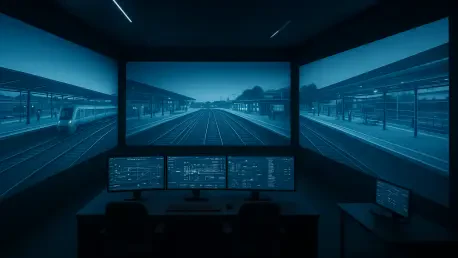
The cornerstone of the Immerse space is a 270-degree video projection system that moves beyond the limitations of traditional training manuals by creating a truly multi-sensory environment. Trainees are no longer confined to reading about operational procedures; instead, they are physically enveloped in a digital reconstruction of a busy station concourse or a remote trackside location. The technology integrates high-definition visuals with directional audio and even olfactory stimuli to replicate the unique atmospheric conditions of the railway. By including specialized equipment such as industrial-strength fans to simulate wind and weather, the facility prepares employees for the physical stressors associated with outdoor platform work. This high-fidelity simulation ensures that staff are not surprised by the sensory overload of a peak-hour commute. This level of realism allows for a more profound connection between the training curriculum and the actual conditions encountered during daily service.
Expanding on the technological depth of the facility, the sensory integration is designed to heighten situational awareness across diverse operational roles. By synchronizing light, sound, and scent, instructors can recreate specific scenarios, such as the distinct metallic scent and sharp echoes of an underground station or the blinding glare of a sunset during a platform dispatch. These nuances are critical because they dictate how a professional perceives and reacts to potential hazards in the real world. The transition from passive observation to active engagement helps encode information more effectively in the human brain compared to standard lecture formats. Furthermore, the system’s ability to manipulate these environmental variables in real-time allows trainers to introduce sudden changes, such as a localized power failure or an unexpected weather event. This flexibility ensures that the workforce remains agile and capable of maintaining operational continuity regardless of the external conditions.
Building Psychological Safety and Technical Confidence
One of the most significant advantages of this facility is the creation of a controlled, fail-safe environment where staff can practice managing difficult scenarios without real-world consequences. Psychological safety is paramount in high-stakes industries like rail, where the fear of making a mistake can hinder decisive action during an actual emergency. At the Talent Academy, employees are encouraged to experiment with different responses to technical malfunctions or intense passenger surges. This repeated exposure allows individuals to build the necessary muscle memory and mental resilience to remain calm under pressure. By removing the immediate risk to passenger safety or service punctuality during the learning phase, the company fosters a culture of confidence and professional curiosity. Trainees can explore the limits of their decision-making processes, knowing that every error serves as a constructive data point rather than a costly failure that disrupts the wider transport network.
Building on this foundation of psychological safety, the facility facilitates immediate feedback loops from both expert instructors and peer groups. During a simulation, observers can monitor the trainee’s performance in real-time, identifying areas where communication might have faltered or where a safety protocol was not strictly followed. This collaborative approach to learning ensures that best practices are socialized across the entire workforce, rather than being siloed within individual experiences. The ability to pause a scenario and discuss alternative strategies provides a level of pedagogical depth that is simply impossible to achieve during live operational training on a functioning platform. As a result, when these professionals finally transition to the West Coast Main Line, they do so with a profound sense of preparedness. The training ensures that their responses are not just reactive but are informed by a comprehensive understanding of the operational landscape, leading to a safer environment.
Empathy-Driven Service and Accessibility Awareness
Beyond technical proficiency, the Immerse facility is uniquely equipped to enhance the quality of the passenger experience through empathy-driven simulation. One of the most impactful applications of this technology is its ability to shift perspectives, allowing staff to view the railway through the eyes of a customer with specific accessibility needs. For instance, the system can replicate how a child with autism might perceive the overwhelming noise and flashing lights of a crowded station concourse. By experiencing these sensory challenges firsthand in a simulated environment, staff members gain a deeper understanding of why certain behaviors or environmental factors might cause distress to vulnerable travelers. This perspective-taking is crucial for developing the soft skills required to provide high-quality, inclusive service. It transforms accessibility from a checklist of regulatory requirements into a genuine commitment to passenger comfort, ensuring that every interaction is handled with care.
The focus on accessibility extends to a variety of customer scenarios, including those involving elderly passengers or individuals with limited mobility. The simulation technology allows staff to practice navigating these complex interpersonal dynamics in a setting that replicates the pressure of a busy platform. By fostering this deep level of empathy, the company is equipping its team to provide more supportive service that anticipates the needs of a diverse passenger base. This proactive approach to customer care reduces the likelihood of misunderstandings and ensures that all travelers feel valued and safe. Moreover, the facility allows for the testing of new signage or information displays to see how they are perceived under different lighting conditions or crowd densities. This data-driven approach to empathy ensures that the service provided is not only friendly but also functionally effective for everyone, reinforcing the reputation of the rail network as an inclusive mode of transport.
Strategic Digital Integration and Regional Investment
The Immerse project serves as a key component of a broader digital transformation strategy that harmonizes various technological tools to improve workforce readiness. While individual skills such as train dispatch or maintenance are often addressed through Virtual Reality and Augmented Reality headsets, this new facility focuses on collective problem-solving. It provides a shared space where teams can work together to resolve complex operational challenges, making it a cornerstone for national training standards. By placing this advanced hub in Crewe, the operator has not only honored the town’s historic identity as a central rail hub but has also provided a significant boost to the local economy. This investment establishes Crewe as a center of excellence for rail technology, attracting talent and reinforcing the region’s importance within the national infrastructure. The facility acts as a laboratory where the future of rail operations is refined through constant experimentation and high-tech collaboration.
The development of the Immerse space successfully moved the rail industry toward a more integrated and technologically advanced training model. Stakeholders recognized the value of combining sensory realism with psychological safety, which directly led to a more confident and empathetic workforce. Moving forward, the industry should prioritize the expansion of these digital twin facilities to other regional hubs to standardize training quality across the entire network. Organizations found that the use of immersive technology reduced the risks associated with live rollouts of new protocols, proving that simulation is a cost-effective alternative to traditional trial-and-error methods. Future efforts must focus on updating these simulations to reflect real-time data from the rail network, ensuring that training scenarios remain relevant as technology evolves. By maintaining this commitment to innovation, the sector took a vital step toward ensuring long-term operational resilience and a superior passenger experience.