
The collaborative initiative between the university and Oceano Elementary demonstrates how community-focused engineering can directly improve the daily lives of local students. Imagine a classroom where a child with restricted mobility struggles to reach a standard desk, effectively sidelined from activities due to physical barriers. This was the specific challenge presented to mechanical engineering seniors at Cal Poly, who spent the current academic year designing custom assistive technologies. These students moved beyond classroom theory to engage in empathetic design, spending countless hours observing student-teacher interactions to identify specific ergonomic failures. By focusing on these granular details, the engineering teams developed solutions that are far more effective than generic, off-the-shelf medical equipment. This collaboration emphasizes the university’s commitment to providing students with practical, project-based learning that serves the greater good. The resulting adaptive devices empower young learners to participate fully.
Advancing Technical Design Through Classroom Observation
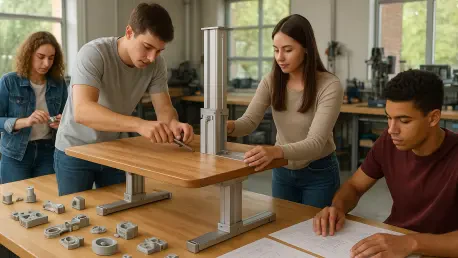
The technical development of these adaptive tools required the engineering teams to apply rigorous principles of biomechanics and materials science to meet the specialized needs of the students. Many children at Oceano Elementary required support structures for sitting or standing that were simply not available through commercial medical vendors. To solve this, the designers utilized 3D printing and precision metal fabrication to create height-adjustable standing frames and modular sensory tables. Each prototype was engineered to be both lightweight and durable, ensuring that teachers could easily reposition the equipment without compromising the safety of the students. Engineering teams conducted extensive structural testing to ensure that every hinge, lever, and support beam met professional safety standards. These efforts resulted in high-quality, professional-grade equipment that provided the school with tailored solutions at a significant cost reduction compared to traditional specialized vendors.
This design philosophy was anchored in a continuous feedback loop between the student engineers and the special education staff who interact with the equipment daily. Unlike many academic projects that culminate in a purely theoretical model, this initiative required a functional, iterative process where prototypes were tested in real-time by the intended users. Engineers observed how the children engaged with various adjustment mechanisms, identifying whether a specific dial was too small or if a support strap caused unwanted pressure. These observations led to critical pivots in the design, such as replacing complex electronic actuators with simpler manual systems that offered greater reliability and ease of use for the teaching staff. By prioritizing the user experience of both students and educators, the teams ensured that the final products were not merely technical achievements but essential tools for daily learning. This focus on practical utility over complexity defined the overall success of the project.
Redefining Accessibility: The Path Toward Inclusive Learning
The integration of these custom-designed tools had a transformative effect on the educational atmosphere at Oceano Elementary, creating a truly inclusive space for all learners. With furniture and assistive devices tailored to their specific physical requirements, students who previously dealt with chronic discomfort could finally focus their full attention on the curriculum. This physical empowerment allowed for greater social integration, as students with mobility aids could now participate in group activities at the same level as their peers. Teachers observed a noticeable improvement in student engagement and a reduction in the time spent on manual positioning tasks, which allowed them to focus more on instructional delivery. The success of this partnership demonstrates a clear model for how localized manufacturing and academic expertise can bypass the limitations of the global supply chain for medical equipment. It highlights a future where technology is designed with the user, rather than just for the user.
The project established a successful blueprint for how higher education institutions applied technical resources to solve pressing localized problems. Stakeholders recognized that the most effective way to address the shortage of adaptive equipment involved direct engagement with the end-users throughout the design lifecycle. Instead of relying on proprietary systems, the initiative promoted the use of open-source fabrication methods that allowed the school district to maintain and upgrade their own devices using accessible local tools. This approach successfully shifted the focus of adaptive technology toward a more personalized and community-driven methodology that prioritized the dignity and autonomy of every student. Educational leaders looked toward expanding these university-school pipelines to ensure that technical innovation continued to support the needs of special education. These specific strategies ensured that the lessons learned from the collaboration were translated into a lasting framework for community-focused engineering.