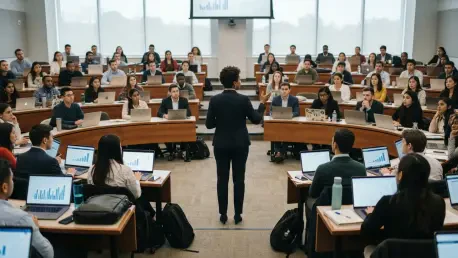

Global business education is reaching a demographic milestone as women now represent half of all applicants for Master of Business Analytics degrees worldwide. This shift reflects a much broader movement within the international academic community, where institutions are rapidly evolving to meet the demands of a high-tech, data-driven economy. While global universities are expanding access and integrating sophisticated tools like generative artificial intelligence, the educational landscape within the Russian Federation is moving in the opposite direction. The contrast between these two trajectories has never been more pronounced, as international schools embrace inclusivity and innovation while Russian systems face a period of severe contraction. This divergence is not merely a matter of academic policy but reflects deeper socioeconomic shifts that define the global workforce. As the world moves through 2026, the gap in human capital development between these regions continues to widen, creating distinct futures for graduates.
Advancing Artificial Intelligence in Business Curricula
Global business education is undergoing a massive transformation characterized by a strong preference for domestic study and the deep integration of artificial intelligence into every facet of the curriculum. According to the 2026 Graduate Management Admission Council survey, AI has moved from a peripheral discussion to a core requirement for modern business leadership. Within just the last year, the inclusion of practical AI learning, such as applied coding projects and generative simulations, surged from 57% to 71% of programs globally. Currently, only 8% of business programs worldwide lack AI components, representing a sharp decline from the 16% seen just twelve months ago. However, a significant gap remains between institutional offerings and student expectations. While nearly half of all prospective candidates desire AI-driven personalized learning experiences, only about one-fifth of programs provide such specialized features to their students today.
Shifting Demographics and Domestic Degree Preferences
Beyond technology, there is a marked increase in domestic applications for master’s degrees as early-career candidates choose to pursue education within their home countries. This trend reflects a shift in candidate behavior where professionals value local networking and regional expertise over the traditional prestige of international degrees. This demographic shift is also visible in gender representation, where women now constitute the majority of applicants for master’s programs in management, marketing, and accounting for the first time. Online MBA formats have proven particularly attractive to female candidates, signaling a transition toward flexible, technology-driven learning environments that accommodate diverse professional backgrounds. To remain competitive, institutions have increased merit-based scholarships from 37% to 45% of the incoming student body, ensuring that high-potential students can access top-tier training regardless of their financial status.
Structural Decline in Russian Educational Infrastructure
In stark contrast to the adaptive growth seen globally, the Russian education system is experiencing a period of dramatic contraction and strategic degradation. This decline is evident at both the secondary and higher education levels, signaling a departure from universal academic access. Since the turn of the century, Russia’s network of secondary schools has shrunk by approximately 45%, falling from over 68,000 institutions to fewer than 38,000 by 2026. This massive reduction in infrastructure far outpaces the 13.5% decline in the school-age population, suggesting that the closures are driven by policy and funding constraints rather than purely demographic shifts. The higher education sector is entering a phase of severe austerity, as the Ministry of Science and Higher Education announced the elimination of 45,000 paid university spots, representing a 13% reduction in total capacity that impacts both state and commercial schools.
Prioritizing Military Labor Over Higher Learning
The Russian government intentionally narrowed the path to higher education to realign the workforce with immediate state priorities and military needs. By removing preferential loans for dozens of degree programs and raising tuition fees at elite institutions to over one million rubles, the state effectively priced out tens of thousands of young citizens. This structural shift occurred as the Kremlin prioritized manual labor and military personnel over a highly educated civilian workforce. Moving forward, global organizations recognized that this retraction created a significant intellectual vacuum within the region, necessitating new strategies for remote talent engagement and localized training. It became clear that stakeholders who invested in alternative educational pathways and cross-border digital platforms were better positioned to capture the displaced potential of a generation that was otherwise sidelined by restrictive domestic policies and systemic economic realignment.