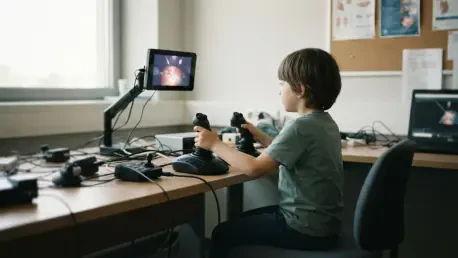

The significant financial and environmental costs of modern surgical training systems have prompted the development of the AdLap initiative to create sustainable and portable training alternatives. This project addresses a critical gap in medical education by moving away from the prohibitively expensive, proprietary systems that dominate high-income healthcare environments. By leveraging modular, reusable robotic hardware and virtual reality, the initiative demonstrates that high-fidelity surgical simulation does not require massive capital investment or stationary lab infrastructure. A recent study utilizing this technology explored how individuals with no medical background, specifically primary school children, interact with these complex systems. This research serves to map the evolution of bimanual coordination and technical aptitude during a period of intense neuroplasticity. By observing thirty-five participants across different age brackets, the researchers gained unique insights into the foundational mechanics of motor learning. These findings not only validate the sensitivity of the AdLap hardware but also provide a benchmark for how human motor control matures from early childhood into adolescence. The results highlight a future where surgical dexterity can be nurtured through accessible, environmentally friendly platforms that provide immediate feedback and quantifiable performance metrics for learners of all ages.
Understanding Neurodevelopment and Pediatric Learning
Children and adults process motor information through distinct biological pathways, primarily due to the ongoing maturation of the central nervous system. A key factor in this development is the myelination of corticospinal motor tracts, which increases the speed and efficiency of nerve signal transmission. During this malleable phase, children exhibit heightened neuroplasticity, which often allows them to adapt to new motor tasks more rapidly than adults. However, because their sensorimotor feedback loops and executive functions are not yet fully matured, their movements often lack the precision, economy of motion, and error-prevention strategies typical of adult operators. The researchers suggest that applying virtual simulation during these formative years provides a safe, quantifiable window into how technical aptitude emerges. It allows for the observation of foundational neuromuscular pathways as they are being established, offering insights into the specific developmental windows where targeted practice yields the most significant gains in movement efficiency and spatial awareness.
The study is grounded in the understanding that identifying these developmental stages is crucial for long-term skill acquisition. By quantifying how younger brains interpret virtual signals, the AdLap initiative can tailor training protocols to the specific needs of different age groups. While adults may rely more on established motor patterns, children provide a clean baseline for observing how the brain builds coordination from the ground up. This biological readiness is not just about the ability to move a joystick but involves complex cognitive processing that links visual input with physical execution. The ability of the simulator to track these minute changes in motor behavior highlights its potential as a diagnostic tool for assessing developmental milestones. Furthermore, understanding the nuances of pediatric learning helps in creating more intuitive interfaces that can be used globally, regardless of the user’s educational background. This approach ensures that the training systems developed today are built on a solid foundation of neurological and physiological data.
Technical Configuration: The AdLap System
The technical backbone of the research involves the Portable Laparoscopic Robotic Master, a console specifically engineered to mirror the operational kinematics of professional clinical platforms like the da Vinci system. This setup features two independent manipulators, each offering seven degrees of freedom, which culminates in a total of fourteen degrees of freedom for the entire assembly. These manipulators are responsible for translating the physical kinetic movements of the user’s hands into precise digital signals via a custom-designed input and output circuit board. This data is then rendered in real time within a virtual reality environment built using the Unity game engine, which allows for a high degree of visual and interactive fidelity. One of the most significant advantages of this hardware is its inherent portability and flexibility; the entire system can be mounted on standard tables of various heights to accommodate the diverse physical statures of growing children. This adaptability ensures that the participants can maintain an ergonomic posture while they engage with the simulator, whether they are seated or standing.
Beyond its mechanical capabilities, the AdLap system represents a significant shift toward sustainability in surgical engineering. The modular design allows for components to be easily replaced or upgraded without discarding the entire system, significantly reducing electronic waste. This design philosophy is particularly relevant for 2026, where environmental impact is a primary consideration in technological development. By using standard computing hardware and a custom-built interface, the developers have created a system that is far more affordable than traditional medical simulators. This cost-effectiveness makes it possible to deploy the training system in resource-limited environments, where the need for surgical skill development is often the greatest. The integration of high-precision manipulators with a flexible software environment means that the simulator can be repurposed for various surgical tasks, from basic suturing to complex bimanual manipulations. This versatility is essential for creating a global training standard that can adapt to the evolving needs of modern medicine.
Experimental Methodology: Participant Stratification
To ensure a rigorous evaluation of age-dependent skill acquisition, the researchers recruited thirty-five healthy school-aged participants. To eliminate confounding variables, any child with prior experience in virtual reality, robotic masters, or laparoscopic surgery was excluded, as were those with known motor impairments. The cohort was divided into three developmental tiers to allow for a cross-sectional analysis of performance. The first group consisted of eleven children in the lower primary bracket, aged four to six years. The second group included twelve children from the middle primary tier, aged seven to nine years. The final group comprised twelve participants from the upper primary level, aged ten to twelve years. This stratification allowed the research team to compare the technical proficiency and learning curves across different stages of childhood maturation. By starting with such a broad range of ages, the study could pinpoint exactly when certain coordination skills become dominant and how they improve with repeated exposure to the simulator.
The experimental protocol was designed to be both challenging and engaging for the young participants. Each session began with a standardized five-minute instructional period to familiarize the children with the hardware and the virtual environment. Following this, the participants performed a bimanual marble-sorting task that required high levels of concentration and hand-eye coordination. The task involved using the left hand to sort green marbles and the right hand to sort blue marbles into designated bowls within the VR simulation. To prevent the use of asymmetric compensatory strategies, such as relying solely on a dominant hand, the exercise required alternating between left and right hand movements for each marble. Each child completed three consecutive trials, with thirty-second rest intervals in between to mitigate physical fatigue. This structured approach ensured that the data collected reflected genuine skill acquisition rather than accidental success, providing a clear picture of how each age group navigated the complexities of the robotic task.
Quantitative Metrics: Assessing Performance
The researchers utilized the internal data collection capabilities of the AdLap system to measure performance across several critical dimensions. One of the primary metrics was task completion time, which provided a baseline for the overall efficiency of the user. However, speed was not the only indicator of success; the system also measured instrument path length, which tracks the cumulative distance traveled by the virtual tools. A shorter path length typically indicates greater movement economy and better spatial planning. Additionally, the study monitored spatial motion volume, which refers to the three-dimensional envelope of space occupied by the manipulators during the task. By assessing how much space a participant used to complete the exercise, researchers could determine whether the movements were controlled and refined or erratic and expansive. These quantitative indicators allowed for a deep dive into the kinematics of pediatric motor control that would be impossible to observe through manual timing alone.
Another vital set of metrics focused on accuracy and spatial awareness, specifically through the tracking of collision frequency. The system recorded every instance of unintended contact between the virtual tools, the hands, or the task boundaries. Frequent collisions serve as a clear indicator of poor spatial depth perception or a lack of fine motor control. The simulator also tracked successful task elements and the frequency with which a participant needed to reset a botched attempt. By analyzing these errors alongside the completion time and path length, the researchers could build a comprehensive profile of each child’s technical aptitude. The immediate feedback provided by the virtual environment was essential here, as it allowed participants to see and feel the results of their mistakes in real time. This data-driven approach not only validated the performance of the hardware but also provided a wealth of information regarding the specific developmental hurdles faced by younger learners when operating complex robotic interfaces.
Cross-Cohort Findings: Age and Proficiency
The analysis of the cross-sectional data revealed a significant correlation between age and technical proficiency in the robotic simulation. The most striking divergence was observed in the task completion times, where the oldest group performed more than twice as fast as the youngest participants. Specifically, the lower primary group required an average of 201 seconds to sort the marbles, while the upper primary group finished the task in approximately 97 seconds. This gap illustrates that as children mature, their ability to process visual information and translate it into fluid motor action becomes vastly more efficient. Furthermore, the older children demonstrated a much higher degree of spatial containment. Their instrument path lengths and motion volumes were significantly lower than those of the younger cohorts, suggesting that they had a better grasp of the kinematic requirements and the workspace boundaries. This refinement in movement is a hallmark of maturing sensorimotor feedback loops.
Collision data provided further evidence of the developmental challenges associated with fine motor coordination. The youngest participants recorded collision frequencies that were more than three times higher than those of the oldest group. Interestingly, collisions were particularly prevalent on the left side among the four-to-six-year-old bracket, indicating that bimanual coordination is still very much a work in progress at that stage of life. The younger children often struggled to manage the movements of their non-dominant hand while simultaneously focusing on the primary task. In contrast, the middle and upper primary groups showed a much more balanced control of both manipulators. This suggests that the biological maturation of the nervous system, combined with a better developed sense of spatial awareness, allows older children to execute complex bimanual tasks with a level of precision that is simply not possible for toddlers. These findings reinforce the idea that surgical training protocols must be tailored to the specific developmental capabilities of the trainee.
Learning Curves: The Critical Nexus
One of the most encouraging findings of the study was the rapid improvement shown by the two younger groups across just three trials. This trial-by-trial progress highlights the high level of neuroplasticity in primary school children, who can adapt to unfamiliar interfaces in a matter of minutes. The middle primary group, consisting of seven-to-nine-year-olds, showed the most robust improvement throughout the experiment. By the third trial, these participants achieved a 34 percent reduction in total path length and a 41 percent reduction in collision events. This dramatic shift indicates that this age range may represent a critical developmental nexus where children are mature enough to follow complex instructions yet plastic enough to adapt their motor strategies almost instantly. Their ability to integrate feedback from the virtual environment and correct their movements was markedly superior to that of the youngest group, making them ideal candidates for early skill-building exercises.
The lower primary group also demonstrated significant gains, particularly in terms of motion volume and task completion time. Even within fifteen minutes of exposure to the AdLap console, these very young children began to adjust their strategies to better navigate the virtual space. This proves that even the youngest school-aged children are capable of engaging with and learning from sophisticated surgical simulations. However, their progress was more gradual compared to the middle group, reflecting the ongoing biological maturation of their motor tracts. In contrast, the upper primary group performed at a high level starting from the very first trial. They hit what researchers called a performance ceiling effect, where the task was not challenging enough to allow for further significant improvement. This baseline stability suggests that by age ten, the fundamental coordination required for such tasks is already well-established, allowing these children to focus on more complex aspects of the simulation if they were provided.
Future Implications: Sustainable Surgical Training
The AdLap study provided compelling evidence that the foundations for complex technical skills can be observed and nurtured during the early childhood years. By utilizing a portable and sustainable simulation platform, the researchers demonstrated that children as young as four could successfully navigate complex bimanual tasks. The findings suggested that the middle primary years are a particularly fertile period for motor learning, characterized by high adaptability and a rapid integration of feedback. This success validated the potential for low-cost, modular robotic trainers to be used in wide-ranging educational contexts, moving beyond the traditional surgical theater. The project illustrated that high-tech medical training could be made accessible, environmentally friendly, and educationally effective across the developmental spectrum. By identifying these peak periods of learning, the study offered a roadmap for designing more effective training protocols that align with the natural maturation of the human nervous system.
Moving forward, the integration of these sustainable systems into mainstream medical and educational curricula could revolutionize how technical aptitude is identified and developed. Future research should prioritize long-term skill retention to determine if the rapid gains observed in these trials persist over weeks or months. Additionally, the inclusion of haptic feedback and more complex task variables will be necessary to challenge older learners and professional medical students. As the AdLap initiative continues to evolve, it will serve as a model for how technology can bridge the gap between high-cost medical education and global accessibility. The ultimate goal is to create a generation of professionals who are not only technically proficient but also accustomed to using sustainable and adaptable tools. By starting this process early, educators can foster a level of manual dexterity and spatial awareness that will benefit a wide variety of high-precision fields well into the future.