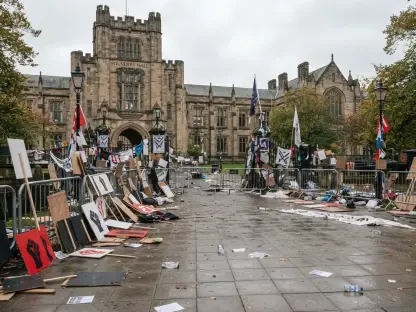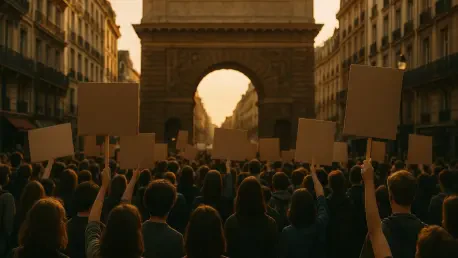

Educational inequality is at the forefront of the movement, with protesters highlighting the lack of air conditioning and furniture in poor districts. What began as a localized expression of frustration at a single high school in the Paris region in mid-September has rapidly transformed into a seismic wave of civil unrest that currently grips the entire nation. By Tuesday, the scale of the mobilization reached a critical peak, with official estimates from the Interior Ministry indicating that approximately 266,000 citizens participated in rallies across France. In Paris alone, over 56,000 demonstrators marched through the streets, while significant actions were reported in Marseille, Strasbourg, and Lille. This widespread defiance represents a direct and formidable challenge to the administration of President Emmanuel Macron, as the youth have moved beyond mere classroom boycotts to implement strategic blockades of roughly 891 schools. This disruption has forced the Education Ministry to suspend classes, signaling a profound rupture in the social contract between the state and the upcoming generation of leaders who feel their basic needs have been systematically ignored by the current political establishment in Paris.
The Root Causes of Academic Unrest
Infrastructure Failures: The Physical State of Schools
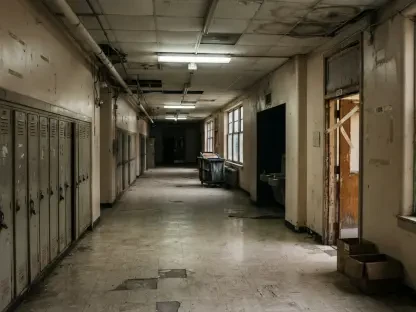
The movement draws its primary energy from the visibly deteriorating state of public education facilities, which many students argue have become entirely unfit for purpose in a modern European state. Within the most marginalized districts, reports have surfaced of classrooms that completely lack basic essential furniture, forcing students to share desks or even stand during lessons. These physical hardships are exacerbated by the increasingly frequent heatwaves that have plagued the region throughout the start of 2026, leaving schools without adequate air conditioning or even basic ventilation systems in a state of dangerous thermal instability. Protesters have documented even more alarming conditions, including persistent pest infestations and structural failures that pose immediate health risks to the student body. For those attending these institutions, the environment is no longer one of learning but one of survival, creating a visceral sense of abandonment by the central government which is tasked with maintaining public safety. This sense of neglect has catalyzed a unified demand for immediate capital investment to ensure that every student, regardless of their economic background, has access to a safe and functional learning environment that meets basic standards of human dignity.
Systemic Resource Deficits: Staffing and Academic Pressure
Beyond the crumbling walls of the institutions, a deeper systemic crisis involving human resources and curriculum demands has fueled the current wave of nationwide strikes. France currently maintains some of the highest compulsory classroom hours in Europe, yet the education system is struggling with a chronic shortage of qualified teaching and support staff to manage this extensive academic burden. This mismatch between administrative expectations and actual resource availability has resulted in an exhausting cycle for both students and educators, who find themselves navigating an overloaded schedule without necessary pedagogical support. The movement has effectively highlighted the growing hypocrisy found within the national motto of “Liberty, Equality, Fraternity,” pointing out that the state’s failure to provide adequate resources in poorer districts serves as a structural barrier to social mobility. Consequently, the students are demanding a comprehensive overhaul of funding priorities to ensure that educational success is not determined by geography. The calls for change are not merely about comfort but about the long-term viability of the French workforce, which protesters argue is being undermined by a system that prioritizes budgetary austerity over the intellectual and physical well-being of its youth population.
The State Response and Political Fallout
Security Tactics: The Growing Human Toll
As the protests have intensified, the government’s reliance on aggressive law enforcement tactics has become a central point of intense public debate and social friction. Law enforcement agencies have been deployed in significant numbers to clear school blockades and manage the vast crowds, leading to more than 6,500 arrests over the previous two weeks. A concerning majority of those detained are minors, a fact that has drawn sharp criticism from humanitarian organizations and legal experts alike. The frequent use of riot-control equipment, including tear gas canisters and rubber bullets, has turned urban centers into volatile zones of conflict. These security measures, while intended to restore order, have often had the opposite effect by galvanizing the student body and drawing in sympathetic adults who view the state’s response as disproportionately heavy-handed. This escalation has moved the conversation away from educational policy and toward a broader critique of the methods used by the French state to maintain domestic control. The human cost of these confrontations reached a tragic level, further polarizing public opinion regarding the legitimacy of the government’s security strategy and its ability to handle internal dissent through peaceful dialogue rather than physical force.
Political Polarization: Economic and Global Pressures
The timing of this nationwide upheaval is particularly sensitive as the country enters the early phases of a critical presidential election cycle. With President Macron unable to seek a third term, various political factions have seized upon the student movement to advance their own ideological agendas and critique the current leadership. The far-left France Unbowed party, represented by prominent lawmakers such as Aurélien Le Coq, has emerged as a vocal ally of the protesters, denouncing the use of riot-control weapons against teenagers as an unbearable violation of civil rights. In sharp contrast, Prime Minister Sébastien Lecornu has maintained a firm stance against the disruption, arguing that the educational system cannot be held hostage by what he describes as radicalized elements within the youth population. Compounding this tension is a broader economic landscape marked by rising poverty and soaring energy prices, exacerbated by regional conflicts throughout 2026. Furthermore, the unrest is no longer confined to France, as neighboring Belgium has recently experienced similar student-led demonstrations in cities like Liege. This international spillover suggests that the grievances being voiced in Paris are reflective of a much larger regional trend of youth dissatisfaction regarding their future economic prospects.
Strategic Pathways: Future Outlook for Reform
In the final analysis, the government recognized that maintaining the status quo was no longer a viable path forward for the stability of the republic. To address the immediate crisis, a multi-stage plan was developed that prioritized the urgent renovation of school infrastructure in the most severely affected districts. This initiative included the immediate allocation of emergency funds for the installation of climate control systems and the replacement of broken furniture to ensure that basic dignity was restored to the learning environment. Furthermore, the administration established a permanent independent oversight committee, which included student representatives, to monitor the distribution of educational resources and ensure that the “Equality” promised by the state became a measurable reality. These steps were seen as essential for de-escalating the immediate tension and preventing a total collapse of the academic year, though many activists maintained that these measures were only the beginning of a much longer process of structural social transformation. The consensus among policymakers was that the youth would no longer accept vague promises, necessitating a concrete and transparent timeline for the modernization of the entire national education system to prevent future cycles of mass civil disobedience.