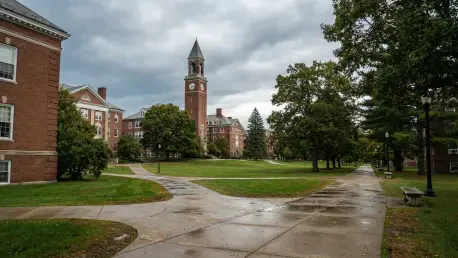

The familiar rhythmic creak of the swings on the Orono campus belies a silent fiscal storm gathering strength within the administrative offices of Maine’s flagship university. While students transition between lectures and research labs, the institution’s financial foundation is under immense pressure. A $19 million deficit is currently projected for fiscal 2028, but the more alarming figure is the $40 million shortfall expected by 2030 if radical changes are not implemented immediately.
University leadership is no longer merely adjusting spreadsheets; they are engaged in a high-stakes battle for the structural integrity of the campus. As administrators prepare for a multi-year period of aggressive intervention, the traditional model of public higher education in Maine faces an existential breaking point. The quiet atmosphere in Orono masks a fundamental shift in how the state’s primary land-grant institution must operate to remain viable.
Institutional Impact: Why the Flagship’s Fiscal Health Matters to Everyone
The instability currently observed at the University of Maine is not an isolated accounting error but a symptom of a demographic cliff threatening schools across the Northeast. With a projected 2% decline in enrollment by 2027, the pool of traditional high school graduates is shrinking faster than most institutions can adapt. This struggle reflects a broader crisis in rural public education, where the cost of maintenance often outpaces the arrival of new tuition dollars.
When a state’s primary research university faces a gap of this magnitude, the ripple effects extend far beyond the campus gates. Local economies that depend on student spending and workforce development initiatives that fuel Maine’s industries are directly at risk. Furthermore, the long-term prestige of a degree from the university depends on the institution’s ability to maintain high-level research facilities and competitive academic standards during this period of austerity.
Recovery Tactics: The Dual-Front Strategy for Financial Recovery
To bridge this massive fiscal gap, leadership has bifurcated the recovery plan into academic and non-academic sectors, each burdened with painful mandates. The non-academic goal is to slash a $9 million gap down to $3 million through $6 million in direct reductions. This involves unspecified layoffs, the elimination of dozens of vacant roles, and the implementation of shorter employee appointments in departments ranging from athletics and student life to the president’s office.
Beyond internal cuts, the university is moving toward a model of centralization and vendor reduction. UMaine aims to consolidate its various research centers and decrease its reliance on expensive external vendors, shifting toward a self-reliant operational framework. By bringing more services in-house and streamlining administrative oversight, the university hopes to create a more nimble organization that can survive the fluctuations of state funding.
The academic affairs unit is under even greater pressure, tasked with cutting $10 million from its base expenses. This plan includes a 20% reduction in vacant academic positions and the consolidation of course sections to maximize instructional efficiency. Long-term measures will likely include raising course seat limits and terminating programs that suffer from chronic under-enrollment, fundamentally changing the variety of degrees and niche specializations previously offered to students.
Leadership Perspectives: Hard Truths from University Leadership
The administration has remained remarkably transparent about the human cost of these maneuvers, moving past the euphemisms often found in corporate restructuring. President Joan Ferrini-Mundy and Provost Gabriel Paquette have publicly acknowledged that while they are pursuing options to limit job losses, staff and faculty layoffs are an unavoidable necessity to reach a balanced budget. This honesty serves as a sobering reminder that the university’s future is being built on significant personal sacrifice.
In addition to expense shaving, the university is looking outward to generate new revenue streams. By partnering with professional facilities management firms, UMaine hopes to transform its campus into a more profitable hub for conferences and external events. This strategy treats the campus as a year-round asset, ensuring that the infrastructure remains productive even when classes are not in session, thereby diversifying the university’s income beyond traditional tuition.
However, the ultimate wildcard in this financial gamble remains enrollment. Leadership emphasizes that while cutting costs is vital, the university’s survival hinges on its ability to attract and retain high-value students. There is a renewed focus on graduate students and those paying out-of-state tuition rates, as these demographics provide the higher margins necessary to offset the rising costs of research and campus operations.
Navigating the Path to a Sustainable Campus
The university established a framework that prioritized student retention over simple recruitment, acknowledging that keeping a student on campus was far more cost-effective than finding a new one. Support systems for first-year and graduate students were bolstered to stabilize tuition revenue and reduce the churn that often plagued the university during times of economic uncertainty. These initiatives sought to create a more resilient student body that felt invested in the institution’s long-term success.
Departments moved toward a model of instructional efficiency, favoring broader, high-capacity courses that minimized the cost-per-student. This shift meant that the era of niche, low-attendance seminars was largely replaced by a streamlined curriculum designed to move students toward graduation with fewer delays. Every vacancy across the campus was scrutinized under a necessity-only lens, preventing the budget from ballooning back to previous levels once the immediate crisis passed.
Finally, the university community embraced a business model where campus assets were utilized year-round. Officials identified strategic partnerships that allowed for the monetization of campus facilities during the summer and winter breaks, ensuring that the university’s massive physical footprint paid for itself. These actions provided a blueprint for other rural institutions facing similar demographic challenges, proving that a lean, disciplined approach was the only way to safeguard the future of public higher education in a changing world.