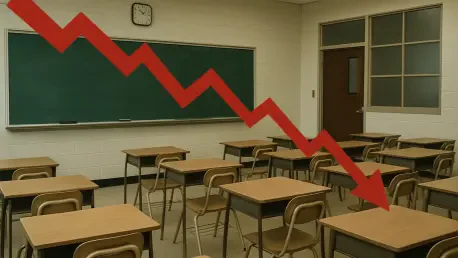

The sight of empty desks in Idaho classrooms has become a stark reality for administrators as public school enrollment figures continue to plummet for the fourth consecutive year. According to recent data released by the Idaho Department of Education, the state experienced a significant loss of 8,983 students this fall, marking a 2.9% decrease from the previous academic cycle. This contraction represents the most substantial enrollment decline observed in over a decade, leaving the total number of students at 304,871. While the state population continues to grow, the educational landscape is clearly shifting under the weight of changing family preferences and economic pressures. This trend suggests that the traditional model of public schooling is facing an unprecedented challenge in retaining its student base across diverse regions. Administrators are now forced to confront a reality where the rapid expansion of the general population does not automatically translate into filled elementary or secondary school classrooms.
Regional Growth Disparities and the Rise of Alternative Education
Analyzing the demographic data reveals a complex paradox where Idaho remains one of the fastest-growing states in the country, yet its school-aged population is not keeping pace with overall migration. Research indicates that only 8% of the new residents moving to the state consist of children who are eligible for enrollment in the public school system. This imbalance has created a situation where the general population boom fails to provide the necessary influx of young learners to sustain traditional district numbers. Furthermore, the decline appears most pronounced in elementary education, while middle and high school enrollment has remained relatively stable in comparison. This suggests that younger families may be choosing different educational paths or that the rising cost of living is deterring families with young children from moving into the region. Districts are struggling to project future needs as the connection between housing growth and school capacity continues to weaken significantly.
Traditional school districts have borne the brunt of the student exodus, with 102 out of 117 districts reporting a drop in their student counts this year. Major metropolitan areas have seen the most drastic reductions; for instance, the Boise School District lost over 1,000 students, while the West Ada School District saw a reduction of 745 learners. Conversely, charter schools have managed to buck this trend by achieving a net gain of approximately 515 students, a growth largely facilitated by the strategic opening of seven new charter institutions. This shift was accelerated by the Idaho Parental Choice Tax Credit, which offered up to $7,500 per student to cover non-public educational expenses. In its inaugural year, the program received over 12,500 applications, signaling a robust appetite for alternative education. As more households utilize these credits, the financial impact on traditional districts becomes more pronounced, leading to a cycle where reduced enrollment results in lower funding.
The state recently addressed these challenges by implementing more rigorous oversight of virtual learning environments and school funding allocations. Legislative leaders cut $3 million in funding for online education after reports surfaced regarding the potential misuse of funds in certain home learning academies. This scrutiny led to a 10% enrollment drop in programs like the Idaho Home Learning Academy, which previously attracted many remote students. To move forward, educational leaders prioritized the alignment of school capacity with community needs and developed flexible enrollment strategies. These steps ensured that public institutions remained competitive by emphasizing program quality and fiscal transparency rather than relying solely on geographic mandates. Stakeholders recognized that stabilizing the system required a focus on diverse learning models that reflected modern parental demands. By adapting to the reality of school choice, the state sought to ensure that taxpayer dollars effectively supported high-quality outcomes in every setting.