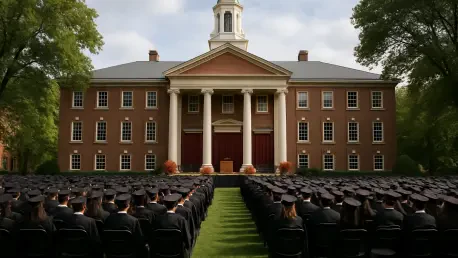

As thousands of prospective graduates across the Blue Ridge Mountains prepare to transition from years of academic rigor to their professional careers, higher education institutions throughout Western North Carolina have formalized their spring commencement strategies for the 2026 academic cycle. The orchestration of these ceremonies represents a monumental logistical undertaking designed to balance massive attendance with the need for intimate, departmental recognition. Large-scale public universities, including Appalachian State University and Western Carolina University, have implemented multi-day, tiered schedules to ensure every student is acknowledged without overwhelming local infrastructure. Appalachian State has opted to partition its graduation into seven distinct sessions over a three-day window, providing specialized focus for groups such as the Hayes School of Music and the Walker College of Business. This modular approach allowed families to navigate campus more easily while maintaining the dignity of the individual achievements being celebrated in a structured environment.
Peak Timing and Institutional Coordination
A notable trend emerging from the newly released data is the significant concentration of ceremonies during the second weekend of May, creating a synchronized wave of celebration across the region. Institutions such as UNC Asheville, Brevard College, Mars Hill University, Warren Wilson College, and Montreat College have all aligned their primary activities for Saturday, May 9. This coordination required extensive planning regarding regional traffic flow and hospitality capacity, as thousands of visitors descended upon the mountain counties simultaneously. Following this initial peak, the focus shifted toward the region’s community colleges, which typically serve a distinct demographic of adult learners and technical specialists. Haywood, Southwestern, and A-B Technical Community College scheduled their events for the middle of May, allowing the regional spotlight to transition from four-year liberal arts programs to specialized vocational training. South College stood out as a logistical outlier, scheduling its ceremony for late June to accommodate its specific academic calendar requirements.
Venue Logistics and Professional Transitions
The diversity of locations selected for these events highlighted the collaborative relationship between academic institutions and regional civic centers. While many schools utilized on-campus athletic fields and arenas to foster a sense of tradition, others moved ceremonies to prominent off-campus sites like Harrah’s Cherokee Center and the Wortham Center for Performing Arts. These professional venues provided the necessary audio-visual infrastructure and seating capacity to handle modern graduation demands. To prepare for future cycles, administrative teams established comprehensive digital archives and feedback loops to refine the guest experience and streamline the movement of graduates. The regional education departments moved to implement more robust shuttle services and pre-registration systems to mitigate congestion in downtown hubs. These efforts ensured that every academic discipline received dedicated recognition within a cohesive timeline. As the 2026 season concluded, stakeholders reviewed attendance metrics to better align venue capacities with projected enrollment growth through 2028.