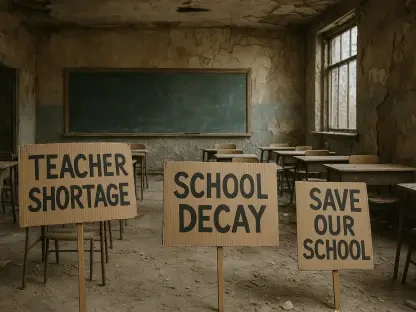

The New School is currently navigating a period of profound institutional turbulence, caught between its historic identity as a progressive intellectual sanctuary and the harsh fiscal realities of a post-pandemic world. With Camille Faivre, an expert in education management and e-learning implementation, we examine the fallout of a staggering $160 million structural deficit that has led to a controversial wave of layoffs and a total reimagining of the university’s organizational chart. This conversation explores the friction between faculty advocates and university leadership, the strategic consolidation of colleges, and the external economic pressures that are forcing even the most prestigious institutions to make painful, life-altering choices to ensure their long-term survival.
With a $160 million deficit and a 20% decline in student enrollment since its 2021 peak, how should a university prioritize its survival without destroying its academic core?
The financial gravity of a $160 million cumulative deficit is almost impossible to ignore, especially when you pair it with an enrollment drop that has seen the student body shrink to a projected 8,300 students. At a certain point, the math becomes a cold reality that forces leadership to look at “rebalancing” as a tool for survival, even if that word feels like a sanitized euphemism to those on the front lines. The primary goal for any institution in this position must be to stabilize the ship by fiscal 2028, but the cost of that stabilization often feels like a betrayal of the mission. When you look at the 19 faculty and 68 staff members recently let go, you aren’t just looking at payroll reductions; you’re looking at the removal of the very people who facilitate the learning experience. The administration is aiming for a 15% reduction in the fiscal 2027 budget, which is a massive undertaking that requires a delicate touch that many feel is currently missing in the process.
The administration is currently moving to consolidate four of its colleges into just two. What are the long-term risks of such a drastic restructuring of the academic landscape?
Merging units like the liberal arts and social research colleges is a classic management move intended to find efficiencies and reduce administrative overhead, but it often carries a heavy price in terms of intellectual identity. By condensing these structures, the university hopes to align its faculty and staff levels with the “needs of a new structure,” but this can lead to a homogenization of programs that were once distinct and vibrant. We are seeing a specific “firewall” being placed between course economics and performance reviews, which suggests that the survival of a department is now based purely on instructional need and available student numbers rather than academic merit. There is a palpable fear that by merging these four colleges into two, the university might lose the granular expertise and the unique “historic intellectual community” that national observers have warned is being actively dismantled. However, from a management perspective, if the performing arts and design colleges are the only areas showing potential growth, the institution feels it has no choice but to shift resources away from the liberal arts units that have seen significant declines.
There is a significant disparity between the 4.8% growth in administrative salaries and the 2.9% growth for faculty. How does this gap impact the trust required to navigate a fiscal crisis?
This is perhaps the most combustible element of the entire situation because it speaks to a fundamental misalignment of values during a period of shared sacrifice. When the economics department produces an analysis showing that administrative costs grew at nearly double the rate of faculty pay, it creates a narrative that the “gutting” of the academic staff is being used to subsidize a bloated central bureaucracy. Faculty members see a $30.2 million deficit from fiscal 2024 and argue that it could have been a $7 million surplus if administrative spending had simply kept pace with revenue growth. This creates a toxic atmosphere where the “shared governance” mentioned by the provost feels more like a one-way street where information is shared but decision-making authority remains tightly guarded. You cannot expect a faculty senate to buy into a “significantly different and exciting vision” for the future when they feel their financial contributions and years of service are being undervalued compared to those in management roles.
The layoffs have reportedly hit faculty of color and those in the humanities particularly hard. How do these targeted cuts reshape the university’s social and intellectual mission?
When you lose faculty members who have taught at an institution for decades, you lose the institutional memory and the mentorship networks that take generations to build. The fact that a significant number of those fired are people of color is particularly damaging for a university that prides itself on being a progressive leader in social research. The AAUP has been very vocal about this being a “major gutting” of the humanities and social sciences, which are the very fields that often define the moral and intellectual character of The New School. While the administration claims they have managed to place 30 full-time faculty members in other positions to limit the damage, the remaining 19 faculty layoffs still represent a loss of diverse perspectives that cannot be easily replaced by a leaner, consolidated structure. This isn’t just about losing names on a payroll; it’s about the erosion of a community that was built to challenge the status quo, now finding itself victim to the very market forces it often critiques.
University leaders have described the current economic climate as “extremely volatile” due to changes in federal loans and visa policies. To what extent are these external factors to blame versus internal management?
It is a perfect storm of internal vulnerability and external hostility, where the university is caught in a pincer movement between declining domestic enrollment and shifting federal policies. The legislative moves to phase out Grad PLUS loans and the tightening of visa programs for international students are existential threats to a New York City institution that relies heavily on a global student base. When the provost calls the idea of a potential surplus “completely ridiculous,” he is pointing to the “extraordinary” revenue hit that comes from having 20% fewer students alongside a massive spike in healthcare costs and other expenses. You can’t ignore the fact that the entire higher education sector is being placed into a volatile global economy where the old rules of growth no longer apply. While internal management decisions regarding salary growth are certainly part of the equation, the university is also fighting a defensive war against a policy environment that is becoming increasingly restrictive for international and graduate-level education.
What is your forecast for the future of private institutions like The New School that are facing these specific enrollment and deficit challenges?
I believe we are entering an era of “radical consolidation” where the traditional model of the multi-college university will be replaced by leaner, more specialized hubs that are hyper-responsive to market demand. For The New School, the path to balancing the budget by 2028 will likely involve even more integration of e-learning and open-learning programs to offset the loss of physical campus density and the high costs of NYC facilities. We will see a continued tension between the “fiduciary duties” of leaders like the president and the “intellectual duties” of the faculty, with the former almost always winning out in the short term to prevent total insolvency. The success of their “significantly different and exciting vision” for the liberal arts will be the ultimate litmus test; if they can’t turn the tide on enrollment through this restructuring, the 15% budget shrink we’re seeing now may only be the beginning of a much larger contraction. Institutions will have to prove their value proposition more aggressively than ever, moving away from broad academic offerings and toward specialized excellence that justifies the high cost of attendance in a world of shrinking federal support.