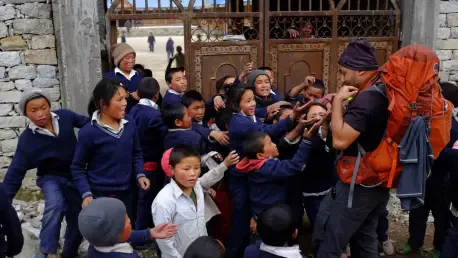

Economic opportunities abroad have disrupted the traditional family structures of rural Nepal, leading to a mass exodus of the very children these schools were meant to serve. This demographic shift has created a startling visual paradox across the hills of the Gorkha district and beyond, where the physical state of educational institutions has never been more sophisticated, yet the hallways have never been quieter. In a region where a sturdy roof and a paved playground were once the ultimate symbols of progress, the presence of modern desks and freshly painted classrooms now stands in stark contrast to the dwindling number of students. While the government and local stakeholders finally succeeded in delivering the “hardware” of education—concrete, bricks, and mortar—the “software” of the system, comprised of the students and the vibrant communal life they represent, is vanishing at an alarming rate. These institutions, built with the blood and sweat of previous generations, are increasingly resembling hollow shells or monuments to a bygone era of village vitality.
The crisis is not merely a matter of empty rooms; it represents a fundamental breakdown in the long-term sustainability of rural development. For decades, the primary goal of local leaders was to ensure that every child had a school within walking distance, a mission that required immense community mobilization and advocacy. Today, as that mission reaches its physical completion, the target population is moving elsewhere, drawn by the gravity of urban centers and the financial lure of international labor markets. This transition from a time of educational scarcity to an era of modern abandonment marks a critical turning point for the nation. It forces a difficult conversation about whether the current model of rural investment is meeting the actual needs of a population in flux or if the focus on infrastructure has inadvertently ignored the shifting social realities of the twenty-first century. As schools become more aesthetically pleasing and better equipped, the absence of the very people they were designed to empower creates a sense of tragic irony that defines the contemporary rural landscape.
The Historic Fight: Local Learning
During the early 1970s, obtaining a basic education in rural Nepal was an arduous journey characterized by physical hardship and systemic neglect. In areas like the Gorkha district, specifically around settlements such as Aampchaur and Kaule, the educational landscape was almost entirely barren, with only a handful of primary schools serving vast, rugged territories. For young children seeking a secondary education, the only option was to leave their families at a tender age and travel long distances to villages that hosted established institutions. This era was defined by a profound hunger for literacy and a collective understanding that education was the sole ladder for social and economic mobility. The primary barrier to progress was not a lack of interest or motivation, but a total absence of physical infrastructure and government support. The struggle for schooling was a grassroots endeavor, led by visionary community members who recognized that their children deserved a future that did not require permanent displacement just to learn the alphabet.
To bridge this immense gap, dedicated groups of villagers launched ambitious grassroots campaigns to establish local learning centers, such as the Dulav Secondary School. These projects were not the result of top-down government mandates or international grants; they were fueled by the collective willpower and meager savings of the villagers themselves. Organizers went door-to-door, collecting small donations and convincing skeptical parents that a local school was worth the investment of their limited time and resources. Men and women contributed physical labor, carrying stones and timber across difficult terrain to raise walls that would eventually house classrooms. At that time, the challenge was entirely centered on the tangible: securing enough building materials, recruiting qualified teachers from distant towns, and navigating the bureaucratic hurdles of the era. The success of these schools was measured by the sheer presence of a building and the enrollment of students who were eager to occupy any space available, even if it meant sitting on dirt floors in overcrowded rooms.
The Prophecy: Reality of Depopulation
During the height of the enthusiasm to build these institutions, a skeptical elder offered a haunting prediction that was largely ignored by the idealistic youth of the 1970s. He suggested that despite the hard work and dedication of the community, these schools would eventually become “nutmeg trees”—unproductive, stationary objects in a landscape that people had abandoned. While the activists of the time laughed off the comment as the cynicism of an older generation, the remark reflected a deep, intuitive understanding of social sustainability. The elder questioned who would attend these schools in fifty years, who would pay for their maintenance, and how the government would sustain them if the local population base shifted. This “dormant knowledge,” which seemed irrelevant during a period of high birth rates and limited mobility, has now become a central theme in the current educational discourse as the predicted circumstances have finally manifested in the form of mass rural depopulation.
The statistical reality of this decline is devastating for those who remember the schools’ peak years. In the mid-1990s, institutions like Dulav Secondary School were bustling hubs of activity, boasting nearly 1,200 students and acting as a central pillar for more than a dozen primary feeder schools. Today, that same institution struggles to maintain an enrollment of 250 students, a staggering drop that mirrors a nationwide trend in rural districts. Many of the smaller primary schools that were established with such immense difficulty have already been forced to close their doors or merge with other struggling institutions. These buildings, which now feature better furniture and more organized classrooms than they ever did during their golden age, stand as silent observers to a changing demographic. The laughter and chatter that once echoed through the halls have been replaced by a quiet stillness, leaving the few remaining students and teachers in a space that feels increasingly out of proportion to their actual needs.
Socioeconomic Drivers: The Rural Exodus
The primary engine behind the hollowing out of rural schools is a massive and sustained wave of internal migration and urbanization. Families are increasingly abandoning their ancestral lands in favor of district headquarters or major urban centers like Kathmandu and Pokhara. This movement is driven by a desire for better economic opportunities, access to modern healthcare, and the convenience of urban amenities that remain scarce in remote hilly regions. As households relocate, they take their children with them, leaving the local school systems with a rapidly shrinking pool of pupils. This shift has fundamentally altered the traditional community structure of the village, turning once-vibrant agricultural hubs into aging settlements where the youth population is conspicuously absent. The local schools, which were designed to serve a growing and stable population, now find themselves over-resourced in terms of buildings but critically under-resourced in terms of human capital.
Beyond the movement within the country, the allure of foreign employment has fundamentally reshaped the family unit and educational priorities in Nepal. A significant portion of the adult male population and an increasing number of women seek work in the Middle East, East Asia, or Europe to provide a better life for their families. The remittances they send home often facilitate the relocation of their spouses and children to urban centers where private schooling is more accessible. There is a growing perception that local government-funded schools are inferior to private or urban institutions, leading even those families who remain in rural areas to bypass the nearby school in favor of a “prestige” education elsewhere. This cultural shift toward private education, combined with the logistical reality of migration, has created a situation where the local rural school is often seen as a last resort rather than a community pride, further accelerating the enrollment crisis despite the high quality of the physical facilities.
Reimagining Development: Beyond Bricks and Mortar
The current state of rural education in Nepal presents a peculiar irony: the “hardware” is finally ready, but the “software” has gone missing. For years, development was defined by the number of bags of cement used and the number of desks delivered. This infrastructure-centric approach, while successful in creating physical assets, failed to account for the long-term viability of the communities it was meant to support. The focus remained on “building structures” rather than “building lives,” ignoring the socioeconomic factors that keep a family rooted in a location. As a result, the nation is left with a “buildings looking for students” scenario, where significant public and private investment sits underutilized. This mismatch highlights a systemic flaw in planning that prioritized quantitative growth over the qualitative and economic sustainability required to maintain a functioning social ecosystem in the mountains.
The conclusion of this educational crisis was met with a clear realization that the old model of expansion had reached its limit. Stakeholders identified that to save the remaining rural institutions, the conversation had to move from the sheer number of classrooms to the qualitative excellence of the learning environment. It was determined that schools needed to offer more than just a roof and a chair; they had to become vibrant centers of innovation that could compete with urban alternatives. This involved the integration of modern laboratories, digital libraries, and a curriculum that was directly relevant to the evolving needs of the local economy. Educators and policymakers acknowledged that a school’s value was defined by the relevance of the knowledge shared within its walls rather than the size of its footprint. By shifting the focus toward teacher effectiveness and community engagement, local leaders sought to ensure that the remaining schools did not become historical footnotes, but rather meaningful anchors for the next generation of rural residents.