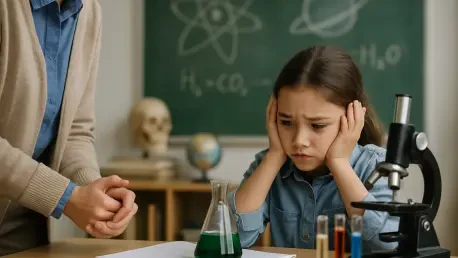

For many middle and high school students, the mere mention of a laboratory experiment or a complex chemical equation triggers an immediate sense of dread and intellectual paralysis. This psychological barrier, often characterized as science anxiety, frequently manifests when individuals internalize the belief that they are fundamentally not “science people.” Education experts observe that this phenomenon is not a lack of intelligence but rather a disconnect between the rigid structure of standardized assessments and the fluid reality of scientific discovery. While contemporary curricula often prioritize the identification of a single correct answer to ensure high scores on state-mandated exams, the actual practice of science is defined by trial, error, and the interpretation of ambiguous data sets. This discrepancy creates a cognitive dissonance that discourages students from taking risks or engaging in the exploratory thinking necessary for deep scientific literacy and long-term academic success in technical fields.
Integrating Practical Strategies: Redefining the Classroom Environment
To mitigate these anxieties, instructional leaders emphasize the necessity of normalizing what is termed “productive struggle” within the daily classroom routine. When educators shift the focus from getting the answer right on the first attempt to analyzing why a specific hypothesis failed, they effectively strip away the stigma of error. This pedagogical shift transforms the classroom into a low-stakes environment where mistakes are treated as data points rather than personal failures. Furthermore, linking abstract scientific principles to tangible real-world applications helps students ground their learning in familiar territory. By examining how biological concepts explain local ecological shifts or how physics governs the mechanics of their favorite sports, students begin to see science as a practical tool for navigating their own environments. This contextualization allows learners to leverage their existing common sense to make logical predictions, thereby reducing the intimidation factor.
Collaborative Discovery: Building Confidence Through Peer Engagement
Beyond individual instructional changes, the integration of collaborative learning models serves as a critical mechanism for dismantling the isolation that often accompanies science-related stress. By organizing students into small, goal-oriented peer groups, teachers facilitate a social environment where collective sense-making replaces individual competition. These interactions allow learners to voice their uncertainties and discover that their classmates often share the same points of confusion, which reinforces a sense of shared intellectual exploration. Looking forward, the emphasis shifts toward ensuring that every student recognizes scientific literacy as a fundamental life skill regardless of their eventual career choice. Educational systems prioritize the development of critical thinking and data analysis over rote memorization of obscure terminology. These strategies collectively empower students to approach scientific challenges with curiosity, establishing a foundation for lifelong learning.