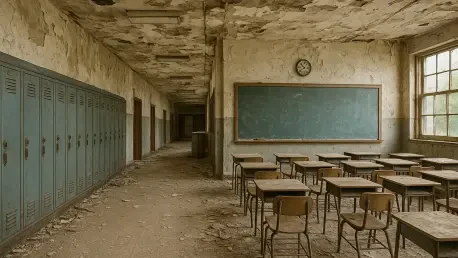

An exhaustive internal assessment has revealed that the average age of a building within the Lawrence school district is now just over forty years old. This demographic reality of the district’s physical plant serves as the primary driver for a staggering $73.9 million backlog in deferred maintenance and infrastructure needs that administrators must now confront. The figure, which emerged from a comprehensive study of twenty-three distinct facilities, underscores a widening chasm between annual budget allocations and the actual costs required to keep schools functional. These properties encompass a diverse array of environments, ranging from elementary classrooms to high school athletic centers and specialized performing arts spaces. As these structures age, the financial burden of simple upkeep grows exponentially, creating a compounding effect that threatens the long-term stability of the learning environment. Deputy Superintendent Larry Englebrick noted that the district is now operating at a level where only emergency repairs can be addressed.
Facility Requirements: A Detailed Financial Breakdown
The financial requirements are distributed across several high-priority categories, with athletic facilities representing the largest portion of the backlog at approximately $25.8 million. Modernizing climate control systems is another urgent necessity, as HVAC infrastructure needs an investment of $12.5 million to ensure proper air quality and temperature regulation for students. Furthermore, the district has identified a $10.4 million requirement for classroom furniture, which is essential for creating contemporary learning environments that support collaborative instruction. Other significant costs include $6.5 million for visual and performing arts spaces, alongside $6.2 million dedicated to hardscape maintenance, such as asphalt and concrete repairs for parking lots. Even essential protective elements like roofing and playground safety require a combined $3.9 million. These figures illustrate the breadth of the challenge, as every facet of the school environment demands significant capital to maintain even basic standards.
Board members have voiced concerns regarding the shift toward a strictly reactive maintenance model, which often results in higher costs when systems eventually fail. Board President Bob Byers compared the situation to a homeowner who is unable to keep up with essential repairs, noting that such a delay ultimately leads to a decrease in the overall value and utility of the property. This cycle of waiting for equipment to break before intervening is viewed as a fiscally inefficient strategy, yet the current budgetary framework leaves little room for proactive measures. The consensus among district leadership is that while the $73.9 million figure is daunting, it must remain a central priority to prevent further deterioration of the student experience. Addressing these needs in a meaningful way would likely require the identification of alternative funding sources, as the existing capital outlay is already stretched to its absolute limit to cover the district’s basic operational needs.
Strategic Milestones: Progress Through Recent Capital Projects
Despite the overwhelming nature of the total backlog, the district managed to complete roughly $8.5 million in capital projects during the most recent summer period. A primary focus of this investment was the $3.4 million renovation of the Centennial Building, which has been transformed into a flexible and nontraditional high school program facility. This project represents a shift toward modernizing existing spaces to better serve diverse student needs without the cost of entirely new construction. Additionally, significant funds were allocated to athletic upgrades, including $1.7 million for track renovations at Lawrence and Free State High Schools, as well as $590,000 for stadium lighting and over $460,000 for press box improvements. These targeted expenditures address visible needs within the district while also tackling critical behind-the-scenes issues like HVAC replacements and roofing repairs that cost nearly $1.4 million combined to ensure structural integrity across campuses.
Sustainability remains a key component of the district’s long-term facility strategy, evidenced by the recent installation of a new solar energy system at Woodlawn Elementary. This project, which cost approximately $85,947, is capable of producing enough daily energy to power roughly one hundred homes and marks the third such installation in the district following successful rollouts at Prairie Park and Sunflower schools. By expanding solar capacity annually, the district aims to mitigate rising utility costs while reducing its overall carbon footprint, selecting future sites based on roof age and suitability for photovoltaic panels. These environmental initiatives provide a dual benefit of immediate operational savings and educational opportunities for students to learn about renewable energy technology. Moving forward, the district intends to integrate these green technologies into the broader maintenance schedule, ensuring that roof replacements work in tandem with energy upgrades to maximize value.
Operational Stability: Ensuring District Safety and Upkeep
Operational stability extends beyond physical buildings to include the safety and security of the student population, a priority recently reinforced by the school board. Members finalized a Memorandum of Understanding with the local police department to continue the School Resource Officer program at no cost to the district through May 2027. This long-standing partnership ensures that officers remain stationed at both high schools and middle schools to provide education, counseling, and law enforcement support. This collaboration allows the district to maintain a secure environment without redirecting funds from the already strained maintenance budget. In addition to security measures, the board approved several specific maintenance bids, including nearly $150,000 for asphalt and concrete work at Kennedy Early Childhood and Southwest Middle Schools. These administrative actions reflect a commitment to maintaining a standard of care for all facilities while navigating the complex logistical hurdles of management.
The school board concluded its recent assessment by acknowledging that the current infrastructure path required immediate and innovative solutions to avoid future crises. Administrators determined that the massive maintenance backlog could no longer be ignored if the district intended to provide a safe and competitive educational environment for the next generation. They suggested that future planning should involve a mixture of community engagement and fiscal reorganization to secure the necessary $73.9 million for long-term repairs. The board successfully identified several actionable steps, including the prioritization of energy-efficient systems and the continued pursuit of public-private partnerships to offset security costs. By focusing on high-impact renovations like the Centennial Building, leadership demonstrated a viable path toward facility modernization despite severe budget constraints. Ultimately, the session established that preserving the district’s twenty-three facilities was a non-negotiable requirement.