
Camille Faivre stands at the forefront of education management, particularly in the complex landscape of post-pandemic institutional development. As an expert who specializes in navigating the intersections of policy, e-learning, and international recruitment, she has spent years helping universities adapt to shifting regulatory environments. Her insights are particularly vital now, as the legal battle over visa fees threatens to redefine how American higher education engages with global talent. By examining the recent judicial overturning of unprecedented financial barriers for high-skilled workers, we can better understand the precarious balance between national policy and the intellectual vitality of our campuses.
The federal court recently shifted the legal interpretation of these visa surcharges, categorizing them as unauthorized taxes rather than regulatory payments. How does this distinction change the way institutions must approach their international recruitment strategies moving forward?
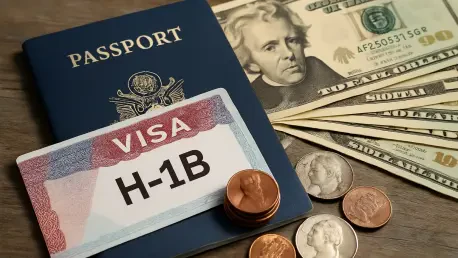
The court’s decision to label the $100,000 fee as an unlawful tax rather than a standard regulatory payment provides a significant sigh of relief for higher education administrators who have been holding their breath. When the fee for a new H-1B petition was suddenly hiked from the traditional range of $2,000 to $5,000 up to a staggering six figures, it fundamentally broke the recruitment model for many departments. By ruling that only Congress holds the power to levy such taxes, Judge Leo Sorokin has restored a sense of constitutional order that allows provosts to plan their faculty searches with actual budget numbers rather than fear-based hypotheticals. This legal clarity is essential because it prevents the executive branch from unilaterally using financial barriers as a tool to bypass the legislative intent of the Immigration and Nationality Act.
High-profile institutions like Stanford, the University of Michigan, and the University of Florida are major players in the H-1B program, each seeing over 100 approvals in fiscal 2026. In what ways would a fee of this magnitude have reshaped the landscape of research and teaching at these elite schools?
The impact on these powerhouse institutions would have been nothing short of transformative—and not in a positive way. If you consider that Stanford or Michigan might bring in over 100 specialized scholars annually, a $100,000 fee per petition would translate to an unbudgeted $10 million annual drain on resources that should be going toward laboratories, student support, and groundbreaking research. These scholars aren’t just names on a payroll; they are the people leading high-stakes engineering projects and teaching the next generation of American innovators in highly specialized fields. The emotional and intellectual toll of losing such talent because of a “tax” disguised as a fee would have caused a ripple effect, leading to stalled research projects and a decline in the competitive edge that these universities provide to the American economy.
Beyond the larger universities, many smaller colleges faced a complete shutdown of their international hiring because of these costs. What does the low number of actual payments—only 85 nationwide—tell us about the practical reality for the broader education sector?
The fact that U.S. Citizenship and Immigration Services received only 85 payments of the $100,000 fee through mid-February is a glaring indicator of how out of touch the policy was with the financial reality of the education sector. For smaller institutions that operate on razor-thin margins, the jump from $2,000 to $100,000 wasn’t just a hurdle; it was a brick wall that effectively ended their ability to participate in the global talent market. Even larger schools with deep pockets expressed a profound reluctance to pay, viewing the cost as an extortionate demand rather than a legitimate administrative necessity. This data proves that the policy functioned as a de facto ban on the H-1B program, successfully discouraging all but the most desperate or well-funded entities from seeking the specialized expertise they need.
We are seeing some states take even more restrictive stances, with Florida and Texas pausing H-1B hiring at public colleges well into 2027. How do these localized mandates complicate the mission of public universities striving for global academic excellence?
The decisions by Governor Greg Abbott in Texas and the public university system in Florida to pause H-1B hiring through May and January 2027, respectively, create a fragmented and deeply confusing landscape for academics. For a researcher sitting in a lab in Europe or Asia, these dates represent a closed door to some of the most prestigious public systems in the United States, potentially for the next several years. This localized approach undermines the “brand” of American higher education, making it appear volatile and unwelcoming to the very people we claim to want for our specialized job sectors. When a state pauses hiring for years at a time, it doesn’t just stop a single hire; it disrupts the continuity of research teams and signals to the global community that these institutions are subject to political winds that may blow against scientific and academic interests.
What is your forecast for the H-1B visa program in the higher education sector over the next few years?
I anticipate a period of high-stakes legal and legislative recalibration as the administration pursues its appeal and other lawsuits from groups like the American Association of University Professors move through the courts. We are likely to see a renewed push for Congress to explicitly define the limits of visa fees to prevent future administrations from using the checkbook as a way to circumvent immigration law. Universities will likely become more politically active in this space, emphasizing that their ability to recruit the best minds is a matter of national security and economic survival. While the current ruling is a victory for institutional autonomy, the ongoing pauses in states like Texas and Florida suggest that the struggle to maintain an open, globalized academic environment will remain a central conflict in American education policy through at least 2027.