
Across packed urban classrooms and remote county schools alike, the daily rhythm of study has shifted as students don headsets, raise AR tablets, and step into composite XR environments where atoms collide, dynasties unfold, and surgical procedures play out with millimeter precision before a single scalpel touches skin. What began as boutique demonstrations has matured into routine practice linking pedagogy, policy, and procurement at scale. The most visible change is not the hardware on carts but the classroom tenor: teachers guide inquiry, students test hypotheses, and assessments capture process as much as product. This transition has been systematized by a shared content backbone, standards for devices and training, and a long-range roadmap that anchors immersive learning to national goals. In the wider BRICS landscape, similar ambitions are rising, but China’s orchestration offers a reference model for moving past pilots toward durable impact.
From Pilots to System Integration
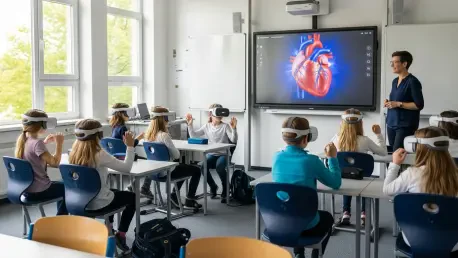
China’s classrooms increasingly treat VR and AR as dependable utilities rather than one-off experiences, pulling immersive modules into lessons that once relied on chalkboards and static slides. Middle schoolers rotate a 3D heart to study valve mechanics, chemistry students titrate volatile acids in a virtual fume hood, and literature classes traverse reconstructed corridors of the Mogao Caves to analyze iconography in situ. Safety and cost considerations make these simulations compelling, but the deeper value lies in how they externalize abstract concepts. A physics unit on electromagnetism becomes a manipulable field; a geography lesson on monsoons becomes a layered model of pressure gradients and terrain. These scenes happen during ordinary periods, not special events, normalizing XR as a daily tool.
A subtler transformation unfolds in how teachers plan and students respond. Lessons are built around heuristics—observe, explore, hypothesize, test—rather than a march of recitation and recall. Short, well-scaffolded experiences nudge learners to make predictions, compare outcomes, and articulate reasoning, with narration and prompts embedded inside the environment to sustain focus without breaking immersion. Cognitive load is managed by chunking tasks and providing just-in-time hints, ensuring challenge without overwhelm. In group sessions, defined roles—navigator, recorder, skeptic—structure collaboration, while teacher dashboards surface heat maps of attention and checkpoints tied to curricular standards. Over time, this choreography builds habits of inquiry that carry into non-immersive work, knitting XR into the fabric of classroom culture.
Policy, Infrastructure, and Content at Scale
The backbone of this system-wide shift has been policy alignment. Since 2018, the Ministry of Education has treated immersive tools as part of a broader digitization program rather than a discretionary add-on, sending a signal to K–12, vocational institutes, and universities that XR belongs in syllabi, labs, and studios. In 2022, the national smart education platform began aggregating standardized VR/AR lessons for core subjects, giving educators vetted modules that match grade-level outcomes and assessment rubrics. Five major domestic suppliers, working to shared specifications, ship headsets, AR tablets, software suites, and training packages that are interoperable across districts. This reduces the burden on individual schools to invent processes from scratch and curbs the risk of stranded investments.
Education Modernization 2035 tightened the frame by insisting on deep integration of information technologies into institutional planning, moving beyond “device drops” toward full smart campuses. In this architecture, XR sits alongside AI, IoT sensors, and analytics to create digital twins of facilities, laboratories, and even outdoor learning spaces. A university’s twin can run crowd-flow simulations for safety drills in the morning and host a multi-user molecular design lab in the afternoon, feeding usage data into dashboards that guide scheduling, maintenance, and pedagogy. Procurement now often packages hardware cycles with content updates and teacher professional development, smoothing refreshes and locking in service-level expectations. The result is predictable access, consistent interfaces, and a cadence for curriculum mapping that keeps immersive content current with standards.
Learning Gains and Classroom Practice
Field studies and institutional reviews point to a recurring pattern of benefits that map cleanly to instructional goals. Intrinsic motivation climbs when students feel agency; exploratory scenes invite curiosity without the fear of a single “wrong” path ending a lesson. Conceptual understanding improves as students move between representations—diagram, model, and simulation—linking symbols to phenomena. Retention gains track with active participation and narrative framing, where tasks unfold with clear stakes and feedback. Collaboration deepens when teams coordinate roles to complete time-bound missions, practice procedural checklists, or debate competing explanations of observed results. Importantly, these effects persist when devices are removed; post-immersion assignments show richer vocabulary and more precise argumentation.
China operationalizes these outcomes through attention to workflow. Teachers start from curriculum objectives, select or adapt XR modules from the national repository, and plug them into lesson arcs with prebriefs and debriefs to bridge virtual and real contexts. Adaptive settings allow pacing to flex for students who need more time at specific nodes, while accessibility modes offer subtitles, audio descriptions, or simplified visuals. In vocational colleges, welding simulators and engine teardown environments compress learning cycles and reduce consumables, letting students practice until competence without risk. In primary grades, short AR overlays atop print materials reinforce phonics or numeracy through immediate, tactile feedback. Across settings, formative checks—embedded quizzes, concept maps, reflective prompts—link experience to evidence, enabling teachers to act on data in the same period.
BRICS Comparisons, Risks, and Strategic Priorities
Across BRICS, immersive learning is converging on mainstream ambition, though starting points vary. India’s market momentum is notable: valued near US$4.84 billion in 2023, growth projections peg a roughly 38.3 percent compound rate from 2026 to 2032, fueled by medical simulation suites, engineering labs, and agricultural training that decouple practice from physical constraints. Brazil’s public-private partnerships bring VR into STEM classrooms and hospital residencies, with state education secretariats co-funding content localized to national standards. Russia pairs STEM-heavy modules with culture-rich reconstructions, blending engineering practice with archival explorations. In South Africa, more than 200 schools are outfitted through about 1.5 billion rand in public funding, with universities leveraging XR to extend access to rural cohorts through hybrid delivery.
Shared lessons cut across these tracks. Systemic enablement beats piecemeal pilots: when ministries set targets, fund training, and host repositories, usage stabilizes. Teacher capacity and content readiness matter as much as device counts; turnkey lessons with facilitator notes shrink prep time and reduce variance in quality. STEM often leads due to clear lab analogs and measurable competencies, but humanities and languages benefit from place-based storytelling, role-play, and social simulations that surface empathy and argumentation. Equity remains both rationale and risk. Rural bandwidth constraints, device scarcity, and maintenance gaps can widen divides unless addressed with targeted subsidies, offline-capable modules, and shared resource hubs. Program evaluation—tracking outcomes, costs, and dropout effects—grounds enthusiasm in evidence and sharpens next steps.
What Effective XR Requires Next
Action now depended on stitching pedagogy, access, and governance into a durable whole. Education agencies should align XR modules with explicit standards and workforce pathways, publishing competency maps so teachers see why each scene exists and how to grade it. Platform stewards ought to expand repositories with open or interoperable packages to avoid lock-in, while requiring vendors to provide exportable analytics aligned to privacy norms. Teacher capacity can advance through micro-credentialed pathways that bundle classroom management in mixed-reality settings, assessment strategies for process skills, and troubleshooting for common device failures. Equity will hinge on last-mile funding for bandwidth, battery replacements, and cleaning kits, plus offline caches for schools with intermittent connectivity. Finally, institutions should adopt review cadences—semester pilots, yearly audits, three-year refresh plans—to prune underperforming content and scale proven sequences, ensuring XR remained a means to better learning rather than an end in itself.