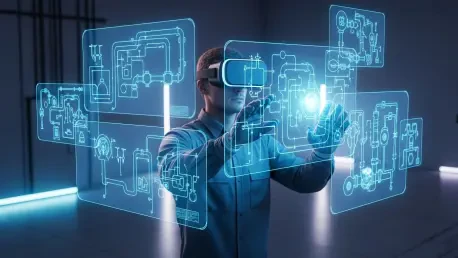

The critical shortage of skilled labor has reached a breaking point, leaving industries such as HVAC and plumbing with a deficit of over 110,000 workers as experienced technicians retire and younger generations overlook vocational career paths. This demographic shift has forced companies and educational institutions to reconsider traditional apprenticeship models in favor of digital innovation. Modern software platforms, including those developed by Interplay Learning, now offer immersive simulations that allow a trainee to stand in a virtual mechanical room, diagnostic tools in hand, without ever leaving a classroom. These environments utilize high-fidelity graphics and haptic feedback, such as a sharp vibration in a handheld controller to simulate an electric shock or the resistance of a stuck valve, creating a high-stakes psychological experience without the actual physical danger. By integrating these tools into the curriculum, educators hope to accelerate the learning curve and attract tech-savvy youth who might otherwise find manual labor unappealing. This digital shift is not merely about convenience; it is a strategic response to a logistical crisis where the demand for infrastructure repair far outpaces the current rate of human certification and training.
The Technological Gateway: Bridging the Experience Gap
The implementation of virtual reality in trade education serves as a sophisticated bridge for individuals who lack any prior exposure to mechanical systems or industrial environments. Many modern students have never held a pipe wrench or used a multimeter, making the initial entry into a physical workshop intimidating and potentially hazardous. Digital simulations provide a controlled space where a learner can fail repeatedly, blowing up a virtual circuit board or causing a simulated refrigerant leak, while receiving immediate pedagogical feedback. This iterative process builds muscle memory and cognitive familiarity with complex systems before the student ever touches expensive, live equipment. Furthermore, the scalability of virtual platforms allows a single instructor to oversee dozens of students simultaneously, each working on a unique troubleshooting scenario that would be impossible to replicate in a physical lab with limited floor space and machinery. These programs translate abstract concepts into visual, interactive experiences, ensuring that the fundamental logic of electrical paths and fluid dynamics is deeply understood through trial and error in a risk-free setting.
However, the efficacy of virtual training is often limited by the current boundaries of tactile technology and the inherent unpredictability of the physical world. While a haptic motor can mimic a basic vibration, it cannot yet replicate the subtle nuances of torque, the specific weight of a cast-iron pipe, or the varying resistance of a rusted fastener. Professionals like those at Southern Home Services have noted that while digital tools are excellent for teaching sequential logic and safety protocols, they cannot substitute for the gritty reality of the field. A technician in a virtual simulation does not have to deal with the oppressive heat of an attic, the cramped quarters of a crawlspace, or the greasy residue that makes tools slip in one’s hand. Consequently, many large-scale service providers treat digital simulation as a supplemental tool rather than a replacement. They continue to invest heavily in physical training labs because the final stage of mastery requires a technician to navigate the physical discomforts and sensory complexities that a headset simply cannot generate. The digital realm provides the blueprint, but the physical lab remains the site where true professional competence is forged.
Strategic Implementation: Career Exploration and Safety
Beyond technical proficiency, virtual reality has emerged as a powerful diagnostic tool for career counseling and early talent identification within school districts like Santa Rosa. By introducing fifth-grade students to virtual trade environments, educators can help children discover an aptitude for mechanics or identify personal phobias—such as a fear of heights or an aversion to blood—long before they enroll in specialized vocational programs. This early exposure functions as a low-cost filter, ensuring that those who eventually enter high-stakes trade schools are already comfortable with the basic parameters of the job. It democratizes access to specialized fields, allowing students from underfunded schools to experience the inside of a nuclear power plant or a high-rise construction site through a headset. This proactive approach reduces dropout rates in advanced technical colleges because the students have already vetted their interests in a digital sandbox. Instead of waiting until adulthood to discover a passion for carpentry or electrical engineering, students can cultivate a professional identity during their formative years through gamified learning modules.
The primary advantage of this digital immersion lies in its ability to standardize safety training across diverse geographical locations without the logistical nightmare of transporting heavy machinery. For companies managing dozens of regional branches, ensuring that every employee receives identical, high-quality safety instruction is a monumental task. Virtual reality solves this by providing a uniform curriculum where every trainee must successfully navigate the same hazardous scenarios to achieve certification. If a technician forgets to lock out a power source in the simulation, the system records the error and requires a remedial session, ensuring that life-saving habits are ingrained through repetition. This data-driven approach allows managers to track the progress of hundreds of employees in real-time, identifying specific areas where a workforce might be struggling with new regulations or updated equipment. By front-loading the most dangerous aspects of trade education into a virtual environment, organizations significantly reduce the frequency of on-the-job injuries and the associated insurance liabilities that often plague the construction and maintenance sectors.
Future Integration: Validating the Hybrid Educational Model
The successful evolution of trade training resided in a hybrid strategy that balanced the efficiency of digital simulations with the indispensable rigors of physical practice. Educational institutions moved toward a model where virtual reality served as the “Level 1” certification, clearing students for the lab only after they demonstrated cognitive mastery of the tools and safety procedures. This transition helped solve the problem of instructor shortages, as digital modules handled the repetitive introductory lessons, allowing human experts to focus their limited time on advanced, nuanced troubleshooting in the workshop. To further enhance this system, developers began integrating more sophisticated data analytics to compare the performance of VR-trained technicians against those trained through traditional methods. These studies provided the empirical evidence needed to refine curriculum design, ensuring that virtual modules targeted the specific skills that were most difficult to teach in a crowded classroom. By treating technology as a partner rather than a replacement, the industry created a more resilient and flexible pipeline for the next generation of essential workers.
As the industry moved forward, the focus shifted toward developing more localized and specialized virtual content that reflected the specific challenges of different regional infrastructures. This involved creating simulations for unique architectural styles, varying climate conditions, and specific brands of equipment that a technician was likely to encounter in their local market. The integration of augmented reality also played a crucial role, allowing technicians in the field to overlay digital schematics onto physical machines, blending the two worlds to provide real-time assistance during complex repairs. Organizations that embraced this multi-layered technological approach saw faster onboarding times and higher retention rates, as employees felt more confident and better supported in their roles. The path to solving the labor crisis was not found in a single software solution, but in a comprehensive rethinking of how human expertise and digital tools could coexist. Looking back, the adoption of virtual reality was the catalyst that modernized the trades, transforming a stagnant training model into a dynamic, tech-forward ecosystem that successfully met the demands of a modern economy.