
In rural and urban Head Start centers across Nebraska, children are now wearing purple cloth vests equipped with digital devices designed to quantify the quality of every verbal interaction with their teachers. This initiative, spearheaded by the Buffett Early Childhood Institute at the University of Nebraska, leverages the LENA “talk pedometer” to bridge the gap in early childhood literacy through data-driven insights. Rather than relying on simple observation, educators now use these compact recorders to capture the nuances of linguistic engagement in a busy classroom. The project is supported by a significant $1.3 million federal grant distributed over a five-year cycle, beginning in 2026, to provide a sustainable foundation for language development. This innovative approach reflects a broader shift in educational philosophy, moving away from just counting words heard to evaluating the quality of back-and-forth exchanges. By focusing on these interactive moments, the program aims to ensure that every toddler and preschooler receives the cognitive stimulation necessary for future reading proficiency and academic success.
Monitoring Interaction: The Role of Wearable Technology
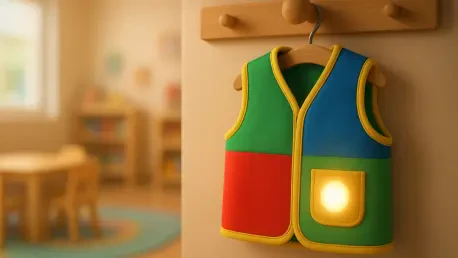
The talk pedometer itself is a marvel of specialized engineering, designed as a small, rectangular device that fits securely into the chest pocket of the child’s vest. In the Nebraska implementation, children wear these vests for one full day each week, allowing the device to capture a comprehensive sample of their vocal environment. The technology is sophisticated enough to differentiate between the speech of adults, the vocalizations of the child wearing the device, and general ambient noise. This precision is vital because it allows researchers to quantify genuine human connection rather than just background chatter. Furthermore, the device is language-agnostic, meaning it can accurately count conversational turns whether the child is speaking English, Spanish, or any other language. This inclusivity is particularly important in diverse Head Start settings where children come from varied linguistic backgrounds, ensuring that the data reflects the true interactive experience of every individual student without cultural or linguistic bias.
Once the recording period concludes, the data is uploaded to a secure cloud where the proprietary LENA software processes the audio into visual reports. These reports serve as a digital mirror for educators, showing them exactly when verbal engagement peaks and where it might be lacking throughout the school day. For instance, a teacher might discover that while interactive turns are high during story time, they drop significantly during transitions or meal times. This level of granular detail transforms anecdotal impressions into actionable evidence, allowing teachers to recognize patterns they might have otherwise missed. By identifying these specific windows of opportunity, the program empowers staff to make intentional adjustments to their daily routines. The objective nature of the data eliminates the guesswork often associated with assessing social interactions in a room filled with active toddlers. This systematic feedback loop ensures that the classroom environment remains a consistently rich linguistic space for every child.
Instruction and Coaching: Using Data for Professional Growth
The technology provides the foundation, but the true driver of improvement within the Nebraska initiative is the professional development framework. Local coaches, who are often experienced staff members trained in the LENA Grow model, meet with teachers weekly to review the generated data and discuss practical classroom strategies. These sessions are designed to be collaborative rather than evaluative, focusing on evidence-based techniques that increase the frequency of high-quality interactions. One such strategy is “parallel talk,” where an educator narrates a child’s actions in real-time, providing a constant stream of descriptive language that connects words to physical movements. Another critical technique is “labeling interests,” where the teacher identifies and names objects that have captured a child’s attention. By centering the conversation around what the child is already curious about, educators can create more meaningful “serve and return” exchanges that are essential for cognitive development and social-emotional growth.
A primary focus of this coaching is the identification and mitigation of “language isolation,” a term used to describe children who receive fewer than five conversational turns per hour. In a bustling classroom, it is often the most vocal or outgoing children who receive the majority of a teacher’s attention, while quieter or nonverbal students may inadvertently fade into the background. The talk pedometer data highlights these discrepancies, allowing coaches and teachers to set specific, measurable goals for high-need students. This intentionality ensures that even nonverbal children, who may not yet be using complex sentences, are still engaged in the back-and-forth rhythm of communication. For example, a teacher might consciously increase their “wait time” after speaking to a less verbal child, providing the necessary space for the student to process information and attempt a response. This targeted intervention is designed to ensure that no child remains linguistically isolated, thereby leveling the playing field for all students within the Head Start environment.
Statistical Impact: Evaluating Language Development Outcomes
Early findings from the pilot programs in Nebraska have demonstrated a clear and measurable impact on the classroom environment. In a recent five-week evaluation of 51 participating children, the data showed that average conversational turns increased by 21%, rising from 33.5 to over 40 turns per hour. This threshold of 40 turns per hour is considered by early childhood experts to be the “optimal” level for fostering robust linguistic and cognitive growth. In contrast, many traditional childcare settings often record as few as 15 turns per hour, leaving a significant gap in developmental potential. The success of the Nebraska initiative suggests that when teachers are equipped with objective data, they are capable of rapidly increasing the interactive quality of their classrooms. This shift is not merely about more words being spoken, but about creating a more dynamic and responsive environment where the child is an active participant in the communication process. These initial gains provide a strong argument for the continued integration of wearable technology.
The impact of the LENA Grow program is even more pronounced when analyzing the progress of children who started with the lowest levels of engagement. Students who initially recorded fewer than 15 hourly conversational turns saw their interactions more than double over the course of the study, jumping from an average of 9.7 to 20.5 turns per hour. This 111% increase highlights the program’s unique ability to support the most vulnerable learners who might otherwise fall through the cracks of a standard educational model. By providing teachers with a clear indicator of which children need more attention, the technology acts as an early warning system for developmental delays. Educators have reported that seeing these numbers change over time provides a powerful sense of professional accomplishment and validation. Furthermore, the positive changes in child behavior and social confidence that accompany increased verbal interaction reinforce the value of the program for both staff and parents. These results confirm that data-driven coaching can effectively bridge the literacy gap during these critical formative years.
Future Perspectives: Scaling Success and Tracking Literacy
Nebraska’s strategic implementation of talk pedometers is part of a growing national movement to modernize early childhood education through technology. Several other states, including Florida and Tennessee, have already committed millions of dollars in grant funding to integrate the LENA Grow system into hundreds of their own preschool classrooms. In Nebraska, the goal is to expand the current pilot to include all 22 eligible Head Start centers by the end of the five-year grant period, which concludes in 2031. This expansion represents a significant commitment to closing the literacy gap across both rural and urban communities. By standardizing the use of data-driven feedback, the state aims to create a uniform level of high-quality instruction regardless of a school’s geographic location. This broader perspective ensures that the benefits of the technology are not limited to a few select locations but are instead made available to a wide demographic of low-income families. The scalability of the program provides a viable roadmap for other states looking to enhance their early literacy initiatives.
Ultimately, the success of the Nebraska initiative was measured by its ability to translate early linguistic gains into long-term academic achievement. Researchers established a framework to track these children through their elementary school years, specifically focusing on third-grade reading proficiency as a primary benchmark of success. By intervening during the vital developmental window of ages two and three, the program successfully laid the groundwork for future cognitive growth. The actionable next steps for the educational community involved integrating these data-driven methodologies into standard teacher training programs across all grade levels. This transition ensured that the insights gained from talk pedometers became a permanent part of the educational landscape rather than a temporary experiment. The project demonstrated that when technology was used to enhance rather than replace human interaction, the result was a more equitable and effective learning environment. This approach provided a clear path forward for policymakers seeking to address systemic literacy challenges through targeted, evidence-based intervention and support.