
The economic landscape for the modern generation is increasingly defined by a stark contrast between high entrepreneurial aspirations and a severe lack of foundational financial knowledge provided by traditional schooling systems across the globe. As young adults prepare to enter a volatile market, the need for practical skills in managing money and running businesses has never been more critical to achieving social mobility and personal stability. Current data suggests that while a majority of youth harbor dreams of independence and business ownership, the education system often leaves them ill-equipped to handle the complexities of tax management, cash flow, and marketing strategies. This disconnect has prompted a strategic partnership between global financial technology leaders and major athletic organizations to provide a bridge between classroom theory and real-world execution. By utilizing the cultural weight of professional soccer and the technical prowess of industry-leading software, this initiative seeks to empower millions of students to navigate their financial futures with confidence.
Practical Applications Through Industry-Leading Software
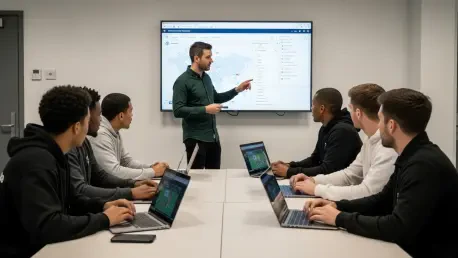
The integration of immersive technology into the learning environment has proven to be a game-changer for students who find traditional mathematical instruction dry or disconnected from reality. During recent forums, participants engaged in a simulation titled The Building Blocks of Business, which required them to utilize professional-grade accounting software to manage the finances of a hypothetical enterprise. By navigating the QuickBooks interface, students learned to track income, categorize expenses, and understand the impact of operational costs on overall profitability in real time. This hands-on approach demystifies the administrative side of entrepreneurship, turning abstract concepts like debt-to-equity ratios and net margins into tangible metrics that dictate success or failure. Such experiences ensure that the next generation of business owners understands that a great idea must be supported by sound fiscal management and data-driven decision-making.
Beyond the internal management of capital, the ability to reach and retain customers serves as the second pillar of financial sustainability in a digital-first economy. The Marketing Campaign Showdown utilized platforms like Mailchimp to teach secondary school students the intricacies of customer acquisition and brand loyalty. Participants designed social media strategies and email marketing campaigns, analyzing how targeted communication directly influences revenue generation and business growth. This exercise highlighted the intersection of creativity and commerce, showing that effective marketing is not merely about aesthetic appeal but about measurable engagement and conversion. By analyzing the results of their digital strategies, students gained a sophisticated understanding of how modern companies leverage data to optimize their reach. This technological immersion provides a scalable model for vocational training that bridges the gap between basic academic literacy and the specific skill sets demanded by the modern labor market.
Leveraging Cultural Influence for Economic Empowerment
The collaborative efforts of a professional sports organization like the West Ham United Foundation provide a unique cultural entry point that standard educational institutions often lack. Soccer serves as a universal language in the United Kingdom, and by situating financial literacy training within the context of a prestigious athletic club, the initiative captures the attention of youth who might otherwise be disengaged from financial discussions. This partnership leverages the emotional connection fans have with their team to foster an environment where learning feels like an extension of their community identity rather than a mandatory chore. The foundation’s involvement ensures that these educational resources reach underserved areas where financial exclusion is most prevalent, creating pathways for social mobility. By focusing on the East London community, the program addresses local economic disparities through the lens of a beloved institution, demonstrating how corporate social responsibility can be effectively localized for maximum social impact.
Insights from high-profile figures such as former professional athlete Anton Ferdinand and education ambassador Bobby Seagull have added a layer of personal relatability and professional credibility to the curriculum. Ferdinand shared his own experiences of signing a significant professional contract at the age of seventeen without having received any formal training on how to manage substantial wealth or plan for long-term financial security. His testimony serves as a cautionary tale for young people entering high-stakes careers, emphasizing that athletic talent must be paired with financial intelligence to ensure a stable life after professional competition ends. This perspective underscores that financial literacy is not just for aspiring corporate executives but is a vital survival skill for anyone entering the workforce, regardless of their path. These mentors help bridge the gap between technical software training and the psychological discipline required to make responsible financial choices under pressure, making the lessons resonate on a deeper level.
Strategic Directions for Long-Term Financial Stability
Statistical analysis regarding the current state of financial education in the United Kingdom reveals a troubling disparity between the desire for self-employment and the actual knowledge required to sustain a business. From 2026 to 2030, the global initiative aims to reach fifty million students, addressing the reality that only twenty-six percent of young adults currently receive any form of financial instruction during their formal schooling. This deficit is particularly concerning given that nearly fifty-eight percent of individuals aged eighteen to thirty-four express a strong interest in starting their own companies. Without intervention, these aspiring entrepreneurs face high risks of failure due to avoidable financial mismanagement and a lack of technical proficiency in business operations. By providing free, high-quality digital resources and mentorship, the program attempts to democratize access to economic opportunity. The focus remains on equipping students with the tools necessary to compete in a global economy that increasingly rewards those who can navigate digital financial ecosystems.
The strategic integration of soccer-based community engagement and financial technology provided a viable blueprint for addressing systemic educational gaps in youth financial literacy. Stakeholders recognized that future economic stability relied on moving beyond theoretical instruction toward practical, technology-driven applications that prepared students for the complexities of modern business. Educational institutions and local governments explored ways to incorporate these digital simulations into standard curricula to ensure that every student, regardless of their socioeconomic background, had access to essential financial tools. The program demonstrated that when private corporations collaborated with community organizations, they created scalable solutions that empowered the next generation of leaders to manage their personal and professional finances effectively. Moving forward, the focus shifted toward expanding these initiatives to reach even more diverse populations and adapting the technology to meet evolving market demands. This proactive approach turned financial literacy from a luxury into a fundamental right, fostering a more resilient and innovative global economy.