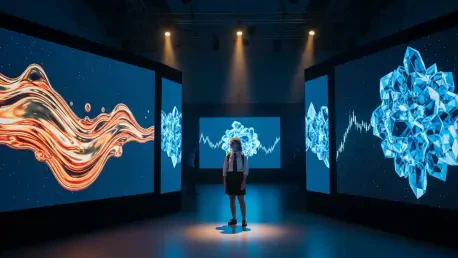

High school students are frequently inundated with dry mathematical formulas and abstract economic theories that often fail to resonate with the practical realities of managing a bank account or planning for a stable future. In an effort to bridge this gap, the 15th annual financial literacy art contest in Oakland County has transformed these complex subjects into a vibrant medium of self-expression. This year, the initiative saw a significant surge in engagement, attracting its second-highest participation rate since its inception, with 153 original entries submitted by students across 18 local high schools. These young artists were tasked with a formidable challenge: translating dense fiscal concepts like budgeting, long-term saving, and the intricacies of market investing into compelling visual narratives. By moving beyond the traditional textbook approach, the program forces participants to internalize economic logic through digital illustrations and mixed media, effectively turning a typically mundane subject into a creative exploration of personal independence.
Bridging the Gap: Creativity and Fiscal Competence
The underlying philosophy of this initiative suggests that the act of creating art requires a level of critical thinking that aligns perfectly with the cognitive demands of financial planning. When a student chooses to represent the concept of compounding interest or the weight of debt through a visual medium, they are not merely decorating a page but are instead distilling complex data into a relatable and understandable form. County Treasurer Robert Wittenberg and Superintendent Kenneth Gutman noted that the diversity of perspectives showcased in these submissions reveals how deeply the younger generation considers their financial trajectory. This educational trend emphasizes that technical skills are more effectively retained when they are tied to emotional and creative experiences. By encouraging students to visualize their future goals, the contest helps them build a psychological foundation for adulthood that is far more durable than one built solely on rote memorization or repetitive classroom lectures.
Successful implementation of such a program requires a robust infrastructure of community support that spans both the public and private sectors. The collaboration involves the Oakland County Treasurer’s Office, Oakland Schools, Flagstar Bank, and the Oakland Livingston Human Service Agency, creating a unified front dedicated to youth empowerment. This partnership reflects a broad community consensus that financial health is a collective responsibility rather than an individual burden. Each organization brings a unique set of resources to the table, from educational expertise to the actual capital needed to fund the competition. By pooling these diverse interests, the program ensures that students receive a multifaceted perspective on how money operates within the local economy. This collaborative spirit demonstrates to students that their community is actively invested in their long-term success. The synergy between these groups creates a sustainable model for other regions to follow, proving that shared resources can significantly amplify student learning.
Tangible Incentives: Rewards and Public Visibility
Beyond the abstract benefits of learning, the contest provides concrete financial rewards that serve as a practical lesson in the value of labor and talent. Supported by a $10,000 fund from Flagstar Bank, the competition offers substantial cash prizes that can be used by students to start their own savings or investment accounts. First-place winners in each grade level, including Olivia Beltran, Avery Feldman, Ava Wagner, and Rishika Pradhap, were awarded $1,000 each, while second and third-place finishers received $750 and $500, respectively. These rewards are not just symbolic gestures; they are significant sums for high school students that reinforce the link between hard work and financial gain. This direct experience with earning and managing prize money provides a real-world application of the very themes the students explored in their artwork. By providing these young individuals with a major paycheck, the program transforms the theoretical concept of wealth accumulation into a tangible reality.
The long-term impact of this initiative was solidified by the public display of the winning entries, which ensured that the educational message reached a much wider audience than the participants alone. By exhibiting the artwork within the county treasurer’s office and featuring it on the official government website for a full year, the program validated the creative contributions of these students while promoting general fiscal awareness. Moving forward, the success of this model suggested that educational institutions should seek to integrate multidisciplinary approaches more deeply into their core curricula. Practical next steps for school boards and local governments involved expanding these types of creative-technical partnerships to include subjects like computer science or environmental policy. These efforts established a precedent where technical literacy was no longer viewed as a separate silo from the humanities but as an interconnected part of a holistic education. Ultimately, the integration of artistic expression provided a blueprint for fostering a resilient citizenry.