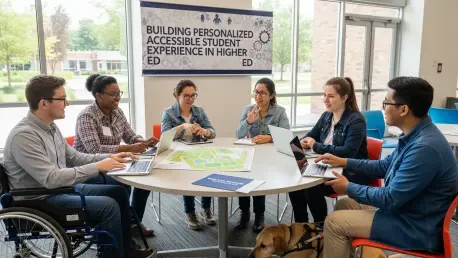

Personalized learning technology is reshaping how higher education supports individual students at scale. As needs diversify in line with academic readiness, digital access, and disabilities, institutions are looking to move beyond one-size-fits-all instruction toward models that adapt to learners.
This shift raises expectations for accessibility, responsible data use, and student support capacity, while raising valid questions about privacy and the role of human interaction in learning.
The article outlines key considerations for institutions seeking to connect these principles to practice and deliver personalized, accessible experiences in higher education.
Why Personalization Is Now a Strategic Priority
Personalized learning is an educational approach that incorporates adaptive tools, data analytics, and, most recently, AI to tailor the pacing, content, and guidance of the curriculum for each learner’s needs and goals.
For higher education, the traditional approach typically centered on uniform lectures, standard assessments, and limited feedback cycles. However, that model made it hard to address readiness gaps in large courses or to provide timely help at scale.
Accounting for learner variability is what helps improve knowledge retention and course progression, and that’s exactly what personalization offers. Since students arrive with different strengths and pacing needs, adaptive platforms and targeted instructions pave the way for actual learning, rather than passive LMS completion.
As AI and edtech evolve, personalized learning is projected to develop across several dimensions, including
- One-on-one AI tutoring
- Virtual and remote immersion
- Continuous, lifelong learning
- Adaptive ecosystems
- Collaborative personalization
- Equitable access
But even if you disregard these dimensions for the time being, the approach itself offers a pragmatic way to widen participation and improve outcomes in high-enrollment courses. Adaptive learning is particularly important for individuals who struggle with the material, but it is also highly relevant for students who are progressing quickly and need to be consistently challenged to meet the learning objectives.
Such targeted support requires access to data. Turning personalization from intention into practice is made possible by leveraging data analytics, which highlight friction points across a course and flag students who need assistance.
Signals such as time on task, accuracy patterns, and engagement trends guide instructors toward specific interventions, rather than more reporting. Formative assessment tools create faster feedback loops for students and clearer dashboards for faculty.
This data-centric approach helps faculties understand where their students are coming from and support them in reaching their full potential.
Ian Pickup, Pro Vice-Chancellor of Education and Experience and COO at the University of East London, explains it this way: “If we can [utilize] pre-entry data while also having an understanding of prior life experience, we can start to map, model, predict, and intervene before things go wrong for students. That is a huge advantage for all institutions to work towards.”
This mindset extends beyond courses. When privacy and consent are built in from the start, institutions can connect analytics to tutoring, advising, and disability services so students get the right support at the right time.
The Access Gap: From Accessibility to Digital Poverty
Personalization only works if every learner can fully participate in the learning process, and the initial credibility test typically concerns accessibility.
For starters, designing the learning process around the principles of Universal Design for Learning (UDL) turns accessibility into a shared standard. Since UDL encourages multiple means of representing, expressing, and engaging with knowledge, it reduces the need for retrofitting and supports consistency across departments.
Institutions that adopt assistive technologies such as screen readers, speech-to-text, text-to-speech, alternative input devices, and accurate captions also improve the student experience by removing specific disability barriers and supporting multimodal learning.
Still, access is also financial and infrastructural. Remote and hybrid course delivery, which gained traction during the COVID-19 pandemic, revealed persistent digital inequalities. One study of U.S. undergraduates found that experiencing connectivity issues or having limited access to functional devices significantly affected learning outcomes.
This is why institutions need to think beyond initial learning design and make device lending programs, connectivity support, and accessible materials an integral part of their personalization strategies.
Digital poverty is further exacerbated by the rapid adoption of genAI and its relevance to the learning process. The HEPI Student Generative AI Survey 2025 reveals strong growth in undergraduate use of generative AI for assessments, with common use cases such as explaining concepts and summarizing articles.
However, the spread of subscription-based AI tools and the associated costs of more advanced features deepen inequalities by restricting access for less privileged students. The Digital Poverty Alliance reports that students from higher socio-economic backgrounds are more likely to use advanced AI features, while disadvantaged students report limited or no use.
The same report reveals that only 36% of students feel adequately supported by their institutions in developing AI skills, with 18% noting that the lack of digital skills has negatively affected their academic experience.
These patterns point to a practical takeaway. If wealthier students can afford premium AI models while others cannot, the benefits of personalization and AI-enabled support will be distributed unevenly. Institutions need to counter this by setting access standards, providing institutionally licensed tools where appropriate, and building consistent digital literacy programs into curricula.
Responsible AI in Higher Ed: Points to Consider
Responsible AI is a governance question before it is a technology choice. The goal is to augment instruction and student services while keeping faculty and staff accountable for learning and well-being.
A consistent governance baseline turns defined principles into enforceable requirements during the initial procurement and internal builds.
Key standards include:
- Accessibility by design: Require UDL alignment and assistive technology compatibility across tools and content.
- Privacy and policy alignment: Define approved data types, storage boundaries, access controls, and consent expectations, aligned with institutional and national policy.
- Human-in-the-loop support: Route insights to tutoring, advising, disability services, and faculty workflows so students receive timely human help.
Careful adoption of these and other standards addresses a common critique that innovation agendas can mechanize teaching for less privileged students and normalize inequality. This way, your institution keeps human expertise at the center while ensuring personalization expands opportunities, not replaces quality instruction.
Moreover, getting governance right helps faculty and staff understand their roles in a human-in-the-loop model and connect crucial data insights to tutoring, advising, and teaching workflows. This, in turn, enables faster scaling further down the line.
How AI Supports Personalization: Case Study and an Implementation Roadmap
With many universities unable to provide the support that students juggling work, family, or travel need, many turn to generic AI tools, which are not course-aligned and can pose privacy and integrity risks.
Working with Amazon Web Services (AWS), Loyola Marymount University (LMU) developed a secure, course-specific tool called the AI Study Companion. The solution provides 24/7 help that reflects each professor’s voice, uses only approved materials, and protects student data and faculty IP. This has earned strong faculty approval while providing students with the support they need at substantial cost savings compared to commercial alternatives. The case study offers a helpful roadmap for institutions that want to unlock key personalization benefits.
Needs assessment and goals focus on understanding learner variability, accessibility gaps, and support bottlenecks in high-enrollment courses, then setting clear outcomes such as progression gains or faster feedback. LMU began by addressing a support capacity gap that traditional office hours and tutoring could not meet, especially for students balancing work or time zone constraints. The pilot reported strong internal acceptance and faculty satisfaction with integration, engagement, and comprehension, with formal research still in progress.
An accessibility and equity plan should embed UDL in course design and validate compatibility with assistive technologies. It must also address digital poverty through device lending, connectivity support, and offline-accessible materials so all students can reliably use tools. The LMU case does not detail UDL checks or device/connectivity programs, so institutions should plan these elements explicitly as part of any AI rollout.
Data design and privacy guardrails define what data is used, where it is stored, who can access it, and how consent is captured, aligned to policy. They also establish feedback loops that route insights to tutoring, advising, and faculty action. LMU treated security and data control as requirements, hosting on AWS to maintain institutional control, protect faculty IP, and align with FERPA considerations.
Tool selection and course alignment prioritize adaptive and differentiated capabilities that adjust pacing and practice without shifting learning outcomes. Course-specific assistants should limit the scope to approved materials and align access with the teaching schedule. LMU implemented a class-specific chat that received only the materials needed each week and reviewed transcripts for accuracy before upload, reducing confusion and misuse while preserving faculty voice.
Security, IP protection, and platform choices require institutional control of data and boundaries that safeguard classroom recordings and other sensitive content. LMU chose AWS to keep data under institutional control, protect faculty IP, and deliver around-the-clock, course-aligned help, showing how platform choices can accelerate adoption by addressing trust barriers early.
Faculty and staff enablement equips instructors and support teams to design UDL-aligned content, use formative assessment, interpret analytics, and follow clear playbooks for interventions. The LMU write-up highlights faculty satisfaction with the ease of integration, suggesting effective enablement, though specific training formats are not described. Institutions should budget time and support for consistent practice.
The pilot project centers on a limited cohort in high-impact courses, followed by measurement of engagement and learning outcomes. LMU launched in August 2025 with about 125 students and reported early acceptance, with formal research continuing. AWS also cites a market rate of $ 30 per student per month for enterprise AI licenses, framing LMU’s custom approach as cost-effective. Results vary, but governance and faculty alignment help institutions advance without outsourcing student data or course IP.
This staged path aligns innovation with governance and equity from the start and provides institutions with clear criteria for evaluating vendors and internal builds.
Conclusion: Scale What Works, Keep Access and Trust Central
Personalization delivers the most value when it complements instruction, includes every learner, and respects policy. Institutions that ground efforts in accessibility and equity, design clear data and privacy guardrails, and keep human support central are best positioned to unlock personalization at scale.
The LMU example shows that course-specific, always-available guidance can align with governance and security while improving access to help. Leaders who connect principles to practice set a durable model for scaling across departments and modalities, advancing student progress with tools that reflect institutional standards rather than just market trends.