
Traditional education systems frequently measure success by how quickly a child can replicate adult standards of literacy and numeracy, often overlooking the neurological necessity of emotional security as the primary catalyst for genuine cognitive development. Research into neuroplasticity indicates that a child’s brain is not simply a smaller version of an adult’s, but a highly sensitive organ that prioritizes survival and emotional safety above all else. When a young learner is forced into high-stakes academic environments before their neurological pathways are sufficiently developed, the resulting cortisol spikes can actually inhibit the formation of memory and the ability to process complex information. Yuliia Kaliuzhna, an expert with over twenty years of international experience, argues that this modern push toward early formalization often backfires, creating a generation of children who may perform well on tests but lack the underlying resilience and curiosity needed for long-term intellectual success. By centering the educational experience on the child’s emotional state, educators can unlock a natural state of flow where learning is not a chore but a byproduct of a safe environment. This shift requires a profound reassessment of how society views the earliest years of life.
Prioritizing Emotional Connection and Developmental Readiness
Shifting the Focus: From Achievement to Maturation
The concept of readiness is often misunderstood as a set of checkboxes involving the alphabet or counting to one hundred, yet true maturation is a biological process that cannot be rushed by curriculum alone. In the current landscape of 2026, where digital literacy and early competitive edge are prioritized, many families find themselves caught in a cycle of anxiety regarding their child’s relative progress compared to peers. However, pushing a child to sit at a desk before they have developed the necessary core strength and fine motor skills can lead to physical frustration and a lifelong aversion to academic settings. Kaliuzhna emphasizes that maturation involves the development of the whole child, including their ability to regulate emotions and interact socially with confidence. When these foundational layers are ignored in favor of rote memorization, the child’s internal motivation suffers, leading to a performance-based identity rather than a growth-oriented mindset that values discovery over correct answers.
Redefining the role of adults in this process is crucial for creating a supportive educational ecosystem that values the child’s unique developmental timeline. Instead of acting as rigid instructors who deliver content from a distance, parents and teachers should aim to be active participants in the child’s world of play and exploration. This involves mirroring the child’s interests, engaging in their imaginative scenarios, and providing a secure base from which the child can venture out into more complex cognitive tasks. By focusing on the quality of the connection rather than the quantity of information transferred, caregivers provide the emotional fuel necessary for the brain to take risks and experiment. Security in the primary relationship serves as a safety net that allows the child to fail and try again without the fear of judgment or loss of affection. This approach fosters a resilient internal architecture that eventually makes formal academic challenges appear manageable and exciting rather than overwhelming and threatening to the child’s self-worth.
Integrating Movement: The Path to Early Literacy
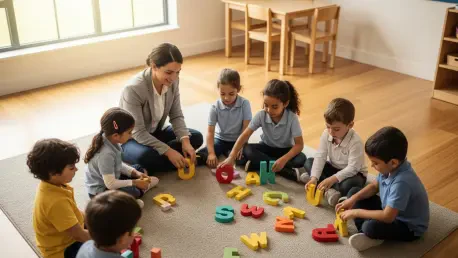
Bridging the gap between the physical nature of early childhood and the abstract requirements of literacy requires innovative methods like the “Finger ABC” system. This approach acknowledges that young children are primarily tactile and kinesthetic learners who understand the world through their bodies before they can grasp symbolic logic. By turning letters into physical shapes and movements, educators can engage the motor cortex alongside the visual and auditory centers of the brain. This multi-sensory integration ensures that the concept of a letter is not just a flat image on a page but a lived experience that involves touch, rhythm, and space. Kaliuzhna’s method leverages the child’s biological drive to move, transforming what could be a static and boring lesson into an active game that reinforces neurological connections. When a child “feels” a letter through their fingertips and larger body movements, the information is stored more deeply and retrieved more easily, bypassing the stress often associated with traditional handwriting drills.
The biological requirement for movement in early childhood is not a distraction from learning but is actually the primary mechanism through which the brain organizes information. When literacy programs ignore this need, they create a friction that manifests as behavioral issues or lack of focus, which are often mislabeled as learning disabilities. Integrating movement into literacy allows for a more inclusive environment where children of different temperaments and physical needs can excel at their own pace. This method also helps in developing the proprioceptive system, which is vital for concentration and the eventual mastery of fine motor tasks like writing with a pencil. By honoring the child’s need to touch and explore, educators create a bridge between the physical and the cognitive, ensuring that the transition to more advanced schooling is seamless. This holistic strategy moves away from the “desk-first” mentality and embraces a “body-first” philosophy that aligns with the natural stages of human development, making the journey toward reading and writing a joyful and intuitive progression.
Advancing Multilingualism and Professional Standards
Harnessing Implicit Memory: Natural Language Acquisition
Language acquisition in the early years differs fundamentally from adult learning because it relies on implicit memory, which absorbs patterns and sounds without conscious effort. Children possess a unique neurological window where they can pick up the melody, rhythm, and nuances of multiple languages simply by being immersed in a rich and supportive linguistic environment. Kaliuzhna advocates for utilizing this natural ability by focusing on the social and emotional context of language rather than formal grammar or vocabulary lists. When a second or third language is associated with positive interactions, songs, and shared activities with a trusted adult, it becomes part of the child’s identity rather than just another subject to study. This immersion method allows children to develop a native-like “ear” for the language, which is far more difficult to achieve later in life. By prioritizing recognition and auditory familiarity before the age of five, educators lay a robust foundation that supports high-level cognitive flexibility and cross-cultural communication skills in the long term.
The effectiveness of early multilingualism is directly tied to the emotional bond between the learner and the speaker, making the social atmosphere of the classroom or home the most important factor. In 2026, as global migration and digital connectivity continue to blend cultures, the ability to navigate different linguistic landscapes has become a vital survival skill. However, this acquisition must remain low-pressure and play-based to avoid the “language anxiety” that can shut down the brain’s learning centers. Meaningful interaction with caregivers who use language to express care, excitement, and shared discovery is what cements these linguistic patterns in the long-term memory. Children do not learn language from screens or repetitive drills; they learn it from people who matter to them in contexts that make sense to their daily lives. By maintaining this focus on joy and connection, educators ensure that the child remains curious about other cultures and languages, viewing them as bridges to people rather than obstacles to overcome. This approach prepares them to be empathetic and effective global citizens.
Professional Synergy: Research and Global Practice
The transition of educational expertise across international borders requires a commitment to both practical experience and the rigorous standards of modern professional bodies. Yuliia Kaliuzhna’s move from the pedagogical landscape of Ukraine to the regulatory environment of the United States highlights the importance of unifying diverse teaching philosophies under a single umbrella of evidence-based practice. By securing high-level certifications such as the California Site Supervisor Permit and engaging with the National Association for the Education of Young Children, experts can validate their clinical observations with contemporary scientific research. This synthesis of global perspectives allows for a more nuanced understanding of child development that transcends local cultural biases. It demonstrates that while teaching methods may vary, the fundamental biological and emotional needs of children remain universal. This professional journey serves as a blueprint for how educators can adapt their skills to meet high-level standards while continuing to advocate for a more compassionate approach.
Scientific inquiry into the psycholinguistic connection between emotion and learning provides the data necessary to convince policymakers and parents of the value of an emotion-first approach. Kaliuzhna’s published research explores how a child’s physical and emotional states are inextricably linked to their ability to process complex information and adapt to multicultural settings. This work suggests that a stable and happy environment is a physiological prerequisite for the executive functions of the brain to operate effectively. In 2026, as educational systems grapple with increasing diversity, this research offers a pathway to creating classrooms that are both inclusive and high-achieving. Future studies will likely focus on the specific hurdles children face when transitioning between different educational cultures and how to mitigate the stress of these shifts through targeted emotional support. By grounding practical classroom strategies in hard science, educators can move beyond anecdotal evidence and build a robust case for a global standard in early education that puts the child’s well-being at the center of the mission.
The findings from these educational advancements demonstrated that the integration of emotional safety and physical movement was the most effective way to foster long-term academic success. Stakeholders within the early childhood sector recognized that moving away from performance-based metrics allowed children to develop the foundational resilience needed for future challenges. To implement these insights, it became necessary for schools to redesign curricula to prioritize play-based sensory exploration and tactile literacy methods like the Finger ABC approach. Educators were encouraged to transition from being lecturers to being emotional anchors who facilitated natural curiosity rather than forced memorization. Furthermore, the emphasis on implicit language learning required a shift in how bilingual programs were structured, focusing on authentic social interaction rather than isolated instruction. By adopting these standards, the community ensured that the transition between different global educational systems remained smooth and supportive. These steps provided a concrete framework for nurturing well-rounded individuals who remained curious and capable.