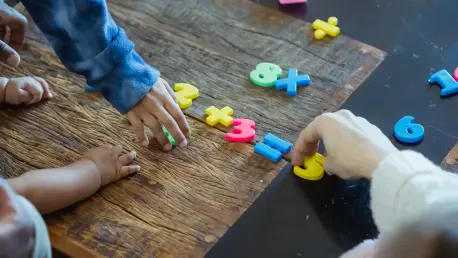

Workshops held in community spaces like libraries and parks are helping parents overcome the dread they feel when discussing math with their toddlers. This grassroots effort represents a significant pivot in Utah’s educational strategy, as the state seeks to address a widening gap in mathematical proficiency before children even set foot in a formal classroom. By launching the MILO & Friends program through the Utah STEM Action Center, officials are acknowledging a fundamental truth: a child’s educational trajectory is often determined long before kindergarten. The program shifts the focus away from traditional institutional instruction toward a decentralized model that empowers parents to serve as their children’s primary math educators. This approach is not merely about teaching numbers; it is about changing the cultural conversation surrounding science, technology, engineering, and mathematics (STEM) within the home. As national test scores continue to fluctuate, Utah is betting that the key to long-term academic success lies in the living room rather than the lecture hall. By providing families with the tools to engage in meaningful mathematical discourse, the state is working to ensure that every child, regardless of socioeconomic background, enters the school system with a robust cognitive foundation. This strategy recognizes that early exposure to mathematical concepts is just as critical as early literacy, yet it has historically received far less public attention and resources.
Bridging the Proficiency Gap: A Response to Declining Standards
The urgency driving these state-level interventions is underscored by a national landscape where mathematical achievement has seen a concerning downturn. Recent data from the National Assessment of Educational Progress illustrates a troubling trend where scores for elementary and middle school students have struggled to return to pre-pandemic levels. From 2026 to 2028, the gap between the highest and lowest-performing students is expected to become even more pronounced if current intervention strategies remain static. Research indicates that students who fall behind in math during their early years rarely catch up, creating a permanent achievement chasm that limits future career opportunities and economic mobility. This decline is particularly acute among children from historically underserved communities, where access to high-quality early childhood resources may be limited. Consequently, the push for early numeracy is viewed not just as an educational goal, but as a critical component of economic equity and workforce readiness. Experts argue that waiting until a child is five or six years old to begin formal math instruction is a missed opportunity, as the brain’s plasticity during the preschool years is uniquely suited for absorbing the foundational logic required for advanced reasoning.
In response to these findings, the Utah STEM Action Center has redefined its mission to include a heavy emphasis on parental engagement. This agency, which typically focuses on high school and collegiate STEM programs, recognized that the pipeline for future engineers and scientists begins with a toddler counting blocks or identifying shapes. The transition to a decentralized model of instruction involves moving resources out of state offices and into the hands of community liaisons who work directly with families in comfortable, familiar settings. This outreach strategy is designed to be inclusive, reaching out to families who may not have pursued supplemental tutoring or advanced educational programs on their own. By meeting parents where they are—at the local library, the neighborhood park, or the community center—the state is breaking down the physical and institutional barriers that often keep families from engaging with STEM topics. This proactive stance is part of a broader realization that schools cannot bear the sole responsibility for a child’s intellectual development. Instead, a collaborative ecosystem involving parents, community leaders, and state agencies is required to foster an environment where mathematical curiosity is nurtured from the earliest possible age, ensuring a more prepared and competitive student body for the years ahead.
Overcoming Psychological Barriers: Confronting Math Trauma
One of the primary obstacles to early numeracy is a psychological one, often referred to as “math trauma.” Many adults carry negative memories of their own experiences with mathematics, leading to a deep-seated belief that they are fundamentally incapable of understanding or teaching the subject. This mindset often results in a “deer-in-the-headlights” reaction when parents are asked to help their children with basic numerical concepts, causing them to subconsciously distance themselves from the topic. The Utah program addresses this head-on by acknowledging these anxieties and reframing math as a series of approachable, everyday interactions rather than a collection of intimidating formulas and equations. By normalizing the feeling of apprehension, instructors can help parents move past their internal barriers and begin to see themselves as capable mentors. This shift is vital because when parents exhibit anxiety toward math, that apprehension can be inadvertently passed down to the child, creating a generational cycle of avoidance. Breaking this cycle requires a concerted effort to build parental confidence, demonstrating that the mathematical engagement required for a preschooler does not involve calculus, but rather the simple identification of patterns, sizes, and quantities in the world around them.
The transformation of a parent from a reluctant observer into an active math advocate is the cornerstone of the MILO & Friends initiative. Through workshops that emphasize validation and support, parents are taught to integrate mathematical concepts into their existing domestic routines. This could be as simple as counting the number of steps to the front door, discussing the shapes of street signs during a walk, or comparing the weights of different fruits at the grocery store. When these activities become second nature, the home environment transforms into a constant source of informal learning that supplements what the child will eventually experience in a classroom. This consistent engagement builds cognitive flexibility and prepares the child to handle more abstract concepts later in life. Furthermore, as parents gain confidence in their ability to guide their children, they are more likely to seek out additional educational resources and advocate for high-quality instruction within the school system. The program successfully converts the domestic space into a laboratory for learning, where the pressure of standardized testing is replaced by the joy of discovery. This cultural shift within the household ensures that math is viewed as a natural and essential language, much like reading, which is integrated into the daily fabric of family life.
The Strategy of Play: Learning Through Cooperative Interaction
Central to Utah’s strategy is the use of play-based learning, specifically through the implementation of the “Happy Bunny” model. After researching hundreds of educational tools, the STEM Action Center selected cooperative board games as the primary vehicle for delivering mathematical content. Unlike competitive games that might discourage a struggling learner, cooperative games require players to work together toward a common goal, fostering a supportive atmosphere where mistakes are viewed as part of the process. In the “Happy Bunny” game, for example, children practice high-level cognitive functions such as abstraction by matching colors on a die to specific squares on a board. They also develop an understanding of sequencing and logical progression as they move their pieces along a path. These activities might look like simple play, but they are actually laying the groundwork for complex problem-solving and critical thinking. By focusing on the mechanics of the game, the program avoids the use of intimidating educational jargon, making the lessons accessible to families from all educational backgrounds. This approach mimics the successful model of early literacy, where reading together is seen as a bonding activity. The goal is to make “math talk” just as common and intuitive as a bedtime story, embedding numeracy into the child’s social development.
Beyond the immediate fun of the game, these play-based interactions target specific mathematical milestones that are predictive of future academic success. Children learn the concept of cardinality—the understanding that the last number counted represents the total quantity of a set—by harvesting items in the game. They also practice categorization and set differentiation, such as sorting items based on specific physical attributes. These foundational skills are the building blocks for more advanced topics like multiplication and division. By engaging with these concepts in a tactile and visual way, children develop a deep, intuitive grasp of how numbers relate to the physical world. This experiential learning is far more effective for young minds than rote memorization or abstract worksheets. Furthermore, the collaborative nature of the games encourages verbal communication, requiring children to explain their reasoning and listen to the logic of others. This develops not only their mathematical ability but also their social-emotional skills, which are equally important for success in a classroom setting. By the time these children reach kindergarten, they are not just familiar with numbers; they are comfortable with the logic of mathematics, allowing them to approach formal schooling with a sense of mastery and confidence rather than confusion or fear.
Analyzing the Socioeconomic Impact of Early Numeracy
The impact of these early interventions extends far beyond individual households, carrying significant socioeconomic implications for the state as a whole. Case studies from the Utah initiative show that children who engage in regular “math talk” at home often enter the first grade performing well ahead of their peers. For instance, some children have been observed mastering concepts like multiplication and division years before they are typically introduced in the standard curriculum. This “head start” creates a compound interest effect on their education; as they continue to excel, they are more likely to be placed in advanced tracks, enroll in college, and eventually secure high-paying careers in STEM fields. From an economic perspective, investing in early numeracy is one of the most cost-effective ways to ensure a skilled workforce and reduce the long-term costs of remedial education and social services. By closing the achievement gap early, the state is effectively leveling the playing field for children from low-income or minority backgrounds who might otherwise struggle to keep up. The data suggests that a child’s mathematical ability at age five is a stronger predictor of future earning potential than their reading ability, highlighting the critical importance of these early interactions. This makes the work of the STEM Action Center a vital component of the state’s broader economic development strategy.
While Utah’s MILO & Friends program is a distinct initiative, it is part of a growing national trend toward parent-focused math education. Similar programs, such as the PBS SoCal Family Math initiative, have demonstrated that these models can be successfully replicated across diverse demographic regions. Evaluations of these programs consistently show a marked increase in parental confidence and engagement, particularly among Spanish-speaking families and those with less formal education. This evidence reinforces the idea that the barriers to mathematical literacy are often more about access and confidence than innate ability. As the program in Utah continues to expand, it serves as a blueprint for other states looking to tackle the numeracy crisis. By prioritizing the parent-child relationship and utilizing community-based delivery systems, the initiative ensures that the most vulnerable populations are not left behind. The immediate shifts in home engagement patterns are promising indicators of the program’s long-term efficacy. As more families adopt these practices, the cultural expectation of what early childhood education looks like is beginning to shift. This movement toward a more inclusive and mathematically literate society is essential for the health of both the economy and the democratic process, as it equips the next generation with the critical thinking skills necessary to navigate an increasingly complex world.
Integrating Sustainable Solutions for Future Generations
To ensure the continued success of early math initiatives, policymakers prioritized the expansion of community-based workshops and the development of accessible, low-cost educational tools. The focus shifted toward creating a sustainable infrastructure that did not rely solely on one-off grants but instead became a core component of the state’s early childhood framework. Leaders recognized that maintaining parental momentum required ongoing support, leading to the establishment of digital platforms where families could share success stories and access new activities. This collaborative network helped to reinforce the “math talk” culture, preventing it from fading once the initial workshops concluded. Furthermore, the integration of these programs into existing social services, such as health clinics and food assistance centers, allowed the state to reach the families most in need of support. By embedding mathematical literacy into the broader social safety net, the initiative ensured that numeracy was treated as a fundamental right rather than a luxury for the privileged. This comprehensive approach provided a clear roadmap for other regions facing similar educational challenges, demonstrating that meaningful change was possible when parents were treated as essential partners in the learning process.
The long-term vision for this movement involved a fundamental reimagining of the transition between home and school. Educators and administrators worked together to align kindergarten curricula with the play-based foundations established by programs like MILO & Friends, creating a seamless experience for the child. This alignment reduced the “summer slide” and ensured that the cognitive gains made during the preschool years were preserved and built upon throughout the elementary grades. Additionally, the success of the parent-focused model prompted a broader discussion about the role of the community in STEM education, leading to increased partnerships with local businesses and libraries. These entities provided the resources and spaces necessary to keep mathematical exploration at the forefront of public consciousness. As the initiative matured, it became clear that the true measure of success was not just higher test scores, but the development of a generation that viewed problem-solving as a joyful and collaborative endeavor. The focus on the emotional and social aspects of learning proved to be a decisive factor in sustaining engagement over time. Ultimately, the commitment to empowering parents as first teachers created a resilient and adaptable educational ecosystem, preparing children to thrive in an ever-evolving global landscape.