
Michigan’s educational policy currently relies on a district-based model that assumes every resident has local access to a community college, which is factually incorrect. This structural oversight has gained significant attention as the Michigan Community College Guarantee enters its third full year of operation since its inception in 2024. While the program serves as a cornerstone for Governor Whitmer’s affordability initiative, its reliance on specific taxing districts creates a paradox for residents in the Upper Peninsula. These taxpayers fund a program they cannot use because their local “community college” is actually a four-year university that provides identical associate degree pathways. This geographical gap effectively punishes students for living in rural areas where the traditional community college model was never established. The exclusion of these regions highlights a fundamental flaw in how the state defines institutional eligibility, sparking a movement among university presidents to rectify this systemic inequality and provide equal access for all.
Bridging the Rural Educational Gap
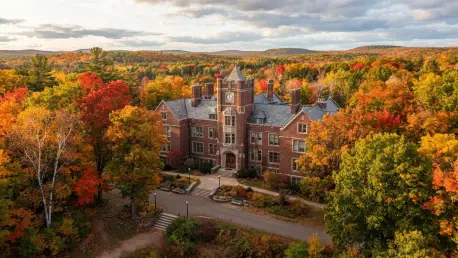
For over half a century, institutions such as Northern Michigan University, Ferris State University, and Michigan Technological University have operated as the primary providers of vocational and associate-level education in regions devoid of independent two-year colleges. These four-year universities function as de facto community colleges, offering critical certifications in fields ranging from nursing to industrial technology. Statistical data from the period between 2024 and 2026 indicates that roughly 5% of all associate degrees granted across the entire state—totaling more than 1,000 graduates—were issued by these four-year schools. At Northern Michigan University alone, 245 students earned associate degrees last year, yet none were eligible for the tuition-free benefits available to their peers in southern Michigan. This lack of institutional recognition creates a barrier for rural students who are seeking the exact same credentials but are forced to pay higher costs simply because their local provider carries a university designation.
The logistical realities of the Upper Peninsula further exacerbate this educational disparity through rigid “in-district” residency requirements. While a few community colleges like Bay College or Gogebic Community College exist, the vast distances between rural settlements make daily commuting impossible for many residents. Even when a student is willing to travel hours to reach a traditional two-year school, they often find themselves classified as “out-of-district” residents, which disqualifies them from receiving the full benefits of the state’s tuition guarantee. This creates a no-win scenario where rural learners must either relocate at an immense personal expense or remain in their home communities and pay full price at a nearby university. The current legislative framework fails to account for these travel and residency barriers, effectively trapping students in a cycle of high debt or limited educational attainment. The demand for reform focuses on recognizing that “community college services” should be defined by the degree offered, not the building in which it is earned.
Navigating the Fiscal Implications of Tuition Reform
Legislative resistance to expanding the tuition guarantee often centers on the complex fiscal differences between institutional billing structures. Unlike traditional community colleges, which maintain lower overhead and specialized tax support, Michigan’s four-year universities typically apply a uniform credit hour rate across all undergraduate levels. This means that a student pursuing a two-year associate degree at a university often pays the same per-credit price as a student in a bachelor’s program, which can be up to three times more expensive than the equivalent at a community college. Lawmakers have expressed valid concerns that extending the guarantee to these higher rates could potentially drain millions of dollars from the state budget. Balancing the noble goal of universal educational access with the cold reality of fiscal responsibility remains the central tension in the state capital. However, proponents of the expansion argue that the cost of inaction—leaving 5% of the state’s graduates behind—far outweighs the budgetary adjustments needed to fix the rural tuition gap.
The ongoing evaluation of Michigan’s educational policy revealed that the most viable solutions centered on legislative flexibility and institutional cooperation. Stakeholders determined that the path forward required a redefined understanding of how community college services were categorized and funded across the state. University leadership successfully advocated for a system where associate degree programs at four-year institutions could receive state funding capped at the average community college tuition rate. This strategic compromise ensured that the state budget remained protected while simultaneously expanding access to thousands of underserved residents in Marquette and Alger counties. The final synthesis of these proposals highlighted the necessity of a regionalized approach that acknowledged the specific needs of Northern Michigan. By addressing these fiscal and geographical hurdles, the state legislature finally resolved the disparities inherent in the original 2024 framework. This comprehensive reform ensured that a student’s zip code no longer dictated their ability to pursue a debt-free higher education.