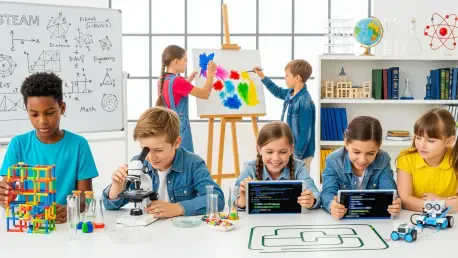

The Godfrey-Lee school district recently transformed the traditional educational landscape by launching an initiative that breaks down the historical barriers between disparate academic disciplines through an immersive community experience. This strategic move, centered on the “STEAM is LIT” event, successfully synthesized science, technology, engineering, art, math, and literacy into a single, cohesive platform for student growth. Rather than treating these subjects as isolated silos, the district introduced a framework where over 125 students and their families engaged in direct, experiential discovery. This approach was not merely an extracurricular supplement but a deliberate pedagogical shift aimed at fostering a culture of innovation and lifelong learning from early childhood through the high school level. By grounding complex concepts in tangible activities, the initiative provided a unique opportunity for participants to see the immediate relevance of their studies, ultimately bridging the gap between theoretical classroom instruction and the practical demands of the modern world.
Blending Scientific Inquiry with Artistic Creativity
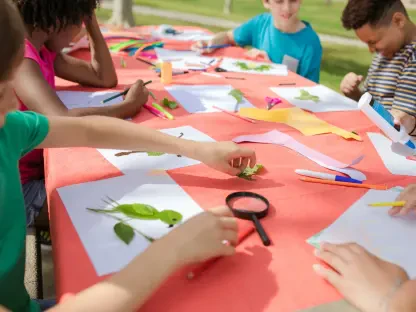
The integration of scientific principles with creative expression was best exemplified through the “fizzy art” experiments, where students explored the chemical properties of matter while producing unique visual designs. By utilizing common household materials such as vinegar, baking soda, and water, participants observed the vigorous reactions that occur when acidic and basic substances interact. This activity allowed young learners to assume the role of professional researchers, making predictions about how different mixtures would behave and documenting the physical changes occurring on their paper canvases. The art room at Lee Middle School became a laboratory of discovery, proving that the scientific method is not confined to textbooks but is an active process of questioning and observation. This hands-on method turned a standard chemistry lesson into a memorable aesthetic experience, ensuring that the fundamental concepts of reaction and states of matter were deeply internalized through the act of creative production.
This interdisciplinary approach highlights the fact that science and art are complementary ways of understanding the environment rather than conflicting ideologies. Art educators emphasized that the meticulous observation required for a successful painting is fundamentally similar to the precision needed for a controlled scientific experiment. When students used colorful chemical reactions to create art, they were practicing spatial awareness and color theory alongside their study of chemistry. This synthesis encouraged a more holistic mindset, where students learned to value the aesthetic qualities of science and the technical rigor of art. By removing the traditional boundaries between these fields, the school district fostered a versatile form of literacy that prepares students to think critically across multiple domains. Such experiences are essential for developing well-rounded individuals who can approach complex problems with both logical precision and creative flexibility, which are two of the most sought-after traits in the current professional landscape of the mid-2020s.
Building Engineering Grit and Critical Thinking
The engineering stations at the event provided a rigorous testing ground for student resilience and technical problem-solving through various high-stakes design challenges. One of the primary activities involved constructing a stable table using only a limited supply of printer paper and masking tape, a task that required an understanding of structural integrity and weight distribution. Students were forced to brainstorm and prototype their designs under specific constraints, discovering through trial and error that certain shapes, like cylinders or triangles, offered superior support for heavy books. This iterative process is the cornerstone of engineering, teaching participants that initial failure is not a setback but a necessary data point in the journey toward a functional solution. By navigating these technical obstacles in real-time, students built “durable skills” such as collaboration and persistence, which are often difficult to convey through standard lecture formats but are vital for future success.
Complementing these structural challenges, the straw rocket station introduced students to the principles of physics and aerodynamics in an accessible and engaging format. Participants crafted paper rockets and experimented with different launch angles and force levels to successfully propel their creations through a target hoop. This activity required a deep focus on precision and an understanding of how air pressure and gravity influence flight paths. Beyond the technical physics lessons, the exercise reinforced the importance of the engineering mindset—specifically the ability to analyze a system, identify points of failure, and refine the design for better performance. These activities were strategically designed to move beyond simple fun, aiming instead to instill a sense of agency in the students. As they refined their rockets and tables, they began to see themselves as capable inventors who could manipulate the physical world through logic and creativity, laying a solid foundation for more advanced technical studies.
Leveraging Technology and Strengthening Community Ties
The technology-focused components of the initiative allowed students to transition from passive consumers of digital content to active creators and troubleshooters of complex systems. In the robotics classroom, participants worked with motorized devices and 3D pens, gaining hands-on experience with the hardware and software that define modern industry. When robots failed to move as expected or 3D pens required adjustment, educators encouraged an inquiry-based approach, urging students to diagnose the mechanical or logical issues themselves. This method of teaching demystifies technology, showing students that robots are not magical objects but machines governed by specific rules that can be understood and mastered. By fostering this diagnostic mindset, the district is preparing its students for a future where technical literacy involves more than just operating a screen; it requires the ability to understand, maintain, and innovate within the digital and physical infrastructures that support global society.
The “STEAM is LIT” event also functioned as a powerful catalyst for community engagement, bringing families together to participate in the learning process as a unified group. This intergenerational collaboration was evident as parents worked alongside their children to solve engineering puzzles or explore literacy-based games like bingo, where participants could win books to bolster their home libraries. By involving the entire family, the district reinforced the idea that education is a collective journey rather than an individual task performed in isolation. This communal approach strengthens the bond between the school and the families it serves, creating a more robust support system for student achievement. Furthermore, by introducing these concepts in a high-engagement, low-stakes environment, the district aligned itself with broader career development models. This early exposure to various professional pathways ensures that students from all backgrounds have the confidence and the vision to pursue specialized fields in the years to come.
Effective Educational Integration
The Godfrey-Lee school district successfully demonstrated that a multi-disciplinary approach to education served as a vital tool for modern student development. By creating a space where science, art, and technology intersected with literacy, the event provided a practical roadmap for schools seeking to enhance student engagement through hands-on discovery. The initiative moved past the limitations of traditional rote memorization, instead prioritizing the development of critical thinking and collaborative skills that students applied in real-world scenarios. This model offered a clear path forward for educational leaders who aimed to bridge the gap between academic standards and the practical needs of the workforce. The project also proved that when families were invited to be active participants in the learning process, the impact of the curriculum extended far beyond the classroom walls, fostering a community-wide appreciation for the complexities of the modern technical world and the importance of ongoing inquiry.
Strategic next steps for the district involved the continued expansion of these programs to include more diverse career pathways and deeper industry partnerships. To build on this momentum, educators sought to integrate these hands-on challenges directly into the daily curriculum, ensuring that the principles of the engineering mindset and artistic observation remained central to the student experience throughout the academic year. The success of the gathering suggested that similar models could be scaled to reach even larger populations, providing a standardized yet flexible framework for experiential learning. By maintaining this focus on interdisciplinary rigor and community involvement, the district established a sustainable method for preparing the next generation of innovators. The overarching lesson was that the future of education thrived when students were given the freedom to experiment, fail, and succeed in an environment that celebrated curiosity as the primary engine of intellectual and personal growth.