
Camille Faivre has spent her career navigating the complex intersection of institutional management and financial sustainability in higher education. As a specialist in education management, she has become a vital voice for universities struggling to adapt their missions to a post-pandemic world defined by economic volatility. With the University of Nebraska System currently grappling with a staggering $36 million shortfall on top of previous austerity measures, Faivre’s expertise offers a window into the difficult decisions leaders must make when state funding fails to meet expectations. This conversation explores the ripple effects of multi-million dollar cuts, the erosion of faculty morale, and the high cost of operating in a perpetual state of financial uncertainty.
With a sudden $36 million funding reduction following an initial $8 million cut, how can the University of Nebraska System protect its academic mission while navigating such severe fiscal constraints?
It is an incredibly delicate balancing act because you are essentially trying to keep a ship on course while the engine is being dismantled for parts. To see Nebraska’s tax revenue fall $307 million short of projections for fiscal 2026 is a massive blow that forces immediate, often painful, defensive maneuvers. When you add the new $36 million reduction to the $8 million they already trimmed, you are moving past simple efficiency and into the territory of structural damage. Success in this environment requires the administration to be hyper-focused on the core mission of teaching and research, even as they comply with the governor’s strict mandates to freeze hiring and slash travel budgets. It feels like a race against time to find ways to sustain institutional quality before the cumulative weight of these cuts starts to permanently degrade the student experience.
The system’s president mentioned that an institution “cannot cut its way to extraordinary.” What are the long-term risks for a university trapped in a constant cycle of budget reductions without even a single year of stability?
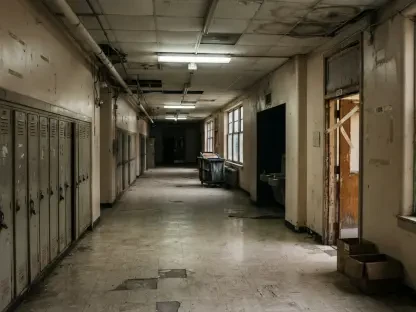
The primary risk is the total loss of momentum and the slow death of institutional ambition. When President Jeffrey Gold speaks about the “limits to what can be achieved,” he is acknowledging a fundamental truth: you cannot innovate or recruit top-tier talent when your staff is constantly looking over their shoulders for the next round of layoffs. Operating in a “constant cycle of cuts” creates a culture of scarcity where departments begin to compete for crumbs rather than collaborating on grand research initiatives. This environment also drives away the very donors and partners who provide the extra margin of excellence, as they are often hesitant to invest in an institution that appears to be in a state of managed decline. The sensory experience on such a campus is one of hushed hallways and empty offices, where the vibrant energy of discovery is replaced by the grim paperwork of austerity.
We have seen significant internal friction at campuses like UNL, including no-confidence votes and the departure of leadership. How should administrations handle the human element of these financial crises?
The human element is often the most volatile part of the equation, and we saw that play out vividly with the no-confidence vote in the former chancellor at the University of Nebraska-Lincoln. When faculty and staff see their programs being nixed or their colleagues departing, the sense of betrayal is palpable and can poison the campus culture for years. Administrators must move beyond high-level memos and engage in radical transparency, explaining the “why” behind every $1.9 million saved or every program cut at schools like the University of Nebraska at Kearney. It is about validating the grief and frustration of the academic community while making it clear that these decisions are being forced by a $307 million shortfall at the state level. Without that empathy and open dialogue, leadership loses the moral authority required to guide the institution through such a brutal fiscal winter.
With hiring freezes and travel restrictions now mandated by the governor’s office, how do these specific administrative hurdles impact the university’s ability to remain competitive on a national stage?
These types of micro-management tactics are often the most damaging because they act as a “slow-motion” drain on institutional quality. A hiring freeze might look like a simple line-item save, but in reality, it means that a cutting-edge research lab might sit empty for a year, or a critical student advisor position remains unfilled, leading to lower retention rates. Travel restrictions further isolate the faculty, preventing them from attending the very conferences where the next multi-million dollar research grant might be brokered or where the university’s reputation is built. It creates a local, insular environment that is the antithesis of what a modern, global university should be. You cannot expect to compete with elite institutions when your professors are grounded and your departments are barred from bringing in the best new minds in their fields.
What is your forecast for the future of state-funded university systems facing these recurring revenue shortfalls?
I anticipate a radical shift toward institutional self-reliance where universities will increasingly look to decouple their core operations from the whims of state tax revenue. We are likely to see more systems adopting the Omaha campus approach of finding deep administrative efficiencies, but eventually, those wells run dry, and the focus will turn toward aggressive private fundraising and specialized, high-revenue online programs. The unfortunate reality is that we may see a tiered system emerge where only a few “flagship” institutions receive the protection they need, while regional campuses are forced to merge or significantly narrow their scope. Ultimately, my forecast is one of consolidation and a painful transition toward a more corporate model of education, unless there is a renewed public commitment to funding higher education as a foundational social good rather than a discretionary expense.