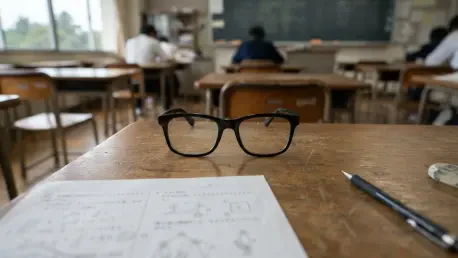

The South Korean government is mobilizing hundreds of specialized officials to ensure that the integrity of the university admission process is not compromised by AI. This massive effort comes as the nation prepares for the College Scholastic Ability Test, or Suneung, an exam that dictates the future of nearly half a million students each year. However, the rise of AI-powered smart glasses has cast a shadow of suspicion over even the most mundane accessories, turning standard prescription eyewear into a source of intense anxiety. In a culture where academic success is often viewed as the singular path to social mobility, the possibility of high-tech cheating has forced authorities to implement unprecedented security measures. Students who have spent years preparing for this single day now find themselves worrying not just about the difficulty of the questions, but whether their physical appearance will trigger a misconduct investigation. This friction highlights a critical juncture in modern education where consumer technology is evolving faster than the institutions designed to regulate it.
The Psychological Toll of Appearance Anxiety
The pervasive “cheating anxiety” among high school seniors has reached a fever pitch, with families flooding education offices with inquiries about appropriate attire. The Busan Metropolitan City Office of Education reported a notable surge in parents asking if their children should switch from thick, plastic frames to thin metal or gold-rimmed versions to avoid being flagged by proctors. This collective paranoia reflects a deep-seated fear that a misunderstanding over a vision aid could result in an immediate disqualification, nullifying years of academic labor. Many students are choosing to abandon their comfortable, familiar glasses in favor of less obtrusive alternatives, fearing that any accessory perceived as “bulky” could be mistaken for a device containing hidden cameras or AI processing chips. The shift demonstrates how the mere existence of sophisticated wearable technology has altered the psychological landscape of the examination hall, creating a new layer of stress for examinees who are already under immense pressure.
Beyond the choice of frames, some families are taking more drastic measures by insisting that students switch to contact lenses for the duration of the testing period. While this might eliminate the risk of being suspected of using smart glasses, it introduces physical discomfort and potential distractions for those who are unaccustomed to wearing them. Experts note that eye fatigue and dryness from new contact lenses can negatively impact a student’s concentration during the grueling nine-hour exam. Despite these risks, the perceived threat of a cheating accusation is so great that parents view it as a necessary trade-off. This atmosphere of suspicion has transformed a standard medical necessity into a potential liability, forcing a re-evaluation of what constitutes “exam-ready” attire. The psychological burden of proving one’s honesty through their choice of eyewear adds an unnecessary cognitive load to a process that is already notoriously difficult, highlighting the deep rift between technological advancement and the rigid traditions of high-stakes testing.
Administrative Protocols and Specialized Surveillance
To address these concerns while maintaining the security of the Suneung, the South Korean Ministry of Education has developed a specific protocol intended to minimize classroom disruptions. Proctors are instructed to avoid immediate, mid-test confrontations unless the violation is blatant and disruptive to others. Instead, the current strategy involves allowing a suspected student to complete the session before requesting a physical inspection of their eyewear. This policy aims to protect the concentration of the examinee and their peers, but it places a significant burden on proctors to maintain constant vigilance throughout the day. To support this effort, the government has deployed hundreds of specialized officials and researchers who are trained to identify the subtle markers of AI integration. These experts are stationed at situation rooms across major cities like Gyeonggi and Busan, ready to provide immediate technical consultation if a proctor identifies a suspicious device. This hierarchy of surveillance is designed to provide a safety net for teachers who may feel overwhelmed by the rapid proliferation of new tech.
Despite the deployment of specialists, many rank-and-file teachers serving as proctors remain skeptical about their ability to detect well-hidden technology. The primary concern is that a single day of training is insufficient to master the nuances of the diverse smart glasses market, where devices often hide cameras behind dark lenses or use bone-conduction audio that is invisible to the naked eye. Educators find themselves in a nearly impossible position: being too thorough risks a lawsuit or a public outcry for harassing a student, while being too lax could lead to a systemic failure of the exam’s integrity. Proctors have voiced concerns that the presence of even a few highly advanced devices could compromise the results of the entire nation, leading to calls for more invasive detection methods, such as the use of signal jammers or high-sensitivity metal detectors at every entrance. However, the logistical and ethical implications of such measures prevent their immediate implementation, leaving teachers to rely on their own observational skills and the support of the newly mobilized technical task forces.
Documented Incidents and Draconian Penalties
The fear of AI-assisted cheating is grounded in recent evidence rather than just hypothetical scenarios, as several students have already been caught using smart eyewear during school-level assessments this year. In a widely reported case in Seoul, an alert proctor noticed a student who did not normally require vision correction repeatedly adjusting the angle of their frames. Upon inspection after the test, the glasses were found to contain a miniature camera capable of transmitting images of the test paper to an external AI model for real-time analysis. Another incident in North Jeolla involved a student whose glasses emitted a faint green indicator light, a common feature in active recording or processing modes. These localized breaches have served as a wake-up call for national authorities, proving that the technology is not only available but is actively being utilized by a small minority of students willing to risk everything for a competitive edge. These cases have led to severe disciplinary actions, including the nullification of grades and mandatory community service, setting a harsh precedent for the national exam.
For the Suneung itself, the legal and academic consequences of being caught with AI technology are significantly more severe than for regular school tests. Any student found using a prohibited electronic device will have their entire exam results voided and will be banned from retaking the test for a minimum of one year. Furthermore, the Ministry of Education has signaled that such cases may be referred to the national police for a criminal investigation under laws regarding the obstruction of official business. This draconian approach is intended to serve as a powerful deterrent, but it also increases the stakes for students who might be wrongly accused due to their choice of eyewear. The government’s emphasis on strict enforcement underscores its commitment to maintaining the meritocratic ideals that the Suneung represents. However, the intensity of these penalties creates a high-pressure environment where every gesture and every piece of clothing is subject to intense scrutiny, making the exam hall feel more like a high-security facility than an educational setting.
Behavioral Analysis: The New Proctoring Frontier
As hardware becomes increasingly difficult to detect through visual inspection alone, some experts argue that the focus should shift toward monitoring behavioral “tells” that indicate the use of smart technology. Dr. Leem Hyun-sung, a prominent figure in the field of optometry and educational technology at Eulji University, suggests that students using AI glasses often exhibit unnatural head movements or specific patterns of fixation that differ from traditional reading habits. For instance, a user might need to keep their head perfectly still or tilted at a specific angle to ensure the camera lens captures the entire test paper clearly. By training proctors to look for these subtle physical cues rather than just scanning for physical ports or buttons, the education system might become more effective at identifying potential cheaters. This approach moves away from a purely technological arms race and toward a more human-centric form of observation that leverages the expertise of experienced educators who understand student behavior under pressure.
Looking beyond immediate security measures, Dr. Leem and other educational reformers are advocating for a fundamental overhaul of the testing philosophy in South Korea. They argue that as AI becomes a permanent fixture in daily life, exams that rely heavily on memorization and standardized responses will inevitably become more vulnerable to technological interference. The suggested solution is to transition toward assessments that prioritize creative problem-solving, critical thinking, and complex synthesis—skills that current AI models and smart glasses struggle to replicate effectively. By changing the nature of the questions themselves, the incentive to use AI as a crutch would be diminished, as the technology cannot easily replace the human ability to navigate nuanced, open-ended challenges. This shift would represent a proactive response to the AI era, transforming the educational landscape from a system of rigid gatekeeping to one that values genuine intellectual adaptability and prepares students for a future where AI is a collaborator rather than a shortcut.
Rethinking the Future: Beyond Visual Detection
The current crisis in South Korea serves as a critical case study for educational systems worldwide, as the miniaturization of AI technology continues to challenge traditional notions of academic integrity. As wearable devices become more “invisible”—integrating seamlessly into standard jewelry, clothing, and eyewear—the feasibility of manual visual inspections will continue to decline. This global trend suggests that institutions must look beyond simple bans and physical checks toward more sophisticated integration of technology within the proctoring process itself. AI-driven monitoring software and advanced signal detection may eventually become standard in testing centers, but these tools must be balanced against the rights and comfort of the students. The South Korean experience highlights the “social friction” inherent in this transition, where the need for security often clashes with the goal of providing a supportive environment for learning. The evolution of these oversight mechanisms will likely define the next decade of standardized testing, requiring a delicate balance between innovation and fairness.
In conclusion, the challenges posed by AI smart glasses during the university admission cycle necessitated a rapid and multifaceted response from both the government and the educational community. Authorities recognized that maintaining the status quo was no longer an option, leading to the deployment of specialized personnel and the implementation of stricter behavioral monitoring protocols. Educational experts successfully pushed for a broader dialogue regarding the future of the Suneung, suggesting that the most effective way to combat high-tech cheating was to evolve the testing format itself. By moving toward more complex, problem-solving-oriented assessments, the system began to mitigate the advantages offered by current AI tools. These steps ensured that the integrity of the national exam remained intact, while also laying the groundwork for a more resilient and modern educational framework. Ultimately, the lessons learned from this period provided a roadmap for other nations facing similar technological shifts, proving that academic honesty could be preserved through a combination of vigilant oversight and pedagogical innovation.