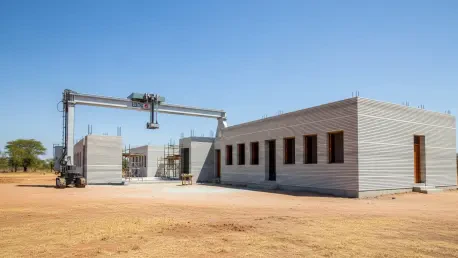

In the Salima district of Malawi, the rapid emergence of a concrete structure marked a definitive shift in how the global community perceives the intersection of robotics and infrastructure development for the better. This specific site hosted the construction of the world’s first 3D-printed primary school, a feat achieved by the joint venture 14Trees, which completed the structural walls in a mere 18 hours. This achievement signals that additive manufacturing has transcended its origins as a niche prototyping tool to become a viable, high-speed solution for regions plagued by chronic infrastructure deficits. By utilizing specialized robotic extruders, the project demonstrated that the time-consuming processes of manual bricklaying and drying can be condensed into a single day of mechanical precision. The success of this endeavor provides a tangible blueprint for other nations, suggesting that the traditional barriers to providing safe learning environments can finally be dismantled through modern technological innovation.
Transforming Construction Timelines
Bridging the Educational Gap
Malawi currently faces a staggering deficit of roughly 36,000 classrooms, an overwhelming shortage that compels thousands of students to travel vast distances on foot every day to attend overcrowded lessons. Under traditional manual construction methods, which rely heavily on seasonal labor and the slow production of fired bricks, experts estimated it would take approximately 70 years to build enough facilities to meet the existing demand. This massive delay represents more than just a logistical hurdle; it is a profound barrier to literacy and economic mobility that has trapped generations of children in a cycle of limited access to quality instruction. When students are forced to learn under trees or in crumbling structures, the educational outcomes suffer significantly, leading to higher dropout rates and a stagnant workforce. The persistence of this crisis necessitated a radical departure from conventional masonry to find a robust solution that matches the scale of the growing population.
Accelerating Infrastructure Delivery
The introduction of 3D-printing technology offers a dramatic shift in this historical timeline, potentially reducing the 70-year construction backlog to just a single decade if the method is adopted at scale. By utilizing a large-scale robotic printer that extrudes specialized concrete layers according to a precise digital blueprint, the process bypasses the inherent slow pace of manual brick-laying and the wait times required for traditional mortar to set between rows. While the finishing touches, such as the installation of roofs and doors, still require skilled traditional labor, the speed of the structural phase provides a massive head start that allows schools to open years ahead of schedule. This hybrid approach leverages the lightning-fast efficiency of automation for the shell and the local expertise of craftsmen for the final details. This shift allows government planners to think in terms of months rather than years for total project completion and student intake across the nation.
Cost-Efficiency and Sustainability
Economic and Environmental Gains
Beyond the sheer speed of delivery, the 3D-printing method is notably more environmentally friendly and cost-effective than the conventional building techniques used throughout Sub-Saharan Africa. The precision of the robotic printer significantly minimizes material waste by depositing only the exact amount of concrete required for structural integrity, leading to an environmental footprint that is more than 50% smaller than that of standard masonry. Additionally, the initial school project in Malawi proved to be approximately 15% less expensive to construct compared to traditional counterparts, demonstrating that this technology can save vital funds for government agencies and aid organizations. These savings are crucial in a region where every dollar must be stretched to cover multiple social services. By reducing the carbon intensity of construction and lowering costs, 3D printing aligns modern infrastructure goals with global sustainability and fiscal targets.
Scaling Investment and Adoption
Despite these clear financial and ecological benefits, the high initial cost of the printing hardware remains a substantial hurdle for widespread local adoption across developing municipalities. Each robotic printer currently costs around $500,000, representing a significant capital investment that requires a well-planned scaling strategy to become truly accessible for smaller local contractors. This upfront expense often necessitates partnerships between private technology firms and public sectors to bridge the funding gap during the early stages of implementation. However, as the technology becomes more common and the manufacturing volume of these printers increases, the cost per project is expected to drop significantly. The long-term economic outlook suggests that the investment will be offset by savings in labor time, material efficiency, and the accelerated social benefits of a better-educated populace. Developing local supply chains for concrete ink will be an essential next step.
A New Chapter for Global Development
Community Impact and Practical Limitations
While 3D printing is undeniably a revolutionary tool for building schools, it must be viewed as one component of a larger educational strategy rather than a standalone cure-all for the learning crisis. A building provides the necessary physical shell, but a successful school still requires qualified teachers, updated learning materials, and ongoing maintenance to function effectively over time. The success in Malawi serves as a powerful “proof of concept,” showing the world that automation can clear the path for human development provided it is supported by a comprehensive commitment to long-term goals. Without a parallel investment in human capital and pedagogical training, the most advanced classrooms will remain underutilized. The focus must remain on the synergy between rapid infrastructure delivery and the quality of the academic experience provided within those walls. This ensures that the technological leap translates into a genuine advancement in student literacy rates.
Advancing Localized Solutions
The path forward required a strategic pivot toward integrating additive manufacturing into national urban planning frameworks to ensure that technical skills were transferred to local workforces. Decision-makers recognized that the sustainable expansion of this technology depended on training a new generation of Malawian engineers to manage the sophisticated hardware independently. Efforts were concentrated on establishing regional hubs where 3D-printing equipment could be shared among multiple districts, thereby spreading the high costs of maintenance and specialized materials. Stakeholders also prioritized the development of locally sourced concrete mixtures to further reduce dependence on imported supplies and enhance the resilience of the local economy. By treating the classroom crisis as a multidimensional challenge, the initiative shifted from a focus on speed to a holistic model of community resilience. This approach ensured that the technological foundation evolved into a self-sustaining system.