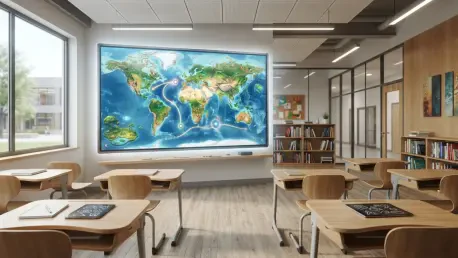

Educators will transition from being mere information providers to facilitators of an interactive environment where technology enhances the pedagogical experience. Sarawak is currently undertaking a monumental shift in its academic landscape, backed by a strategic RM16 million investment aimed at modernizing classrooms across the state. By 2027, the government plans to have more than 1,400 schools equipped with advanced smartboard technology, effectively replacing traditional chalkboards with interactive digital hubs. This initiative, championed by Premier Datuk Patinggi Tan Sri Abang Johari Tun Openg, is far more than a simple hardware upgrade; it is a fundamental realignment of the state’s human capital development strategy. By integrating these tools now, Sarawak is positioning its youth to excel in high-tech industries such as artificial intelligence, semiconductor fabrication, and green hydrogen production. This digital-first model ensures that the local workforce remains competitive in an increasingly automated global economy.
The Strategy: Aligning with Global Educational Standards
In the pursuit of educational excellence, Sarawak is modeling its digital transformation after successful international frameworks found in Singapore and Japan. In Singapore, the Smart Nation initiative has already integrated one-to-one computing for most secondary students, while Japan’s GIGA School Program has successfully installed interactive displays in nearly all public classrooms. By adopting these proven strategies, Sarawak aims to move away from outdated, passive learning models where students are secondary recipients of information. Instead, the focus is shifting toward an active participation model that treats digital literacy as a core competency. This approach recognizes that in the modern job market, the ability to navigate digital interfaces and collaborate via technology is as essential as basic literacy and numeracy. Employers in 2026 expect graduates to be inherently familiar with collaborative software and digital problem-solving, making these smartboards a critical bridge between the classroom and the professional world.
Beyond basic literacy, the integration of multimedia capabilities allows teachers to deconstruct complex, abstract concepts that were previously difficult to explain using static textbooks. In subjects like physics, chemistry, and advanced mathematics, smartboards enable the use of real-time simulations and 3D animations that bring theoretical science to life. For instance, a teacher can now demonstrate molecular bonds or gravitational forces through interactive graphics that students can manipulate themselves. This visual and tactile engagement is designed to spark a deeper interest in STEM fields, which are vital for the state’s industrial ambitions. By transforming the classroom into a dynamic laboratory of ideas, the government is fostering a generation of critical thinkers who are comfortable with the technical complexities of the modern age. The goal is to ensure that science and technology are seen not just as academic requirements but as accessible, exciting career paths that contribute directly to the region’s burgeoning innovation-led economy.
The Goal: Driving Individual Growth and Economic Potential
The introduction of smartboards facilitates a more personalized educational journey through the implementation of differentiated learning techniques. By leveraging digital platforms like Khan Academy and specialized educational software, teachers can tailor their instruction to meet the unique needs of every student. High achievers are given the freedom to explore advanced modules and complex problem-solving exercises at their own pace, while students who may be struggling with foundational concepts can access interactive tutorials and simplified visual aids without feeling left behind. This flexibility ensures that the classroom remains an inclusive space where individual progress is prioritized over a rigid, one-size-fits-all curriculum. As students engage with these digital tools, they develop a sense of autonomy and self-directed learning that is crucial for lifelong success. This pedagogical shift empowers learners to take ownership of their education, preparing them for the independent research and technical adaptability required in higher education.
Looking at the broader economic picture, this project serves as a strategic investment in human capital intended to transform Sarawak into a regional hub for technological innovation. The state government views education not as a recurring administrative expense but as the primary engine for long-term economic growth and social mobility. By equipping schools with smartboards today, the state is laying the groundwork for a future where every student eventually has access to personal mobile devices and a fully integrated global digital ecosystem. This vision aligns with the goal of creating a high-income economy that is less reliant on traditional resources and more focused on knowledge-based sectors. As the workforce becomes more digitally competent, it attracts international tech firms looking for a skilled labor pool capable of leading complex projects. Ultimately, the smartboard initiative is a stepping stone toward a sophisticated society where technological fluency is the standard, ensuring the state remains a leader in the global energy and tech markets.
The Challenge: Overcoming Hurdles to Success
Despite the significant potential of this rollout, the state must address the substantial logistical challenge of bridging the digital divide between urban centers and rural communities. Sarawak’s vast and rugged geography often makes it difficult to provide the high-speed internet connectivity necessary for smartboards to function at their full capacity. Without a reliable web connection, these advanced interactive tools risk becoming little more than expensive, glorified whiteboards. The government has acknowledged that infrastructure development must keep pace with hardware distribution to ensure that schools in remote areas are not disadvantaged. This requires a coordinated effort between telecommunications providers and educational authorities to implement satellite or fiber-optic solutions that reach even the most isolated districts. Ensuring equitable access to digital resources is a non-negotiable prerequisite for the program’s success, as the benefits of modernization must be felt by every student, regardless of their geographic location or socioeconomic background.
Another vital component of this transformation is ensuring teacher readiness and providing consistent professional development for educators across the state. The effectiveness of any technological tool is directly tied to the competence of the individual operating it in the classroom. Simply placing a smartboard in a room is insufficient if the teacher is not trained to integrate its features into the daily curriculum. Consequently, the state is prioritizing comprehensive training programs that teach educators how to create digital content, use collaborative software, and perform basic technical troubleshooting. This shift requires a long-term commitment to changing the culture of teaching from a traditional lecture-based format to one that is more interactive and technologically assisted. By investing in the skills of the teaching force, the government ensures that the hardware becomes an organic part of the learning experience rather than a distracting novelty. Continuous support and mentorship will be essential for helping teachers navigate this transition smoothly and effectively.
The Result: Ensuring Long-Term Sustainability and Impact
The successful deployment of this initiative throughout 1,400 schools depended on a robust support network that addressed the long-term sustainability of the hardware. The government established a comprehensive framework for software updates and cybersecurity measures to protect sensitive student data in an increasingly connected environment. Furthermore, a dedicated maintenance infrastructure was developed to handle the inevitable wear and tear of daily classroom use, ensuring that the investment did not succumb to technical obsolescence. Strategic planning efforts emphasized that the true measure of success was not found in the initial installation but in the measurable improvements in student performance and engagement over time. By focusing on these logistical foundations, the state secured the longevity of its digital tools, turning them into permanent fixtures of the academic landscape. This systematic approach ensured that the RM16 million expenditure functioned as a catalyst for ongoing educational reform rather than a one-time project.
Moving forward, the focus shifted toward integrating these digital capabilities into a unified statewide curriculum that aligned with global industry standards. Stakeholders recognized that the next logical step involved expanding personal device access for all students, creating a seamless transition between school-based and home-based learning. The government encouraged local tech industries to collaborate with schools, providing real-world projects that allowed students to apply their digital skills in practical scenarios. This collaboration fostered a culture of innovation where students were no longer just consumers of technology but became creators and leaders within the digital space. The proactive measures taken to train teachers and upgrade rural infrastructure provided a blueprint for other regions seeking to modernize their own education systems. By treating the classroom as a dynamic incubator for technical talent, Sarawak effectively prepared its citizens to navigate the complexities of a high-tech future, ensuring that the state remained at the forefront of the global knowledge economy.