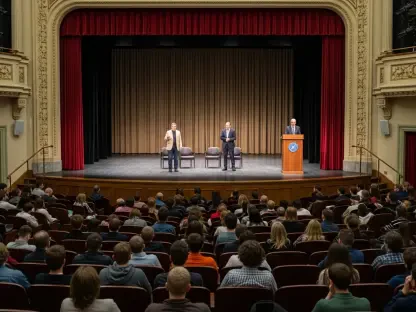

A sweeping school finance recalibration bill, forged in the crucible of intense debate between fiscal conservatives and education advocates, is now poised for consideration by the full Wyoming Legislature after being advanced by a select committee. This legislation represents a delicate and contentious compromise, seeking to overhaul government spending on public education while addressing persistent calls from educators and school officials for increased resources. Initially proposing drastic cuts to teaching staff and larger class sizes, the bill underwent significant amendments following powerful testimony about the state’s educational needs, transforming it into a complex package that both increases teacher salary models and defers critical decisions on student support services to future sessions. The bill’s journey through committee highlights the fundamental tension in Wyoming politics: the drive to limit government spending versus the constitutional obligation to fund a high-quality education for every child.
The Financial Framework of Recalibration
At the heart of the legislative effort is a fundamental recalibration of the state’s financial commitment to its public schools, a process that has been anything but straightforward. The proposed legislation started its journey through the select committee with a total price tag of $1.8 billion, marking a modest increase over existing spending levels. However, this figure fell conspicuously short of the nearly $1.9 billion recommended by state consultants in their comprehensive, evidence-based model for school funding, a gap that immediately became a focal point for educators and administrators. In response to a week of compelling testimony and rigorous internal discussions, lawmakers on the committee approved a series of amendments on a Friday that collectively added at least $30 million back into the bill’s total appropriation. Despite this late infusion of funds, the bill’s overall cost will still not reach the level advocated for in the data-driven model, a reality that underscores the compromises made. Senator Tim Salazar, the committee’s co-chair, aptly characterized the final version as a product of extensive negotiation, acknowledging the “give and take” required to balance competing legislative priorities and public demands. He emphasized that while the committee worked diligently to integrate public feedback, the political “battle for getting this across the finish line has only begun,” signaling a challenging path ahead when the full legislative session begins on February 9.
The bill’s advancement is the culmination of a protracted process involving several meetings throughout the previous year, which laid the groundwork for a week of intense consideration and amendment before its final endorsement. This legislative crucible brought together lawmakers with a mandate to rein in government spending and a diverse coalition of educators, school officials, and public advocates who testified consistently about the growing needs within the state’s schools. The initial draft, with its significant cuts, was seen by many as a starting point for negotiation rather than a viable final product. The subsequent amendments, while not fully satisfying the requests of the education community, demonstrate a legislative willingness to listen and adapt. The final committee vote to advance the bill sets the stage for a broader debate on the legislative floor, where every line item and policy change will be subject to renewed scrutiny. The detailed fiscal note reflecting the approved amendments is eagerly awaited and will provide a clearer picture of the bill’s true financial impact, shaping the arguments for and against the measure in the coming weeks.
Direct Impacts on Teachers and Classrooms
One of the most significant and fiercely debated aspects of the bill involves its direct and multifaceted impact on teachers, touching upon their salaries, job security, and daily working conditions. The new funding model proposes to set the average teacher salary at slightly more than $70,000. This is a critical adjustment, as it addresses a long-standing issue where school districts often paid salaries at or above this level but were only reimbursed by the state based on a much lower model salary. This discrepancy historically forced districts to divert funds from other essential areas, such as classroom supplies or support staff, to cover the actual cost of teacher compensation. However, the proposed salary increase has not been met with universal praise from the education community. Many advocates and teachers have argued that the benchmark should be a starting salary of $70,000, not an average, to truly address the significant financial challenges that compel many educators to work summer jobs just to make ends meet. Trystin Green, the Chief Financial Officer for Albany County School District No. 1, testified that the positive effect of the salary bump is being overshadowed by other detrimental provisions in the bill. She explained that teachers are not expressing gratitude for the raise because they anticipate negative consequences, such as larger class sizes and the loss of colleagues, which will invariably lead to an increased and unsustainable workload.
The initial draft of the recalibration bill would have delivered a severe blow to the state’s teaching workforce, mandating the elimination of over 600 core teaching positions statewide. This drastic reduction was directly tied to a proposal to increase target class sizes across all grade levels, a move aimed at generating significant cost savings. The original language sought to change the targets from the current 16 students per class in grades K-5 and 21 in middle and high school to a new, more crowded model of 15 students in grades K-3 and 25 students in grades 4 and up. Recognizing the potentially devastating impact this would have on student learning and teacher morale, the committee adopted a crucial amendment from Senator Wendy Schuler. Her amendment revised the target class sizes to a more moderate structure: 16 students for grades K-3, 22 students for grades 4-5, and 25 students for middle and high school. Because the state’s complex funding formula is directly linked to these class size targets, Senator Schuler’s amendment not only reduced the potential increase in class sizes but also restored funding for approximately 96 teaching positions, at an estimated statewide cost of $10 million, providing a significant measure of relief to educators across Wyoming.
A separate but equally critical issue arose from a glaring oversight in the original bill draft that would have drastically and unintentionally reduced the minimum number of teachers for which small K-12 schools are reimbursed. This provision was so fundamentally flawed that even the consultants who developed the new formula took the unusual step of recommending that lawmakers amend it, highlighting the severity of the error. Responding to this urgent need, Speaker of the House Chip Neiman introduced a successful amendment to rectify the oversight, thereby restoring essential funding and positions for these vital small schools, which are often the lifeblood of rural communities. Speaker Neiman’s amendment is estimated to add approximately $20.6 million back into the school finance model and preserve an additional 198 teaching positions that would have otherwise been lost. When combined, the amendments from Senator Schuler and Speaker Neiman effectively added back nearly 300 of the teaching positions that were slated for elimination, increasing the bill’s overall cost by roughly $30 million and mitigating some of the most severe cuts proposed in the initial draft. A reworked version of the bill reflecting these and other approved amendments is expected to be published before the legislative session begins.
Structural Adjustments and Deferred Decisions
Beyond its impact on staffing and salaries, the recalibration bill also seeks to fundamentally alter the methodology for calculating student enrollment, a key variable that dictates the distribution of state funding to school districts. The current system provides a crucial buffer for districts, particularly those in small towns with fluctuating populations, by allowing them to use either the previous school year’s enrollment or the average of the last three years, whichever figure is greater. This flexibility helps prevent sudden and catastrophic budget shortfalls. The bill, however, proposes to eliminate this option entirely and base funding solely on the previous year’s enrollment count. This change raised significant concerns among school administrators about the potential for sudden and steep funding drops, or “cliffs,” from one year to the next, which could destabilize school operations. To address this legitimate concern, Representative Ocean Andrew introduced a thoughtful amendment designed to “smooth” any potential fluctuations by limiting the change in a school’s calculated enrollment to a maximum of five percent in a single year, whether it be an increase or a decrease. This amendment, which provides a measure of predictability and stability for district budgeting, was passed unanimously by the committee.
In a move that drew both understanding and sharp criticism, the committee made a deliberate decision to postpone action on several critical funding areas, including support for counselors, nurses, school resource officers, and school nutrition programs. This decision is particularly notable given that it comes despite a court order—currently under appeal before the Wyoming Supreme Court—directing the state to provide better funding for precisely these types of essential student services. Co-Chair Representative Scott Heiner explained the committee’s rationale, stating a desire to avoid a “Band-Aid” solution and a firm belief that these complex and vital issues require more dedicated time and testimony to address properly. Consequently, the committee’s work is set to be extended into the 2026 interim to specifically tackle these deferred topics. This delay was met with pointed criticism from education advocates. Commenters, including Trystin Green, stressed that mental health and support services are “not luxuries” and questioned why the Legislature could act with swiftness on other matters, such as a gun law, but required two years to fully address pressing student mental health needs that are impacting classrooms today.
A Compromise with a Delayed Fuse
In a final act of compromise, the committee did address the issue of student mental health, albeit with a delayed implementation. Senate President Bo Biteman successfully introduced an amendment to fund mental health counselors at the rate recommended by the evidence-based model, which would fund approximately one counselor per school across the state. This move was seen as a partial victory for those who had advocated for immediate action on student support services. However, this new funding is not scheduled to begin until the 2027-2028 school year, providing the Legislature ample time to alter the plan during its upcoming interim studies. Biteman noted that this extended timeline was intentional, allowing for a more thorough examination of the issue. He explained that if the interim studies revealed a need for a different course of action or a more effective funding mechanism, changes could be made before the funding actually took effect. This decision effectively passed a bill that acknowledged a critical need but deferred the financial commitment, leaving the ultimate fate of comprehensive student support funding to be determined in future legislative sessions.