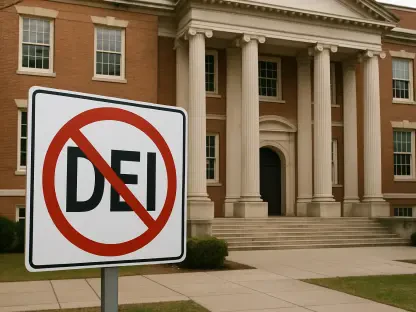

In the complex and often contentious intersection of politics and academia, a recent 4th U.S. Circuit Court of Appeals ruling has sent ripples through higher education. We’re joined by Camille Faivre, an education expert specializing in institutional management, to unpack what this decision on two anti-DEI executive orders means for colleges and universities. Our conversation will explore the shifting legal landscape for challenging executive power, the practical steps administrators must now consider to protect their diversity initiatives, and the subtle but powerful impact this will have on campus speech and culture.
The 4th Circuit’s ruling distinguishes between the president’s policy priorities and legal overreach. How might this decision affect the way future administrations use executive orders to influence higher education, and what precedent does it set for challenging those directives in court?
This ruling really sharpens the line between a president’s policy agenda and an agency’s specific actions. The court, led by Judge Albert Diaz, essentially affirmed that the executive branch has the authority to direct its agencies to prioritize or de-prioritize certain types of funding. In this case, the president decided “equity” wasn’t a priority. What this does is make it much harder to challenge a broad executive order on its face. Instead of fighting the policy itself, the precedent now pushes legal challenges downstream. Institutions can no longer just say the entire order is vague or unconstitutional; they must wait for a tangible injury—like a specific grant being canceled—and then sue the specific agency that took the action. It’s a fundamental shift from a broad ideological battle to a series of smaller, more focused legal skirmishes.
One order requires federal funding recipients to certify that their DEI programs comply with anti-discrimination laws. What practical steps should university administrators now take to audit their initiatives, and what are the key risks they face given the lack of a clear definition for “illegal DEI”?
This is the million-dollar question for administrators, and the ambiguity is precisely the point of concern. The first practical step is a thorough, proactive audit of all DEI and accessibility programs. Legal counsel needs to be deeply involved, examining every initiative through the lens of existing federal anti-discrimination laws. The risk is that the term “illegal DEI” remains undefined, leaving it open to the administration’s interpretation. An institution might believe its programs are perfectly lawful, but if the government decides to launch one of its nine potential investigations into a university with an endowment over $1 billion, the school will be forced into a defensive posture. The real danger isn’t just losing funding; it’s the chilling effect of having to prove a negative and the immense resources consumed by navigating a federal investigation.
The court advised plaintiffs to sue specific agencies over canceled grants rather than challenge the executive order itself. Can you walk through what this legal strategy would look like in practice for a university and explain the difference in the burden of proof required?
Imagine a university has a significant federal grant for diversity-related research that gets abruptly canceled. Before this ruling, the university might have joined a lawsuit arguing the executive order itself was an unconstitutional overreach. Now, that path is largely closed. The new strategy requires the university to file a lawsuit directly against the federal agency that terminated the funding. The legal argument would shift from “the President can’t do this” to “this agency unlawfully terminated our contract.” The burden of proof changes significantly. The university would have to demonstrate that the agency acted in an “arbitrary and discriminatory” manner or that it violated the specific terms of the grant agreement, rather than proving the president’s order itself chilled free speech. It becomes a much more granular, contract-based legal fight, which can be both costly and time-consuming.
Plaintiffs argued the orders would chill protected speech, but the court viewed the certification as a simple matter of legal compliance. From your perspective, what is the real-world impact on campus dialogue and DEI programming when facing the specter of federal investigations and funding loss?
The court’s perspective is very clinical, but on the ground, the impact is anything but. The “specter of a looming civil rights investigation,” as the plaintiffs put it, is a powerful motivator for self-censorship. Even if a university is confident its DEI programs are legal, the mere threat of being targeted can make administrators risk-averse. They might choose to scale back or rename programs, not because they are illegal, but to avoid attracting unwanted attention from the federal government. This creates a chilling effect that permeates campus life. Faculty might become hesitant to propose research on certain topics, and open dialogue around equity could become more guarded. The court may see it as a simple certification, but for campus leaders, it feels like a Sword of Damocles hanging over any initiative that uses the words “diversity, equity, and inclusion.”
What is your forecast for the future of federally funded DEI initiatives in higher education following this ruling?
I foresee a period of significant strategic adjustment and, frankly, a lot of legal and operational uncertainty. In the short term, many institutions will likely become more cautious with the language they use, perhaps shifting from “DEI” to terms like “student success,” “campus belonging,” or “institutional excellence” to describe similar initiatives. We will almost certainly see a rise in targeted lawsuits against specific federal agencies as grants are inevitably canceled. Over the long term, this ruling solidifies a pathway for future administrations to use the power of the federal purse to shape campus policies. This isn’t the end of DEI in higher education, but it marks a move from a centralized, ideological conflict to a decentralized, institution-by-institution battle for resources and the right to self-govern. The focus will shift from defending the concept of DEI to defending the legality of its specific implementation, one program at a time.