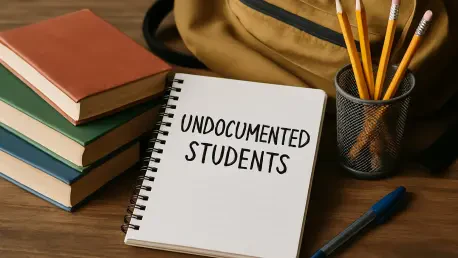

The right of every child on U.S. soil to receive a public education has long been considered a cornerstone of American society, yet this fundamental principle now finds itself at the center of a fierce and escalating political storm. Caught between the constitutional mandate for equal protection and a rising tide of restrictive policies, the educational futures of hundreds of thousands of undocumented students hang in the balance. This is not merely a debate over policy; it is a profound conflict that tests the nation’s commitment to its founding ideals against the pressures of modern immigration politics, economic anxieties, and the very definition of who belongs. As federal and state governments increasingly challenge long-standing legal precedents, the stability of a system that has provided a pathway to opportunity for generations is now more precarious than ever, leaving students and their families in a state of profound uncertainty.
The Shaky Legal Ground
The K-12 Foundation of Plyler v. Doe
The legal foundation for the education of undocumented children in the United States rests almost entirely on the landmark 1982 Supreme Court case, Plyler v. Doe. This pivotal decision directly addressed a Texas state law that permitted school districts to either deny enrollment to undocumented children or charge them tuition, effectively creating a barrier to public education. The Supreme Court, in a 5-4 ruling, found the Texas statute unconstitutional, arguing that it violated the Equal Protection Clause of the 14th Amendment. The Court’s majority opinion powerfully asserted that this constitutional protection extends to all “persons” within a state’s jurisdiction, irrespective of their citizenship or legal immigration status. This ruling established a crucial precedent, affirming that states could not create a subclass of residents and then deny them the basic educational opportunities available to others, thereby securing the right to a free public K-12 education for every child.
While Plyler v. Doe established a formidable legal shield for elementary and secondary education, its protections have proven to be narrowly defined and are facing renewed and vigorous challenges. The ruling did not grant undocumented individuals a federal right to education but rather prevented states from enacting laws that specifically deny it based on immigration status. This distinction is critical, as it leaves the door open for other forms of restrictions and has not stopped subsequent legislative efforts from attempting to chip away at its foundation. The decision itself was not unanimous, and the dissenting opinions laid the groundwork for future arguments centered on states’ rights and federal immigration authority. Today, as the political climate grows more polarized, the very principles that underpinned the Plyler decision are being questioned, and a wave of hostile executive orders and state-level bills seeks to test its limits, making this once-settled legal precedent a key battleground in the ongoing immigration debate.
Higher Education’s High Barriers
The landscape of postsecondary education for undocumented students stands in stark contrast to the protections afforded at the K-12 level, largely due to restrictive federal legislation. The pivotal law in this domain is the 1996 Illegal Immigration Reform and Immigrant Responsibility Act (IIRAIRA). Section 505 of this act explicitly prohibits states from granting in-state tuition rates to undocumented students unless they offer the same rates to all U.S. citizens, including those residing out of state. This provision effectively creates an insurmountable financial hurdle for many aspiring college students, forcing them to pay significantly higher out-of-state or international tuition fees. While some states have found legislative workarounds to offer tuition equity through specific state-level laws, the federal statute remains a major impediment, reflecting a congressional intent to limit access to public benefits, including affordable higher education, based on immigration status, thereby creating a legal and economic chasm between high school graduation and college matriculation.
Beyond the challenge of tuition costs, access to federal financial aid is virtually nonexistent for undocumented students, creating another significant barrier to higher education. The Free Application for Federal Student Aid (FAFSA), which is the gateway to federal grants, loans, and work-study programs, requires applicants to provide a Social Security Number. Since undocumented students lack this identification, they are automatically ineligible for any form of federal assistance. This exclusion forces them to rely on a limited pool of private scholarships, institutional aid from specific colleges, or personal and family resources, which are often insufficient to cover the high costs of a college degree. This systemic exclusion from federal aid programs not only complicates the financial calculus for these students but also sends a clear message that, despite their academic achievements and contributions, they remain outside the system of support designed to foster educational advancement for the nation’s youth.
A Rising Tide of Challenges
Federal Policies Threaten Safe Havens and Citizenship
The environment for undocumented students has grown increasingly perilous due to recent shifts in federal enforcement policy that have eroded long-standing protections. In a significant reversal, a January 2025 memorandum from Immigration and Customs Enforcement (ICE) Acting Director Caleb Vitello, titled “Common Sense Enforcement Actions in or Near Protected Areas,” rescinded a 2021 directive that had largely shielded schools from immigration raids. The previous policy designated sensitive locations like schools, places of worship, and healthcare facilities as “protected areas” where enforcement actions should generally be avoided. The new memo explicitly permits ICE to conduct raids in these locations, a change that has sent a wave of fear through immigrant communities. The immediate consequence has been a documented chilling effect, with reports of parents becoming too frightened to send their children to school, fearing that a routine school day could end in family separation and deportation.
Adding to this atmosphere of uncertainty is a direct executive-level challenge to the foundational principle of birthright citizenship. President Donald Trump’s Executive Order 14160, issued in January 2025, attempts to fundamentally reinterpret the 14th Amendment to the Constitution. The order advances the argument that children born in the United States to undocumented parents are not “subject to the jurisdiction” of the U.S. and, therefore, are not entitled to automatic citizenship. Although this executive order was immediately met with legal challenges and its constitutionality is highly disputed, its issuance marks a significant and aggressive effort to redefine a cornerstone of American law that has been upheld for over a century. For undocumented students and their families, this executive action represents not just a policy shift but an existential threat, questioning their children’s very place in the nation and further destabilizing their already precarious lives.
State-Level Assaults on Enrollment
The campaign to curtail educational access for undocumented students is being waged with equal intensity at the state level, where legislative proposals have sought to directly dismantle established rights. In 2025, Tennessee’s H.B. 793 represented one of the most direct challenges to the Plyler v. Doe ruling in recent memory. The bill aimed to grant public and charter schools the authority to refuse enrollment to undocumented children, a blatant contradiction of the Supreme Court’s precedent. While the legislation included a provision requiring schools to first offer families the option to pay tuition, its core intent was to create a legal mechanism for exclusion. Despite generating mass protests and widespread condemnation from civil rights advocates, the bill successfully passed through two House committees before it ultimately failed to advance further, illustrating the growing willingness of some state legislatures to openly defy federal court rulings on this issue.
A similar effort to restrict access, this time focused on higher education, emerged in Alabama in 2024 with the introduction of H.B. 210. This bill sought to impose a new set of stringent prerequisites for undocumented students seeking to attend the state’s public colleges and universities. Under the proposed law, these students would have been required to have completed three years of high school in the state, possess a diploma or GED, and, most onerously, have an active application for legal status pending with the federal government. The bill passed overwhelmingly in the Alabama House of Representatives, signaling strong political support for creating additional barriers to postsecondary education for this population. Although the legislation eventually died in the state Senate, both the Alabama and Tennessee bills underscore a concerted and geographically dispersed legislative trend aimed at systematically rolling back educational opportunities for undocumented students at every level of the academic ladder.
The Competing Arguments Shaping Policy
The Case for Inclusion and Economic Integration
Proponents of equal education access for undocumented students argue compellingly that education serves as a critical pathway toward legal status and successful societal integration. This perspective is reinforced by the structure of past comprehensive immigration reform proposals, such as the 2013 Border Security, Economic Opportunity, and Immigration Modernization Act and the 2021 United States Citizenship Act. Although these bills failed to pass, they both included educational milestones, such as high school completion, as key criteria for individuals to earn legal status. This demonstrates a consistent legislative consensus that educational attainment is a vital marker of an individual’s commitment and qualification for protection and eventual citizenship. The success of the Deferred Action for Childhood Arrivals (DACA) program provides concrete evidence of this link; a 2024 Center for American Progress report found that an overwhelming 94.9% of DACA recipients were either employed or enrolled in school, illustrating that educational opportunities are indispensable for enabling these individuals to become productive members of society.
Beyond the path to legalization, a strong economic case is made for investing in the education of undocumented students. Access to postsecondary education enables these individuals to qualify for higher-paying jobs, which in turn fuels the national economy through increased tax revenue and greater consumer spending. This upward mobility also offers a crucial escape from the cycle of poverty and exploitation that defines the low-wage sectors where many undocumented workers are currently concentrated. Without legal status or educational credentials, they face a high risk of abuse, including child labor and conditions tantamount to modern-day slavery. Because these workers fear that reporting abuses will lead to deportation, these exploitative practices often go unchecked. Advocates contend that education is one of the most effective tools to break this cycle, empowering individuals to secure stable employment, contribute more fully to the economy, and achieve financial independence, benefiting both themselves and the nation as a whole.
The Push for Restriction and Rule of Law
Conversely, opponents of providing equal educational access to undocumented students ground their primary argument in the principle of the “rule of law.” Think tanks like The Heritage Foundation contend that since residing in the country without authorization is a civil offense under federal statute (8 U.S.C. 1325), it is fundamentally illogical and unethical for public institutions to grant benefits to individuals who have violated federal law. This perspective holds that a nation governed by laws must not create policies that appear to reward illegal behavior. They argue that Congress holds the constitutional authority to regulate immigration, and as such, restrictive policies like the IIRAIRA’s ban on in-state tuition are justified expressions of that authority. From this viewpoint, providing public services like education to undocumented individuals undermines the integrity of the nation’s legal and immigration systems and sends a message that federal laws can be disregarded without consequence.
This legal and ethical objection is frequently coupled with concerns over the increased financial burden that enrolling undocumented students allegedly places on public school systems and taxpayers. Opponents argue that the influx of these students strains local and state resources, requiring additional funding for bilingual teachers, expanded facilities, school lunches, and transportation services. This argument was prominently featured in a lawsuit filed by former Oklahoma State Superintendent Ryan Walters, who demanded $474.9 million in federal reimbursement to cover these exact expenses. This narrative is further bolstered by reports of overcrowding in school districts with large immigrant populations, such as New York City, leading critics to frame the education of undocumented students as a direct and unsustainable drain on taxpayer funds. This economic argument is often linked to the idea that offering such benefits acts as a “pull factor,” incentivizing further illegal immigration and exacerbating the strain on already limited public resources.
An Uncertain Future in a Polarized Landscape
The landscape of educational rights for undocumented students had been shaped by a delicate and often contentious balance between legal precedent and political will. The foundational ruling of Plyler v. Doe stood for decades as a bulwark, ensuring that the doors of K-12 schools remained open to all children. However, the recent onslaught of hostile executive orders, aggressive federal enforcement policies, and persistent state-level legislative challenges demonstrated that this bedrock was far from secure. The ensuing battles in courtrooms and statehouses revealed a nation deeply divided, where the principles of equal protection clashed with anxieties over economic costs and the enforcement of immigration law. The future for these students became contingent not on their academic potential but on the unpredictable currents of a polarized political climate, leaving their pursuit of an American dream hanging precariously in the balance.