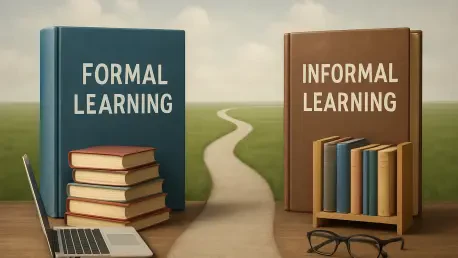

A student diligently following a chemistry lab manual and another who learns to cook by experimenting with ingredients in the kitchen are often perceived as engaging in two fundamentally different types of learning. This traditional dichotomy has long shaped educational philosophy, drawing a distinct line between the structured, curriculum-driven knowledge of formal schooling and the organic, experiential wisdom acquired through life. However, recent scholarly work is challenging this rigid separation, proposing that the most impactful learning occurs not at these opposite poles but within the fluid, nuanced space that connects them. This emerging perspective suggests learning is a continuous spectrum, recasting the educator’s role as that of a facilitator who guides students in anchoring their personal discoveries to established academic frameworks, thereby transforming raw observation into deep and applicable understanding.
Redefining the Educational Spectrum
The Quantum Analogy for Knowledge Acquisition
Recent academic thought, published in a peer-reviewed education journal, introduces a novel framework for understanding how students learn by drawing a compelling analogy from the world of quantum mechanics. This theory, co-authored by a university professor and a public school music director, proposes that a student’s potential knowledge often exists in a “suspended” or probabilistic state, much like a quantum particle before it is observed. This latent understanding is built from a collection of personal experiences, passive observations, and informal discoveries that have not yet been codified into a formal concept. For instance, a student might intuitively grasp a scientific principle through trial and error in a hobby without knowing the official terminology or the underlying mathematical formulas. The knowledge is present but not yet concrete. This perspective shifts the focus from a simple transfer of information to a process of making latent understanding tangible, recognizing that students arrive in the classroom with a rich but often unarticulated base of knowledge waiting to be activated and defined.
Within this quantum-inspired framework, the educator’s primary role is transformed into that of an observer and facilitator who helps “collapse” this suspended state of knowledge into a concrete, understandable form. The teacher acts as the catalyst who connects a student’s informal observation to a formal curricular structure. To illustrate, consider a music student who notices that a conductor’s specific hand gesture consistently makes the ensemble play louder. This is an informal, experiential discovery. The teacher then intervenes by labeling this gesture and its corresponding musical effect with the formal term “crescendo.” In this moment, the student’s personal observation is anchored to the established language of music theory. This act of bridging doesn’t create the knowledge from scratch; rather, it solidifies and contextualizes what the student had already begun to understand intuitively. This process empowers students by validating their personal discoveries and integrating them into a broader, more structured academic landscape, making learning a collaborative act of construction rather than a passive reception of facts.
Fostering a Student-Centered Learning Environment
A significant trend supported by this research is the move away from rigid pedagogical categories and toward a more holistic, student-centered approach that acknowledges the constant state of learning individuals are in. Education is not confined to the four walls of a classroom; it happens through observation, collaboration with peers, personal experimentation, and engagement with the world. An effective educational environment is one that intentionally recognizes and leverages these diverse and often informal inputs. Instead of viewing outside experiences as separate from or irrelevant to academic subjects, this model encourages educators to actively seek out and incorporate them into the curriculum. This creates a more dynamic and relevant learning experience where students can see direct connections between their lives and their studies. By allowing students to “have a hand in their learning,” educators can foster a sense of ownership and agency, which are powerful motivators for deeper engagement and long-term retention of knowledge. This approach values the entire ecosystem of a student’s life as a valid source of learning.
The practical application of this integrated model requires a fundamental shift in how lesson planning and classroom interaction are approached, moving from a prescriptive to a responsive methodology. Teachers are encouraged to become adept listeners and observers, identifying the moments when a student’s informal knowledge intersects with the formal curriculum. This might involve designing projects that allow students to draw on personal hobbies, facilitating discussions that connect abstract concepts to current events, or simply being flexible enough to pivot a lesson based on a student’s insightful question or observation. The goal is to create a symbiotic relationship where the curriculum provides structure and the students’ experiences provide context and relevance. This approach not only makes learning more meaningful but also equips students with the critical skill of synthesis—the ability to connect disparate pieces of information and build a coherent understanding. Ultimately, it redefines the classroom as a space where students don’t just learn about a subject, but learn how to integrate it into their own evolving worldview.
Reconciling Different Paths to Mastery
The Synergy of Formal and Informal Methods
A key finding from this educational research is the importance of a balanced perspective on different learning styles, rejecting the notion that one method is inherently superior to another. The paper highlights the value of informal learning by pointing to examples from various fields, such as popular music, where many highly successful musicians learn their craft through listening, imitation, and experimentation rather than formal conservatory training. This observation lends significant weight to the idea that structured, academic instruction is not the only viable path to achieving a high level of proficiency. Informal methods often foster creativity, adaptability, and a deep, intuitive understanding of a subject that can sometimes be stifled by overly rigid formal systems. By acknowledging the legitimacy and effectiveness of these self-directed learning paths, educators can better appreciate the diverse ways in which expertise can develop and can create more inclusive learning environments that cater to students who may thrive outside of traditional pedagogical structures.
While celebrating the merits of informal discovery, the research simultaneously cautions against the extreme view that it alone is sufficient for true mastery. Arguing that formal education is unnecessary “devalues a lot of the training that did happen” and overlooks the critical role that structured guidance plays in refining raw talent and correcting misconceptions. The consensus viewpoint emerging from this work is that the most robust and applicable knowledge arises from the synergy between a student’s natural discovery process and a teacher’s expert guidance. Formal training provides the theoretical foundation, a common language for collaboration, and a systematic approach to problem-solving that can accelerate learning and prevent the reinforcement of bad habits. When a student’s intuitive grasp of a concept is combined with a teacher’s structured curriculum, the result is a more comprehensive and resilient form of understanding. This synthesis allows learners to be both creative and precise, innovative and disciplined, embodying the best of both worlds.
From Intuitive Practice to a Shared Framework
One of the most compelling aspects of this learning model is its recognition that it is not a prescriptive new system to be implemented from scratch, but rather a way of thinking that many successful educators already practice intuitively. Great teachers have always found ways to connect curriculum to their students’ lives, to validate their questions, and to build on their existing knowledge. What this research provides is a formal language and a theoretical framework to describe and analyze these intuitive practices. By giving a name to this process, it allows educators to become more conscious and deliberate in their application of these techniques. It transforms an unconscious skill into a transferable and teachable methodology. This framework can be used for professional development, teacher training, and peer coaching, enabling the broader educational community to understand, replicate, and refine what was once considered simply an innate talent for teaching, thereby elevating the practice for everyone.
The dissemination of these insights has already begun to contribute to a broader academic and professional conversation on pedagogy. The researchers have presented their findings at professional development sessions for state-level music education associations and at international conferences focused on the sociology of education. This active sharing ensures that the theory does not remain confined to academic journals but is tested, debated, and adapted in real-world educational settings. By engaging with fellow educators, the authors are fostering a collaborative effort to explore the nuances of the formal-informal learning spectrum across different disciplines and age groups. This ongoing dialogue is crucial for refining the model and discovering its full potential. As more educators become familiar with this way of thinking, it can lead to curriculum redesign, new assessment strategies, and a culture shift that more deeply values the holistic development of every student, recognizing them as active participants in the construction of their own knowledge.
A New Foundation for Educational Synergy
The exploration of the space between formal and informal learning ultimately reframed the conversation around effective pedagogy. It moved beyond a simple debate of which method was superior and instead focused on the critical, dynamic interplay between structured instruction and individual discovery. This perspective provided a valuable language for educators to articulate and refine the intuitive techniques they had long employed to connect with students. The model’s real impact was in its validation of the student’s entire world as a source of knowledge, establishing the educator’s role as a vital bridge between personal experience and academic understanding. By conceptualizing learning as a continuous spectrum, this research encouraged a more holistic and responsive approach to teaching that empowered students to become active co-creators of their own education, fostering a depth of mastery that neither method could have achieved alone.