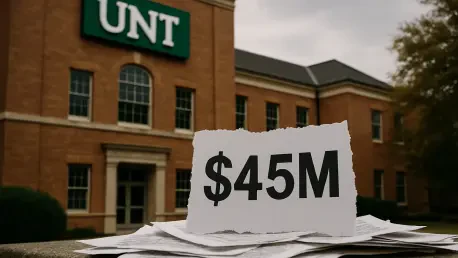

The University of North Texas is currently grappling with a formidable financial challenge, as administrators work to close a newly revealed budget deficit that has swelled to $45 million for the 2026 fiscal year. This significant shortfall, described by University President Harrison Keller as a “structural, not just temporary” problem, signals a period of profound fiscal instability for the institution. The crisis stems from a potent combination of diminished state financial support and unexpected downturns in student enrollment, forcing the university into a position where difficult decisions are inevitable. The administration has begun to prepare the campus community for a period of austerity, acknowledging that the necessary budgetary adjustments will have a widespread impact across all departments and programs. This situation places UNT at a critical juncture, compelling a reevaluation of its financial models and operational strategies to ensure long-term sustainability in an increasingly competitive higher education landscape. The complexity of the issue demands a multifaceted approach, one that addresses immediate needs while laying the groundwork for future resilience.
The Twin Pressures of Funding and Enrollment
A primary driver behind the university’s current financial strain is a significant reduction in state funding, which has created a substantial gap in the operating budget. For the upcoming fiscal year, UNT is contending with a $32 million decrease in state appropriations designated for instruction and operations. This cut directly impacts the university’s core academic functions and day-to-day activities. In Texas, public universities rely heavily on a system known as formula funding, where state financial support is calculated based on metrics like student credit hours and graduation rates. Consequently, any dip in enrollment figures has a direct and often immediate negative effect on the amount of funding the institution receives from the state. The $32 million reduction is a direct reflection of recent enrollment shifts, compelling the university to find ways to operate with considerably less public investment. This dependency on state-level financial decisions underscores the vulnerability of public institutions to legislative budget cycles and policy changes, making long-term financial planning a persistent challenge.
Compounding the issue of reduced state aid is a sharper-than-anticipated decline in a key demographic: international graduate students. While the university had already prepared for a downturn in this area, budgeting for an initial $47.3 million year-over-year drop in tuition and fee revenue, the reality has proven more severe. A first-quarter report revealed that year-end revenue is now projected to fall short by an additional $14.7 million, a deficit attributed specifically to the lower-than-expected enrollment of nonresident graduate students. This group is particularly vital to the university’s financial health because they typically pay higher out-of-state tuition rates, which helps subsidize various institutional costs. The steeper decline suggests a shifting global landscape for higher education, potentially influenced by visa policies, international competition, and economic factors. The university’s reliance on this revenue stream has now become a significant liability, exposing a need for greater diversification in its enrollment and funding strategies to mitigate such risks in the future.
A Reversal of Fortune and Campus Response
The recent enrollment figures represent a stark reversal of a previously positive trend, adding another layer of complexity to the financial crisis. Between 2019 and 2024, UNT experienced robust growth, with its student population increasing by approximately 19%. This period of expansion came to an abrupt halt last fall, when the university recorded a significant 5.7% drop in headcount, translating to a loss of over 2,600 students. This decline was noted as one of the largest among public colleges in Texas for the period, directly contributing to the administration’s decision to budget for a $16 million loss in state formula funding for fiscal 2026. Despite this downturn, international students remained a substantial part of the university community, constituting over 15% of the student body in fall 2024. Their continued presence, even in reduced numbers, highlights their integral role in both the cultural fabric and the financial stability of the institution, making their recruitment and retention a critical priority for administrators moving forward.
In response to the escalating budget deficit, which grew from an initial projection of $31.2 million to the current $45 million, President Keller has issued a sober warning to the campus community, stating that “hard choices” are on the horizon. He acknowledged that the impact of the necessary cuts will be felt across the entire institution, affecting academic departments, administrative services, and student programs alike. In his communications, Keller has committed to managing these budgetary challenges in a responsible and deliberate manner, with a primary focus on minimizing the adverse effects on students and the broader university community. To foster trust and maintain morale during this difficult period, the administration also pledged to provide frequent and transparent updates as specific budget-balancing measures are developed and finalized. This proactive communication strategy aims to keep faculty, staff, and students informed about the decision-making process as the university navigates this period of significant financial adjustment and strategic realignment.
Deep-Seated Tensions and a Challenging Outlook
The announcement of the fiscal crisis did not occur in a vacuum; it amplified pre-existing frustrations among faculty and staff regarding the university’s financial management. For years, long before the current deficit came to light, there had been growing discontent over stagnant compensation and a lack of consistent raises, even during periods of enrollment growth and relative financial stability. An unnamed faculty member, speaking to the student newspaper, suggested that the problem extended far beyond a single challenging year. This individual pointed to a perceived long-standing lack of transparency and proactive long-term financial planning from the administration. This perspective cast the current crisis as a culmination of systemic issues rather than an isolated incident, suggesting that the university’s financial foundations were not as secure as they appeared. The budget shortfall, therefore, served to validate long-held concerns and deepen the divide between the administration and the campus community it led.