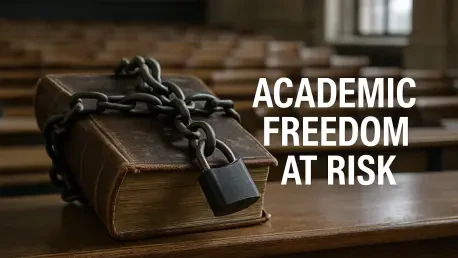

The humble course syllabus, long considered a private pact between a professor and their students, is now at the center of a contentious public battleground across North Carolina’s university system. A sweeping new policy from the University of North Carolina (UNC) System mandates that these academic roadmaps be posted online, accessible to anyone with an internet connection. This move has ignited a fierce debate, pitting the administration’s stated goals of transparency and public trust against the faculty’s deep-seated fears of political harassment, self-censorship, and threats to academic freedom itself. As the university community grapples with this new reality, a critical question emerges: can radical transparency coexist with intellectual integrity?
From Classroom Guide to Public Record
At its core, the new policy fundamentally redefines the purpose and audience of a syllabus. Traditionally an internal document outlining course expectations, readings, and assessments, the syllabus is now officially classified as a public record as of January 15. This classification is the first step toward a much larger change set to take full effect in the 2026-27 academic year, when all 16 UNC institutions will be required to house their syllabi on a single, “readily searchable” online platform.
This shift transforms the document from a pedagogical tool into a public declaration. What was once a flexible guide for a specific group of enrolled students will become a static artifact subject to scrutiny from parents, politicians, activists, and the general public. The transition marks a significant departure from academic norms, where course design has largely been the protected domain of the instructor, and it sets the stage for a system-wide experiment in educational transparency.
A Fractured System Forged a Unified Mandate
This system-wide policy was not conceived in a vacuum; it was forged in the crucible of administrative inconsistency. The catalyst was a wave of targeted public records requests that revealed a stark divide in how different UNC campuses responded to outside pressure. A massive request from the Oversight Project, a conservative activist group, sought extensive course materials from UNC-Chapel Hill related to politically charged terms like “diversity and inclusion,” “sexuality,” and “implicit bias.”
The university system’s response was fractured. Citing the intellectual property rights of its instructors, UNC-Chapel Hill ultimately denied the request. In stark contrast, administrators at UNC Greensboro took the opposite stance, compelling their faculty to comply with a similar demand by submitting syllabi for the upcoming semester. This conflicting approach created an untenable situation, highlighting an urgent administrative need for a single, consistent policy that could be applied uniformly across all of the system’s institutions.
The Anatomy of a Transparent Syllabus
Under the new mandate, every publicly posted syllabus must contain a specific set of elements. The core requirements include the official course name and description, a detailed outline of the methods used for student assessment, and a complete list of all required books, articles, and other materials. This level of detail is intended to provide a comprehensive overview of the course content and structure for any interested party.
Beyond these basic components, the policy also mandates the inclusion of a carefully worded disclaimer. Each syllabus must feature a statement noting that the course engages with diverse scholarly perspectives to foster critical thinking and that the inclusion of any particular reading does not imply an endorsement by the instructor or the university. In a clear concession to faculty safety concerns, the policy explicitly states that the instructor’s name and contact information will be omitted from the public-facing documents, a measure designed to mitigate the risk of direct harassment and doxxing.
A Clash of Ideals Trust Versus Academic Integrity
The administration, led by UNC President Peter Hans, has championed the policy as a vital step toward rebuilding public trust in higher education. Hans argues that the mandate provides necessary consistency, empowers students to make more informed course selections, and demonstrates a willingness to “stand behind our work” in an era of institutional skepticism. He has acknowledged that the policy will invite criticism but frames this as a “normal fact of life at a public institution” and an essential part of a healthy societal debate.
This rationale has been met with swift and organized opposition from faculty members who see the policy not as a tool for trust, but as a weapon for intimidation. In a widely circulated op-ed, two UNC Charlotte professors warned that the public posting of syllabi would lead to the “weaponization of this information,” creating a “chilling effect” that encourages self-censorship on controversial topics. This sentiment was amplified by the North Carolina conference of the American Association of University Professors (AAUP), which launched a petition against the policy that has garnered over 2,800 signatures. The AAUP decries the move as “politically motivated” and “partisan pandering,” arguing it offers no tangible benefit to students while exposing faculty to significant professional and personal risk.
The Unanswered Questions Haunting the Halls of Academia
As the policy moves toward full implementation, it leaves a trail of unresolved tensions that will define the future of academic life within the UNC System. The central conflict remains whether this level of transparency will genuinely foster public trust or simply provide ammunition for “bad actors” to harass faculty and disrupt the educational mission. Vague administrative promises to “safeguard faculty” who face intimidation have done little to assuage fears in an era of heightened political polarization and online threats.
The most profound question, however, relates to the subtle, unquantifiable impact on the classroom itself. The knowledge of constant public scrutiny may inevitably alter how instructors design their curriculum, select readings, and facilitate discussions, particularly on politically sensitive topics. This raises the specter of a preemptive, self-imposed censorship that could narrow the scope of intellectual inquiry. Furthermore, the policy re-ignites a perennial debate in higher education over the ownership of intellectual property, forcing a confrontation over whether course materials created by faculty truly belong to them or to the public university that employs them.
The new rule was officially put into place, and the ideological lines were clearly drawn between an administration seeking public accountability and a faculty fearing for its autonomy and safety. The UNC System moved forward with its transparency initiative despite a significant and vocal outcry from the very educators tasked with carrying it out. The full consequences of this decision, whether it successfully rebuilt public confidence or inadvertently stifled open inquiry, became a case study for public universities nationwide, with the academic world watching closely to see what unfolded in the classrooms of North Carolina.