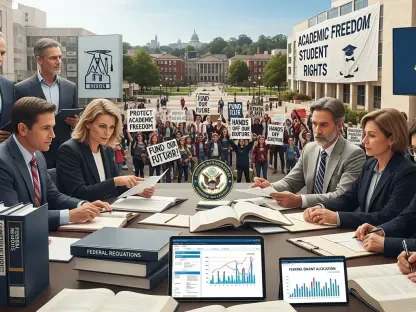

The traditional image of the American university as a self-governing bastion of academic freedom is rapidly dissolving as state legislatures across the country seize direct control over the ideological boundaries of the modern college classroom. For decades, the university campus was viewed as a sanctuary for unfettered inquiry where the pursuit of truth was guided by scholarly consensus rather than political mandates. However, a new wave of state-level legislation is fundamentally shifting these boundaries, moving the oversight of academic expression from internal faculty committees to the hands of elected officials and politically appointed boards. This trend signifies a transformative era in American education, one where the concept of “intellectual diversity” is being institutionalized through rigorous state oversight.
A primary catalyst for this shift is Indiana’s Senate Enrolled Act 202, a landmark piece of legislation that serves as a blueprint for this burgeoning national movement. The law seeks to ensure that public universities reflect a broader range of ideological perspectives, specifically targeting what proponents describe as a progressive bias in academia. By examining the mechanisms of such mandates, it becomes clear that the trend of legislated intellectual diversity is not merely a debate over syllabus content but a structural overhaul of how faculty are hired, evaluated, and retained. This article explores the legislative drivers of this trend, details the real-world consequences for educators, and evaluates the potential long-term impact on the stability of tenure and the future of institutional autonomy.
The roadmap of this analysis follows the implementation of these new standards from the statehouse to the lecture hall. It will examine how “periodic review” models are replacing traditional lifetime tenure, provide specific accounts of faculty members who have faced sanctions under these new rules, and contrast the arguments of legislative proponents with the warnings of civil liberties experts. Finally, the discussion will project how these policies may trigger a “brain drain” of top-tier talent and redefine the very meaning of diversity within the academic context, moving toward a future defined by political accountability and frequent legal challenges.
The Rise of Legislative Oversight in Academic Settings
Data and Global Adoption Trends
As the calendar moves through 2026, the movement toward legislative intervention in higher education has reached an unprecedented scale. Indiana’s SB 202 is no longer an isolated experiment but part of a robust national trend where approximately 93 bills aimed at restricting or redirecting higher education instruction were introduced across 32 states this year alone. This surge reflects a coordinated effort to reshape public institutions, with currently 23 states having passed laws that directly impact classroom teaching. These legislative actions now affect over 50 percent of the college student population in the United States, suggesting that the era of institutional self-regulation is being replaced by a model of public accountability enforced by state statutes.
The most significant structural change within this trend is the fundamental shift in the nature of academic tenure. Historically, tenure functioned as a shield that allowed researchers to pursue unpopular or controversial ideas without fear of termination. However, the current trend represents a marked departure from “lifetime” tenure toward “periodic review” models. In Indiana, for example, the state now mandates comprehensive faculty evaluations every five years specifically to measure “intellectual diversity” contributions. This means that a professor’s job security is no longer based solely on research output or teaching excellence, but on their ability to prove to a governing board that they have fostered an environment where varied political viewpoints, including conservative ones, are given sufficient space.
This legislative oversight also involves the creation of sophisticated reporting mechanisms that allow students to bypass departmental channels and go directly to university administrations or state boards with complaints about ideological bias. These systems are designed to capture instances where a professor may have introduced personal political opinions that are deemed irrelevant to the curriculum. As these data points accumulate, they form the basis for the new five-year review cycle, making the classroom a space that is constantly monitored for compliance with state-defined standards of neutrality.
Real-World Applications and Institutional Impact
The practical application of these laws has already led to significant disciplinary actions that serve as a warning to faculty members across the country. At Indiana University Bloomington, a formal reprimand was recently issued to Benjamin Robinson, a professor in the Department of Germanic Studies. The sanction followed a student complaint alleging that Robinson’s personal political anecdotes regarding his own arrests during protests were irrelevant to the course material. While Robinson argued that these anecdotes were pedagogically linked to the philosophical concepts of the “prisoner’s dilemma” and state authority, the university administration concluded that the focus had shifted too far from the established curriculum, thereby violating the neutrality requirements of SB 202.
Beyond formal reprimands, the trend has introduced new forms of administrative oversight that critics argue undermine the authority of the instructor. For instance, lecturer Jessica Adams was placed under “administrative monitoring” following a grievance over a graphic used in her classroom. This practice involves having a designated observer or “babysitter” present during lectures to ensure that the content remains ideologically neutral and does not cause undue discomfort to students based on their political affiliations. This level of scrutiny represents a significant departure from traditional academic norms, where the classroom was considered the private domain of the professor and their students.
This environment has created what many educators describe as a profound “chilling effect” across various disciplines. Former student media director Jim Rodenbush noted that the discourse on campus has become “frozen,” with faculty increasingly avoiding “hot-button” topics to mitigate the risk of litigation or disciplinary action. In fields like journalism, sociology, and political science, where current events are often central to the curriculum, the fear of being reported for a perceived lack of balance has led to a more sterilized and cautious approach to teaching. This trend suggests that the goal of “viewpoint diversity” may, in practice, lead to a reduction in the depth of classroom debate as instructors seek the safety of the middle ground.
Industry Perspectives: Proponents vs. Academic Freedom Advocates
The Legislative Rationale
The driving force behind laws like SB 202 is the belief that public universities have become ideological monoliths that alienate a significant portion of the taxpayers who fund them. State Senator Spencer Deery, the primary author of the Indiana legislation, argues that these laws serve as a necessary “corrective” for partisan blind spots that have historically marginalized conservative viewpoints. From this perspective, the university is not an island of absolute autonomy but a public trust that must remain accountable to the diverse citizens of the state. Proponents assert that by institutionalizing intellectual diversity, they are actually protecting free speech by ensuring that students are exposed to a full spectrum of ideas rather than a single dominant narrative.
Furthermore, proponents argue that the legislation is intended to protect students from “indoctrination” by maintaining a clear boundary between academic instruction and personal political activism. Senator Deery has emphasized that the law does not prohibit professors from holding personal views, but rather requires that those views do not overshadow the educational objectives of the course. By requiring periodic reviews and providing a grievance process, the state aims to create a “marketplace of ideas” where conservative, moderate, and liberal perspectives are all treated with equal academic rigor. This rationale views the state as a neutral arbiter ensuring that public funds are used to support a truly inclusive intellectual environment.
The Academic Critique
In contrast, organizations such as PEN America and the American Association of University Professors (AAUP) view these legislative mandates as a “minefield” that threatens the very foundation of higher education. They argue that “diversity” is being weaponized to allow student discomfort to dictate pedagogical choices, effectively giving the state the power to censor ideas that do not align with the prevailing political winds. Critics suggest that the requirement for “ideological balance” is often a subjective standard that can be used to force the inclusion of scientifically or historically discredited theories under the guise of fairness.
The academic community is particularly concerned that these laws undermine the expertise of the faculty. By allowing students or political appointees to judge the “relevance” of classroom discussions, the state is encroaching on the professional judgment of scholars who have spent decades mastering their fields. Academic freedom advocates warn that if a professor must constantly worry about how a specific lesson plan will be perceived by a state-mandated review board, the quality of education will inevitably suffer. They contend that true intellectual diversity arises naturally through the rigorous exchange of ideas among experts, not through the imposition of bureaucratic quotas for political viewpoints.
Institutional Rankings
The impact of these legislative frameworks is also reflected in the changing landscape of national institutional rankings. The Foundation for Individual Rights and Expression (FIRE), an organization that tracks campus free speech, recently ranked Indiana University near the bottom of its College Free Speech Rankings. This low ranking was attributed specifically to the restrictive environment created by the new legislative mandates and the university’s response to faculty expression. Such rankings serve as a metric for the reputational damage that institutions may face when they are perceived as being under the thumb of state politics rather than the principles of academic inquiry.
These rankings influence not only public perception but also the decisions of prospective students and donors. As universities are forced to choose between compliance with state law and the maintenance of their traditional academic values, they risk losing the prestige that comes with being a “world-class” institution. The tension between political accountability and academic reputation is a central theme of this trend, with many institutions finding themselves in a precarious position as they attempt to satisfy both state lawmakers and the broader scholarly community.
Future Implications: The Evolving Landscape of Higher Ed
The Erosion of Tenure
The most enduring consequence of the trend toward legislated intellectual diversity will likely be the permanent erosion of the traditional tenure system. As more states adopt five-year review cycles based on political neutrality, the concept of tenure as a lifetime guarantee of employment is transitioning into a series of renewable, high-stakes contracts. This shift changes the psychological and professional landscape for faculty members, who may now prioritize job security over the pursuit of risky or groundbreaking research. In this new era, the “safe” academic is one who avoids controversy and adheres strictly to the state-mandated curriculum, a reality that could stifle innovation in the humanities and social sciences.
This transition also places immense power in the hands of university governing boards, which are often composed of political appointees. If tenure is subject to the approval of these boards every five years, the university effectively becomes an extension of the state’s political apparatus. This could lead to a system where the “correct” ideological contributions are rewarded with contract renewals, while dissenting or unpopular voices are gradually phased out under the guise of maintaining balance. The long-term result would be a more homogenous academic environment, the exact opposite of the “diversity” the legislation claims to promote.
Recruitment and Retention Challenges
A primary negative outcome of this legislative trend is the potential for a significant “brain drain” from states that have adopted these restrictive standards. Top-tier researchers and educators, particularly those in high-demand fields, are increasingly likely to migrate to private institutions or states that maintain traditional protections for academic freedom. When recruitment becomes a challenge, the overall quality of public higher education in “legislated diversity” states will inevitably decline. Universities may find themselves unable to attract the best talent if prospective faculty members view the environment as overly litigious or ideologically constrained.
Moreover, the retention of existing faculty becomes difficult when the professional atmosphere is defined by surveillance and the threat of sanctions. Junior faculty members, in particular, may choose to establish their careers in more stable environments where their professional advancement is not tied to political metrics. This migration of talent creates a stratified educational system where elite private colleges remain centers of free inquiry, while public state universities become increasingly focused on vocational training and state-sanctioned discourse.
The Redefinition of “Diversity”
This trend signals a broader move away from traditional Diversity, Equity, and Inclusion (DEI) frameworks toward a new model of “viewpoint diversity.” While DEI programs focused on historical underrepresentation and social equity, the new legislated diversity focuses on political and ideological balance. This shift could lead to the mandatory inclusion of “both sides” in scientific or historical debates where a scholarly consensus already exists. For example, history departments might be pressured to provide “balanced” views on settled historical events, or science departments might be asked to include non-scientific perspectives in the name of ideological variety.
The redefinition of diversity in these terms poses a challenge to the integrity of academic disciplines. It suggests that all viewpoints are equally valid within the classroom, regardless of their scholarly merit or evidentiary support. This trend threatens to blur the line between academic debate and political opinion, potentially confusing students about the nature of expertise and the methods of scientific inquiry. As universities adapt to these new definitions, the curriculum may become a patchwork of competing ideologies rather than a cohesive body of knowledge.
Legal Thresholds
The future of this trend will ultimately be shaped by the legal thresholds established through First Amendment litigation. As faculty members challenge their reprimands and dismissals in court, judges will be forced to decide the extent to which a state government has the right to manage the specific “pedagogical boundaries” of a public university professor. These court cases will determine whether the classroom is a public forum where the state can mandate content or a specialized space protected by professional norms of academic freedom.
Expect an increase in litigation as both proponents and opponents of these laws seek to establish clear precedents. These legal battles will likely reach the highest levels of the judiciary, with far-reaching implications for the relationship between the state and the university. If the courts side with the state’s right to oversee curriculum and tenure, the traditional model of the American university will be fundamentally and perhaps permanently altered. Conversely, if the courts reaffirm the principle of academic autonomy, state legislatures may be forced to find more indirect ways of influencing higher education.
Navigating the New Academic Frontier
The movement toward legislated intellectual diversity has transitioned from a series of theoretical debates into a functional and often disruptive reality for American higher education. The findings of this analysis show that the implementation of mandates like Indiana’s SB 202 has resulted in the creation of formal reporting systems, the introduction of mandatory periodic tenure reviews, and direct disciplinary actions against faculty members. These changes have created a highly pressurized environment where the traditional boundaries of the classroom are being redrawn by legislative hands. What was once a matter of departmental policy has now become a point of state law, with significant consequences for those who fail to comply with the new standards of ideological balance.
The conflict between taxpayer accountability and academic autonomy represents a fragile balance that is becoming increasingly difficult to maintain. While state lawmakers argued that they were merely holding public institutions to the standards of the citizens who fund them, the resulting atmosphere of surveillance and self-censorship suggested that the cost of such accountability was the very freedom of inquiry that defined a world-class education. The shift from “lifetime” tenure to renewable contracts based on political metrics was perhaps the most drastic change, signaling a future where the stability of the academic profession is tied to the shifting priorities of state government. This shift posed a direct threat to the ability of universities to serve as independent centers of critique and discovery.
As the trend gains momentum across the country, the future of higher education was left at a critical crossroads. The recruitment of top-tier talent and the preservation of institutional rankings became secondary to the demands of political compliance, leading to a potential stratification of the American educational system. The actionable lesson for the future was that true ideological variety could not be easily legislated without risking the integrity of academic expertise. Moving forward, the survival of the university as a space for genuine intellectual exploration will depend on whether institutions can develop new ways to foster diverse perspectives internally, thereby proving to the public—and the state—that they are capable of self-regulation without the need for external mandates.