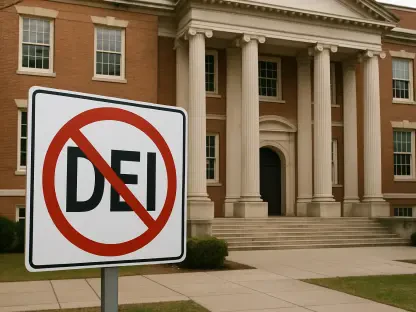

A single legal memorandum from the Department of Justice has quietly initiated a sweeping overhaul of federal education policy, threatening to dismantle decades of financial support for minority-serving institutions across the nation. This pivotal moment extends the Supreme Court’s 2023 ban on affirmative action in college admissions into the vast and complex world of federal funding. The significance of this trend cannot be overstated, as it places billions of dollars in educational grants and long-standing policies designed to uplift underrepresented students directly in the crosshairs. This analysis will dissect the DOJ’s legal reasoning, identify the specific programs impacted, present the starkly contrasting arguments from supporters and opponents, and explore the uncertain future of educational equity funding in the United States.
The Policy Shift From Affirmative Action to Race-Neutral Criteria
The Data of Disruption Quantifying the Impact on Grant Programs
The scale of this policy disruption is immense, directly impacting a significant portion of federal aid to higher education. The most immediate consequence was the Department of Education’s cancellation of $350 million in discretionary grants for Minority-Serving Institutions (MSIs), an action that preceded the memo’s public release but was rooted in the same legal interpretation. The formal justification arrived in the DOJ’s Office of Legal Counsel memorandum on December 22, 2025, which determined that using race-based eligibility criteria for federal grants is unconstitutional. This finding effectively invalidates the foundational logic of numerous programs designed to address historical inequities.
The DOJ’s guidance creates a clear bifurcation among targeted programs. Several are deemed entirely unconstitutional, including grants for Hispanic-Serving Institutions (HSIs), Predominantly-Black Institutions (PBIs), Alaska Native and Native-Hawaiian-Serving Institutions, and specific career education funds for Native Hawaiians. The memo advises that funding for these programs may be legally repurposed. However, a second category of programs is permitted to continue, provided they pivot to race-neutral criteria. This group includes the Ronald E. McNair Postbaccalaureate Achievement Program and the Minority Science and Engineering Improvement Program, both of which must now be fundamentally restructured to comply with the new legal standard.
Real-World Application How the Ruling Reshapes Higher Education
The theoretical shift in policy is already translating into tangible crises on college campuses. Consider a Hispanic-Serving Institution whose burgeoning STEM programs, which have successfully created pathways for first-generation students into high-demand fields, are heavily reliant on targeted federal grants. Administrators there now face a sudden funding cliff, forcing them to contemplate deep program cuts that could reverse years of progress. This scenario is not hypothetical but an impending reality for hundreds of institutions that built entire academic departments around the promise of this specialized federal support.
Similarly, a Predominantly-Black Institution that has been using formula grants to fund initiatives for low-income Black students must now halt these efforts. A mentorship program proven to boost retention and graduation rates, for example, is now ineligible for the very funding created to support it. This proactive implementation has been championed by the Department of Education, with Education Secretary Linda McMahon affirming the department’s commitment to the new directive. The decision to halt discretionary grants even before the DOJ memo was released signals the administration’s intent to move swiftly, leaving institutions with little time to adapt to the new funding landscape.
The Ideological Divide Perspectives from Key Stakeholders
This policy change has ignited a fierce national debate, exposing the deep ideological fault lines over the government’s role in promoting equity. Representing the administration’s perspective, U.S. Education Secretary Linda McMahon has framed the shift as a necessary course correction toward fairness and impartiality. In a recent statement, she asserted that the move is essential to “put a stop to DEI in government” and ensures that taxpayer funding is allocated based on “merit and fairness,” not race. This view posits that race-based criteria are inherently discriminatory and that a colorblind approach is the only constitutionally sound method for distributing federal resources.
In sharp contrast, opponents argue that this legal interpretation willfully ignores the systemic barriers these programs were designed to overcome. Representative Bobby Scott, the ranking Democrat on the House education committee, condemned the decision as a gross misreading of the Higher Education Act. He argued that programs supporting MSIs are critical tools to combat “intergenerational poverty and systemic racism,” ensuring that students from all backgrounds can access a quality education. From this perspective, abandoning race-conscious funding is not a move toward fairness but a retreat from the nation’s commitment to providing equitable opportunities for historically marginalized communities.
Future Outlook Navigating a Post-Affirmative Action Funding Landscape
The Department of Education now faces the monumental task of overhauling its grant-making processes, a complex undertaking that is almost certain to trigger a wave of legal challenges from affected institutions and advocacy groups. This administrative overhaul will also likely become a flashpoint for congressional debate, as lawmakers grapple with how to legislate funding for disadvantaged students without running afoul of the new constitutional interpretation. The immediate future for these grant programs is one of profound uncertainty, defined by legal battles and political maneuvering.
As institutions and federal agencies adapt, a pivot toward socioeconomic status as the primary proxy for “disadvantaged” funding appears to be the most likely path forward. While seemingly race-neutral, this shift presents its own set of complex challenges. Universities will need to navigate new, potentially cumbersome eligibility rules, and there is no guarantee that socioeconomic criteria alone will effectively reach the same student populations that race-conscious programs were designed to serve. The transition will require significant administrative resources and a fundamental rethinking of how institutions identify and support students in need.
The implications of this trend extend far beyond the Department of Education. This legal framework could easily be applied to other federal agencies and programs that use race-based criteria to address historical inequities in sectors like housing, healthcare, and business development. What begins as a change in education funding could cascade across the federal government, fundamentally altering its approach to civil rights and equity. This move represents a potential paradigm shift in how the nation addresses its history of systemic inequality.
Conclusion The Crossroads of Equity and Law
The Department of Justice’s landmark decision has placed American education policy at a critical crossroads where legal interpretation and the pursuit of equity collide. At present, billions of dollars in grants are in jeopardy, threatening the stability of hundreds of minority-serving institutions that are vital engines of social mobility. The starkly opposing views on this issue, one championing race-neutral merit and the other defending targeted support as a remedy for systemic inequality, define the national conversation. For the institutions and the students they serve, the path forward remains clouded by legal and financial uncertainty.
This trend marks a defining moment, one whose consequences will reverberate for years to come, profoundly shaping student diversity, institutional vitality, and the federal government’s role in fostering an inclusive society. The decision forces a national reckoning with how to balance constitutional principles of equal protection with the moral and economic imperative of addressing historical disadvantage. It is a challenge that goes to the heart of America’s promise of opportunity.
Ultimately, this new landscape demands innovation and resilience. Policymakers, philanthropic organizations, and educational leaders are now called upon to develop new, legally sound strategies to support students from all backgrounds. The goal of ensuring that every student has the chance to succeed cannot be abandoned; instead, it must be pursued with renewed creativity and an unwavering commitment to finding pathways to opportunity that are both effective and enduring.