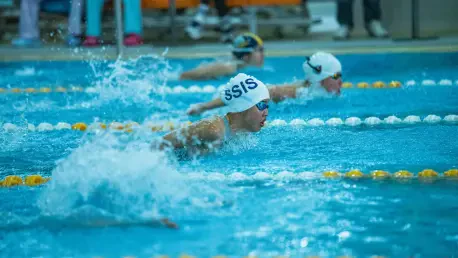

The West Virginia North Region big school swimming meet, hosted at The Bridge Sports Complex in Bridgeport, evolved into far more than a simple qualifying event; it became a profound demonstration of athletic perseverance against a backdrop of unforeseen challenges. Student-athletes from across the region converged not only to compete for a coveted spot in the state championships in Morgantown but also to navigate the complexities of a newly instituted classification system and contend with a significant, weather-induced delay that dramatically altered their preparation schedules. This confluence of factors transformed the high-stakes meet into a crucible, testing the swimmers’ physical endurance, mental toughness, and adaptability in ways that a standard competition rarely does. Their subsequent success in qualifying was a direct reflection of their dedication and ability to perform under immense pressure, setting a compelling stage for the upcoming state finals where their resilience will be put to the ultimate test against the state’s best.
Navigating New Challenges
The Pressure of the Clock
The most immediate and disruptive challenge faced by the competitors was the week-long postponement of the meet due to a significant snowstorm. While a delay might seem like a minor inconvenience, it created a stark and consequential disparity in preparation time between the North and South Divisions. Athletes from the South, whose regional meet proceeded as scheduled, benefited from a comfortable eleven-day period dedicated to recovery, focused training, and strategic tapering ahead of the state championships. In stark contrast, the swimmers who qualified from the North Division were thrust into a grueling, compressed four-day turnaround. This drastically shortened window for rest and refinement places an enormous physical and mental burden on the athletes. It forces them and their coaches to make critical decisions about prioritizing recovery over last-minute training, all while managing the psychological stress of an abbreviated preparation timeline. The situation introduced an unpredictable variable that could significantly influence endurance and peak performance at the state level.
This uneven playing field created by the weather delay extends beyond simple rest, impacting every facet of an athlete’s final preparations for the season’s most important competition. The art of tapering—the strategic reduction of workout intensity to ensure a swimmer is at their physical peak for a championship meet—was severely compromised for the North Division qualifiers. Coaches had to scramble to adjust meticulously planned schedules, balancing the need for final technical refinements with the more urgent demand for physical recovery. This scenario tests not just the swimmers’ raw talent and conditioning but also their mental fortitude and ability to adapt to last-minute changes. For many, the a compressed timeline meant entering the state meet with less-than-ideal preparation, relying more heavily on their season-long training and competitive grit. The potential impact of this disparity adds a layer of intrigue to the state championships, as the North’s best will have to prove they can overcome this significant logistical disadvantage to compete with their well-rested southern counterparts.
A Revamped Competitive Landscape
This competitive season was also defined by a structural evolution in West Virginia high school swimming, marked by the introduction of a new two-tiered classification system. Following a model already successfully implemented in sports like track and field, schools are now divided into “big-school” and “small-school” categories. The primary objective of this restructuring is to foster a more equitable competitive environment across the state. In the past, smaller schools with limited resources and smaller teams often struggled to compete against larger, more established programs. This new system is designed to level the playing field, creating more meaningful championship pathways and allowing a wider range of athletes to experience success at the highest levels. By grouping schools of similar size, the West Virginia Secondary Schools Activities Commission (WVSSAC) aims to encourage greater participation and ensure that team championships are contested by programs with comparable athletic populations, making the competition more balanced and rewarding for all involved.
Complementing the new classification system was a comprehensive overhaul of the state qualification process itself, moving away from a purely time-based system to one that emphasizes regional performance. Previously, the top twelve finishers in each event at the regional meets, supplemented by the next twelve fastest times from across the state, advanced to the championships. Under the new format, the state is geographically divided into North and South divisions for each classification. The top four finishers in every individual and relay event from each of these divisional meets now earn an automatic berth at the state meet. The remaining eight spots in each event are then filled by the next fastest times from across the state, regardless of region. This hybrid approach guarantees broad geographic representation at the state championships while still rewarding exceptional speed. It provides swimmers with a clearer and more direct path to qualification, placing a premium on head-to-head racing at the regional level and reducing the uncertainty of waiting for statewide time comparisons.
Ohio Valley Schools Shine Amidst Stiff Competition
Team Standings and Regional Powerhouses
The intense team competition at the North Region meet saw the host, Bridgeport High School, leverage its home-pool advantage to secure the boys’ regional championship, while the formidable Washington High School team from Jefferson County captured the girls’ title. Morgantown High School showcased the impressive depth of its program by earning the runner-up trophy in both the boys’ and girls’ divisions, establishing itself as a major force heading into the state finals. Among the schools from the Ohio Valley, the girls’ teams delivered strong collective performances. The John Marshall High School girls, the defending big school state champions, led the local contingent with a solid fifth-place finish. They were closely followed by Brooke High School, which claimed sixth place, and Wheeling Park High School, which rounded out a competitive showing by placing seventh. On the boys’ side, John Marshall also set the pace for the area, achieving an impressive fourth-place team finish, while Wheeling Park’s boys’ squad battled to a respectable seventh place in a deep and talented field.
These team results underscored the competitive balance within the region and highlighted the consistent strength of programs from the Ohio Valley. While Bridgeport and Washington claimed the top honors, the close placements of John Marshall, Brooke, and Wheeling Park demonstrated their ability to compete at a high level. For John Marshall, the girls’ fifth-place and boys’ fourth-place finishes signaled that both squads possess the depth needed to be factors at the state championships. The performance of the girls’ team, in particular, served as a strong statement that they are prepared to defend their state title against formidable challengers. Brooke and Wheeling Park also proved their mettle, with their top-seven finishes indicating well-rounded teams capable of scoring points across multiple events. The collective success of these Ohio Valley schools not only reflects the hard work of the athletes and coaches but also speaks to the robust health of the swimming community in the region, which consistently produces high-caliber talent ready to compete on the state’s biggest stage.
Dominant Performances from Local Girls
The meet was illuminated by a series of exceptional individual and relay performances from local female swimmers, many of whom secured high seeds for the state championships. The John Marshall Monarchs’ girls’ team, aiming to defend its state title, demonstrated its formidable relay strength. The 200-freestyle relay team, a powerful combination of Ella Finley, Seanna Leyland, Savannah Potts, and Zoe Zervos, blazed to a second-place finish with a time of 1:48.51. Zervos was also a standout in her individual events, showcasing her versatility by earning a runner-up spot in the fiercely contested 50-yard freestyle (26.09) and securing third place in the 100-yard freestyle (58.09). The Monarchs’ 200-medley relay squad, featuring Adah Aubrey, Sarah Hess, Seanna Leyland, and Zoe Zervos, also reached the podium with a strong third-place time of 2:01.02. Wheeling Park’s efforts were spearheaded by senior Molly George, who delivered two masterful runner-up performances, touching second in the 100-yard backstroke (59.28) and the 100-yard freestyle (56.52).
The depth of talent from the Ohio Valley extended to other local programs as well, with Brooke High School’s girls making a significant impact. Lindsey Kettler emerged as one of the meet’s top swimmers, battling to impressive second-place finishes in two demanding events: the 200-yard freestyle (2:04.61) and the 100-yard butterfly (1:04.55). Her teammate, Kiersten Harvath, proved her endurance prowess with a hard-fought third-place finish in the grueling 500-yard freestyle, clocking in at 5:43.68. The Bruins capped off their successful meet on a high note, as their 400-freestyle relay team—composed of Kettler, Ivy Myers, Harvath, and Faith Farrell—claimed a runner-up spot with a time of 3:59.18. Wheeling Park’s overall team depth was also on full display, as all three of its girls’ relay teams finished in the top six, a crucial achievement that ensured their qualification for the state meet. These powerful swims from John Marshall, Wheeling Park, and Brooke athletes set the stage for an exciting showing at the state level.
Boys Punch Their Tickets to State
On the boys’ side of the competition, athletes from the Ohio Valley delivered equally compelling performances, particularly in the relay events where teamwork and precision are paramount. The John Marshall Monarchs continued their successful day, with the 200-medley relay team of Evan Harrison, Wyatt Jefferson, Dalton Brown, and Brodie Baker powering to a second-place finish in a swift 1:43.75. This same quartet demonstrated their consistent speed and chemistry by also claiming third place in the 200-freestyle relay with a time of 1:34.28. Individually, Wyatt Jefferson established himself as a dominant force in the pool. He captured the regional title in the 100-yard breaststroke, winning with an impressive time of 1:00.89, and also showed his all-around skill by placing third in the 200-yard individual medley (2:07.96). Teammate Dalton Brown made significant contributions to the team’s point total with a third-place finish in the 100-yard butterfly (55.65) and a gritty fourth-place result in the demanding 500-yard freestyle (5:13.19).
The successful outings were not limited to a single school, as Wheeling Park’s boys’ team also put together a strong regional performance that resulted in a large contingent advancing to the state championships. The Patriots showcased their program’s depth by successfully qualifying all three of their relay teams, a critical achievement for scoring significant points at the state level. In addition to the relays, a large group of individual swimmers from Wheeling Park punched their tickets to Morgantown, ensuring the team will be well-represented across a wide range of events. This widespread success from both John Marshall and Wheeling Park, along with qualifiers from Brooke High School, culminated in a substantial list of state-bound athletes from the Ohio Valley. The impressive results from swimmers like Brady Bowie, Jacob Walters, Evan Harrison, and Ryan Kettler, among many others, reflected the region’s strong swimming talent and set the stage for what promised to be a highly competitive and exciting state championship meet.