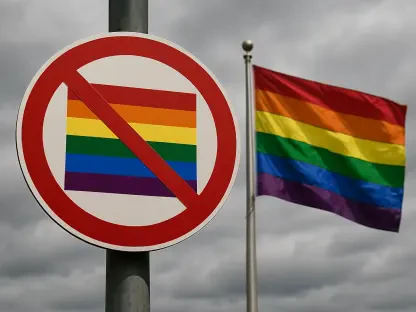

With the Supreme Court poised to rule on two landmark cases, the future of Title IX and the rights of transgender students hang in the balance. We are joined by Camille Faivre, an education management expert who helps institutions navigate the complex and often fraught intersection of federal law and student life. Today, we’ll delve into the nuances of these cases, exploring how the Court might distinguish between a K-12 student and a college athlete, the chaos created for schools by inconsistent federal policies, and the towering precedent of the Bostock decision. We will also examine how a ruling could ripple far beyond the sports field, potentially reshaping school policies on everything from restroom access to locker room use, all while being viewed through the dual lenses of Title IX and the 14th Amendment.
The Supreme Court is reviewing two distinct cases: one involving a K-12 student who has received puberty blockers and hormone therapy, and another concerning a college athlete. How might these different factual scenarios influence the legal arguments presented for each case under Title IX?
The factual differences here are incredibly significant and create two very different emotional and legal narratives. In the B.P.J. case, you have a child who has identified as a girl since the third grade and, with medical support, took medication to block male puberty before starting hormone therapy. This case is about an 11-year-old wanting to run cross-country with her friends in middle school, a setting where the focus is often on participation and development. The legal argument can be powerfully framed around the personal journey of a child and the importance of social inclusion during formative years. On the other hand, the Hecox case involves a college athlete at Boise State University, where the stakes of competition are higher, involving NCAA regulations. While the injunction has allowed Lindsay Hecox to participate in club sports, the case originated from her desire to try out for official collegiate teams, which brings up more pointed arguments about competitive fairness that resonate differently than a middle school context.
Federal guidance on this issue has shifted dramatically between administrations, creating a patchwork of policies for schools. How does this inconsistency affect districts trying to create stable, long-term policies, and what kind of legal clarity are they hoping the Court will provide?
It creates a state of near-paralysis for school administrators. They are caught in a political whiplash that makes long-term planning almost impossible. You had the Biden administration in 2023 proposing a nuanced framework that would have prohibited categorical bans like West Virginia’s, suggesting criteria based on grade level and sport. This was a complex but workable middle-ground approach. Then you have the Trump administration, which not only advocated for complete bans but actively threatened to pull federal funding from non-compliant districts and referred states like California and Maine to the Department of Justice. For a principal or a school board, this isn’t an abstract debate; it’s a terrifying tightrope walk between state law, shifting federal mandates, and the threat of devastating lawsuits or financial penalties. They are desperately hoping for a clear, decisive ruling from the Court that provides a stable legal foundation, regardless of who is in the Oval Office, so they can create policies that serve students without fearing their world will be upended every four years.
In 2020, the Bostock decision protected LGBTQ+ individuals from employment discrimination. To what extent do you expect that precedent to influence this ruling on student athletes, and what are the key legal arguments for either extending or distinguishing Bostock in an educational setting?
The shadow of the 2020 Bostock decision looms incredibly large over these cases; it’s the legal precedent everyone has been watching. The argument for extending its logic to schools is quite direct: Bostock determined that discriminating against someone for being gay or transgender is inherently a form of discrimination “because of sex.” Since Title IX uses that same crucial language to prohibit sex discrimination in education, it feels like a natural extension. However, the arguments for distinguishing it will be just as forceful. Opponents will claim that while the principle might apply to a workplace, school athletics are a unique environment where physical separation based on sex has been a long-standing practice designed to ensure fair competition for students assigned female at birth. They will argue this specific context was not what the Court was considering in an employment case, creating a potential exception to the Bostock framework. The central question for the justices is whether the logic of Bostock is a universal principle of civil rights law or if school sports are a carve-out with their own set of rules.
A ruling on athletic participation could have significant consequences beyond the sports field. Could you walk me through how a decision might create a ripple effect, shaping school policies on other gender-identity issues like restroom access or locker room use?
Absolutely. While the headlines are all about sports, the core legal question is much broader: does “sex” under Title IX include gender identity? If the Court affirms that it does, establishing that transgender students are a protected class, it would send a powerful signal to every school district in the country. It would become legally very difficult to justify a policy that allows a transgender girl on the cross-country team but then denies her access to the girls’ locker room or restroom. The legal foundation for such exclusionary policies would crumble. Conversely, if the Court rules that Title IX requires the exclusion of transgender students from sports to protect cisgender girls, that same logic could easily be weaponized to justify segregation in other school facilities. This ruling won’t just decide who gets to play; it will define the fundamental right of transgender students to exist and participate fully in public education.
These cases will be examined not only under Title IX but also through the lens of the 14th Amendment’s equal protection clause. How does this second legal framework change the nature of the arguments, and what could a ruling based on equal protection mean for state-level bans?
Bringing in the 14th Amendment elevates the argument from one of statutory interpretation to a fundamental constitutional question. Title IX is about whether an institution receiving federal funds is discriminating based on sex. The Equal Protection Clause of the 14th Amendment is more profound; it states that the government itself cannot deny people equal protection under the law. An argument on these grounds would claim that a state law, like the ones in Idaho and West Virginia, creates an inherently unequal system by targeting a specific class of people for different treatment. A ruling based purely on Title IX could be modified by future acts of Congress, but a ruling based on the 14th Amendment would establish a constitutional right. This would be a much stronger and more permanent protection, potentially striking down all similar state-level bans as unconstitutional, regardless of the specifics of federal education law.
What is your forecast for how the Supreme Court’s decision will shape the landscape of Title IX and student rights over the next decade?
This decision will be a watershed moment that sets the course for a generation. If the Court issues a broad ruling in favor of the students, affirming that Title IX and the 14th Amendment protect transgender youth, we will see a rapid dismantling of the 20-plus state laws that currently restrict participation. This would create a unified national standard and solidify a more inclusive interpretation of civil rights in education. However, if the Court rules against the students or issues a very narrow, fractured opinion, it will likely embolden more states to pass even more restrictive laws, not just in sports but in other areas of school life. This would deepen the already stark divide between states, creating a chaotic and unequal landscape where a student’s right to participate in school fully depends entirely on their zip code. The outcome will echo for years, defining not just the rules of the game, but the very meaning of equality in our nation’s schools.