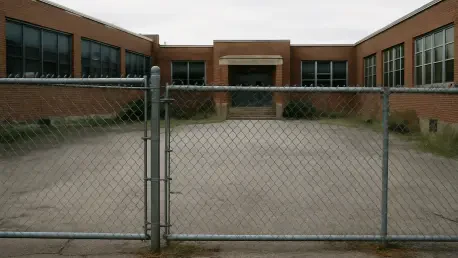

The Olathe Public Schools district is preparing for a significant transformation driven by demographic shifts that reflect a broader national trend, grappling with the challenge of declining student enrollment that has necessitated a comprehensive plan to close an undetermined number of schools. After reaching a peak of 30,216 students in 2019, the district’s population has fallen to 28,140 and is projected to dip below 26,000 within the next 15 years. District officials have identified a combination of factors contributing to this decline, including slowing birth rates, escalating housing costs that make the area less accessible for young families, and a generally aging population. In response to these pressing realities, district leadership has initiated a multi-phase strategy not only to identify which schools will be consolidated but also to redraw the very boundaries that define its educational communities, a process that promises to reshape the district for years to come. This move follows the recent decision to close Westview Elementary, a precursor to the larger-scale adjustments now on the horizon.
1. A Deliberate and Phased Approach
The first stage of the district’s comprehensive strategy centers on the formation of a “Student Enrollment Facility Alignment Task Force,” a body designed to ensure broad community and staff representation in the initial decision-making process. This task force will be meticulously assembled, comprising one parent and one staff member from every school within the district. They will be joined by several school principals, key district leaders, and potentially representatives from the city and the Olathe Chamber of Commerce, ensuring that diverse perspectives are considered. To guide their analysis, an external consultant will be brought in to provide objective expertise and facilitate discussions. The task force is scheduled for three intensive meetings throughout April and May, during which members will delve into critical data sets covering student enrollment trends, detailed financial information, and various geographic considerations. The culmination of this phase will occur at the June school board meeting, where the task force will present a crucial recommendation: a proposed range for the number of schools the district should close to align its physical footprint with its current and projected student population.
Following the initial analysis, a more focused 15-person steering committee will be established to undertake the second phase of the consolidation plan. This group is tasked with a deeper, more granular examination of specific schools, particularly those that are significantly under-enrolled. Deputy Superintendent of Organizational Operations, Jim McMullen, illustrated the issue by describing scenarios where a cluster of four elementary schools, once serving 500 to 800 students each, now operates with enrollments hovering around 300 to 350. The committee’s evaluation will be multifaceted, extending beyond mere student numbers. McMullen emphasized that the final recommendations will heavily weigh what makes the most sense geographically, considering factors like transportation efficiency, community cohesion, and the strategic location of facilities. The committee’s work will progress through the summer, with a target of presenting a formal list of recommended school closures and a potential timeline to the board in September. This will lead to a pivotal board vote in October, which, if passed, would set in motion a transition period expected to unfold over the next two to three school years.
2. Redrawing Boundaries and Repurposing Facilities
Once the board approves specific school closures, the district will enter the third and arguably most complex phase: adjusting school attendance boundaries. This process is designed to be highly interactive, involving a series of community meetings where parents and residents can provide direct feedback on proposed changes. The district will simultaneously analyze demographic and geographic data to create new boundaries that are logical, equitable, and designed to balance enrollment across the remaining schools. According to the current timeline, the board will review the various boundary options presented in December and is scheduled to vote on a final map in January 2027. Following that decision, the district will manage the extensive logistical details, including the delicate process of reassigning staff members and ensuring a smooth transition for students. McMullen also outlined the potential futures for the vacated school buildings, noting that the district has several viable options. “Sometimes those buildings are repurposed internally,” he stated, while other times they “are sold to another entity — could be a church, could be another educational group.”
The district already has a recent and relevant case study for this process in the closure of Westview Elementary. In August, the board voted not only to close the school but also to repurpose its building into an innovative K-8 alternative education program, a unique facility in the region. The decision was prompted by a steep decline in enrollment, with Westview’s student body dropping to just 150 students this school year. For perspective, the district’s next smallest elementary school, Northview, has 199 students, while the largest, Manchester Park, serves 601. In planning the transition, district staff prioritized boundary changes that would keep the entire Westview student population together as they move to Rolling Ridge Elementary next year. The new boundaries were also carefully drawn to preserve the existing middle and high school feeder patterns for these students and to prevent any overcrowding at the receiving schools. This careful handling of the Westview closure serves as a practical model for the broader consolidations ahead, demonstrating a commitment to minimizing disruption while maximizing the use of district assets.
The Community Impact of Reshaping a District
The decisions made by the Olathe Public Schools district represented more than a series of logistical adjustments; they marked a fundamental reimagining of the community’s educational landscape. As Board Member Claire Reagan acknowledged during a recent meeting, this undertaking went far beyond individual school closures. She framed it as a collective “remaking of what our district is going to look like,” a significant “community shift” that would be felt by families across the city. This sentiment was echoed by Deputy Superintendent Jim McMullen, who underscored the financial urgency compelling these actions. He explained that given the enrollment trends and the district’s financial status, the time for decisive action had arrived. The multi-phase plan was therefore initiated as a necessary step to ensure long-term stability and efficiency. The process, from forming a representative task force to carefully redrawing boundaries, was structured to navigate this difficult transition with transparency and thoughtful consideration for the students, staff, and families whose lives would be directly impacted by the changes.