
Imagine a young adult, fresh out of high school, standing at a crossroads with dreams of a bright future but burdened by the looming shadow of student debt before even stepping onto a college campus. This scenario is all too common in today’s economic landscape, where the promise of higher education often comes with a staggering price tag. Real estate mogul Grant Cardone has recently sparked heated debate by calling a college degree a risky financial bet, one that may not pay off for many. His bold critique, shared through social media, challenges the long-held belief that a diploma is the golden ticket to career success. Instead, Cardone points to crushing debt, rising tuition costs, and bleak job prospects for graduates as evidence that the traditional path might be more of a trap than a triumph. This perspective taps into a growing disillusionment with higher education, prompting a deeper look at whether the investment truly matches the return in an era of evolving career options.
The Crushing Weight of Student Debt
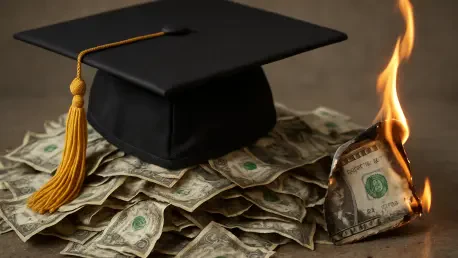
The financial burden of pursuing a college degree has become a national crisis, with student loan debt in the United States sitting at a jaw-dropping $1.7 trillion. Grant Cardone highlights this staggering figure as a central reason to rethink the value of higher education. For many graduates, the debt doesn’t just linger—it grows, thanks to high interest rates that can turn manageable loans into lifelong shackles. Cardone recounts stories of individuals, like a 26-year-old who saw their debt balloon despite consistent payments, illustrating how these funds could have been funneled into more lucrative ventures such as real estate or stock investments. This isn’t just a personal struggle; it’s a systemic issue that ties up money which could otherwise stimulate economic growth through other channels. The sheer scale of this debt forces a hard question: is the pursuit of a degree worth the risk of financial ruin for so many young people starting their lives?
Moreover, the emotional toll of this debt cannot be ignored, as it often delays major life milestones for graduates. Instead of saving for a home, starting a family, or building a nest egg, countless individuals find themselves allocating a significant chunk of their income to loan repayments for years, if not decades. Cardone argues that this opportunity cost is a hidden price of college, one that isn’t discussed enough when students are encouraged to enroll. The dream of a degree often overshadows the reality of monthly statements and compounding interest, leaving many to wonder if they’ve made a grave misstep. In contrast to the marketed image of college as a stepping stone to prosperity, this financial strain paints a far grimmer picture. It’s a cycle that traps graduates in a paradox—educated, yet unable to fully capitalize on their credentials due to the very cost of obtaining them. This perspective fuels the growing skepticism about whether higher education is a sound investment for everyone.
Diminishing Returns in a Changing Job Market
Turning to employment prospects, Cardone’s critique gains further traction when examining the struggles of recent graduates in securing stable jobs. Data reveals that 25.3% of total unemployment in the country includes those with four-year degrees, a statistic that shatters the myth of a degree as a guaranteed job ticket. Since the 2008 Financial Crisis, unemployment among college-educated white-collar workers has doubled, nearing levels seen during the height of the pandemic. Gen Z graduates, in particular, face unemployment rates higher than the national average, exacerbated by a shrinking pool of entry-level positions. Cardone ties this trend to the rise of artificial intelligence and automation, which increasingly replace roles once filled by young professionals. This mismatch between education and market needs raises serious doubts about the relevance of traditional degrees in today’s fast-evolving workforce.
Additionally, the contrast between the struggles of degree-holders and the success of those who opt for alternative paths is striking. Many who skip college and pursue trades or apprenticeships find themselves in demand, often earning competitive salaries without the burden of debt. Cardone points out that this reality challenges the societal bias toward higher education as the only respectable route to success. While a degree might open certain doors, it’s becoming clear that those doors aren’t always leading to prosperity. Instead, the job market seems to reward adaptability and practical skills over formal credentials in many sectors. This shift in dynamics suggests that the value of a college education isn’t universal, and for some, the time and money spent in lecture halls might be better invested elsewhere. It’s a sobering reminder that the landscape of opportunity is changing, often faster than academic institutions can keep up.
Rising Costs Versus Questionable Value
The escalating cost of tuition forms another pillar of Cardone’s argument, as university expenses continue to climb despite growing public skepticism about their worth. Families are forced to make significant sacrifices—forgoing vacations, dipping into savings, or delaying major purchases—just to afford a college education. Yet, the return on this investment remains uncertain, with many graduates unable to land jobs that justify the expense. Cardone questions whether these trade-offs are reasonable, especially when trade schools and vocational programs offer viable, often less costly alternatives with clearer paths to employment. This trend of rising costs against diminishing returns has fueled a broader societal shift, where the automatic assumption that college is the best option is no longer taken at face value. The numbers simply don’t add up for everyone, prompting a reevaluation of priorities.
Furthermore, this financial disconnect is mirrored by a cultural shift, as more people recognize that success doesn’t always require a diploma. Cardone’s perspective aligns with a rising chorus of critics who argue that the opportunity cost of college—both in dollars and years—often outweighs its benefits. The money spent on tuition could be redirected toward building a business, investing in markets, or gaining hands-on experience, all of which might yield quicker, more tangible results. This isn’t to say that higher education lacks value entirely, but rather that its merits should be weighed on a case-by-case basis. As tuition continues to outpace inflation, the gamble becomes riskier, leaving students and parents alike to ponder if the traditional route is still the smartest bet. This growing doubt reflects a deeper reckoning with how society defines and achieves career fulfillment in a modern economy.
Reevaluating the Path to Success
Looking back, Grant Cardone’s sharp critique of higher education as a questionable financial investment struck a chord with many who had felt the weight of student debt and job scarcity firsthand. His arguments, backed by hard numbers like the $1.7 trillion debt crisis and alarming unemployment rates among graduates, painted a vivid picture of a system that often failed to deliver on its promises. This perspective didn’t just challenge individuals to rethink their choices; it spotlighted a systemic issue demanding broader attention. The narrative shifted from blind faith in a degree to a more critical, tailored approach to career planning.
Moving forward, the conversation Cardone ignited suggests a need for actionable alternatives and reforms. Educational institutions might consider aligning curricula more closely with current market demands, while policymakers could explore ways to ease the debt burden through innovative financing models. For students, the takeaway is clear: explore all options, from vocational training to self-directed learning, before committing to a costly degree. This evolving dialogue encourages a future where success is defined not by credentials alone, but by strategic, informed decisions that prioritize long-term financial health and personal goals.