
In a move that sends shockwaves through Florida’s higher education landscape, Governor Ron DeSantis has unveiled a budget proposal that would see the rapidly transforming New College of Florida assume complete control of the University of South Florida’s Sarasota-Manatee campus. The proposal, part of the governor’s recommendations for the 2026-27 fiscal year, represents not just a potential physical expansion for one institution but a major escalation in a statewide campaign to reshape public universities along conservative ideological lines. This plan pits two state-funded schools against each other, setting the stage for a contentious legislative debate over the future of higher learning in the region.
A Calculated Conquest or a Desperate Solution
The proposal presents a striking paradox: New College of Florida, an institution on an aggressive expansion trajectory, currently pays millions to rent dorm rooms from the very USF campus it now seeks to acquire. This arrangement highlights a critical housing crisis at New College, where a surge in enrollment, driven by its new conservative leadership, has outpaced its residential capacity. The governor’s plan offers a direct, if controversial, solution to this logistical problem by handing over USF’s newly built facilities.
This convergence of practical need and ideological ambition forms the core of the takeover proposal. What began as a pressing need for student housing has evolved into a comprehensive plan that could fundamentally alter the educational ecosystem in Sarasota. The move is framed by supporters as a strategic consolidation of resources, but it is viewed by others as an opportunistic conquest that prioritizes one institution’s politically-driven growth at the direct expense of another’s established presence and long-term plans.
The Conservative Remaking of Florida’s Higher Education
This campus transfer is widely seen as a central component of Governor DeSantis’s broader mission to reform the state university system. New College has been cast as the “lynchpin” in this effort, serving as a model for a new vision of public education. The transformation began in earnest in 2023 with the governor’s appointment of a new, conservative-majority board of trustees and the installation of former Republican House Speaker Richard Corcoran as the college’s president.
Under this new leadership, New College has moved swiftly to implement a series of aggressive policy shifts. The administration dismantled all Diversity, Equity, and Inclusion (DEI) programs and eliminated the gender studies department, actions that align with the governor’s statewide campaign against what he terms “woke” ideology in education. Further signaling its ideological alignment, New College became the first U.S. institution to voluntarily support Donald Trump’s proposed higher education compact, a controversial initiative that has been largely rejected by major research universities over concerns about academic freedom and institutional autonomy.
Deconstructing the Proposal A Blueprint for Acquisition
The governor’s budget lays out a detailed blueprint for the acquisition. It mandates that New College would assume control of the entire 32-acre USF Sarasota-Manatee property and its associated financial liabilities by July 2026. In return for the campus, New College would make monthly payments of approximately $166,600 to USF to cover the outstanding debt on the facilities, including a brand-new student center and residence hall.
A critical provision addresses the existing student body, stipulating a “teach-out” period during which current USF Sarasota-Manatee students can complete their degrees. However, the proposal would immediately freeze all new student enrollments at the campus, effectively beginning the phase-out of USF’s presence. The plan also clarifies what is not included in the transfer: USF students, employees, intellectual property, and equipment would remain under USF’s control. A clause allows for future shared-space agreements, but the primary control would shift decisively to New College.
From Whispers to a Wish List Tracing the Takeovers Origins
The idea of New College absorbing its neighbor did not emerge from a vacuum. Earlier this year, public records revealed that New College officials had already drafted a press release outlining a “strategic partnership” to integrate the USF campus. The draft, discovered by WUSF, framed the move as a way to maximize resources and create a “unified, world-class institution,” suggesting that the concept had been under consideration long before its official inclusion in the governor’s budget.
New College President Richard Corcoran has been open about the ideological goals driving the college’s new direction, stating, “We have no affirmative action or DEI, and we have been building a campus where open dialogue and the marketplace of ideas are at the forefront.” This justification stands in contrast to the more measured political reality described by USF leadership. Will Weatherford, chair of the USF Board of Trustees, characterized the governor’s proposal not as a directive but as a “policy matter that is going to be discussed, debated and worked through” by state lawmakers, placing the final decision firmly in the hands of the legislature.
A Tale of Two Trajectories The Stakes for Both Universities
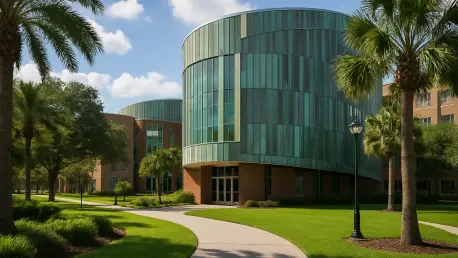
The proposal targets USF Sarasota-Manatee at a pivotal moment in its development. The campus recently celebrated the opening of a 100,000-square-foot student center and its first-ever residence hall, a major milestone in its transition from a commuter school to a more traditional residential campus. This interrupted growth trajectory represents a significant potential loss for USF, which has invested heavily in creating a vibrant, self-contained academic community.
Meanwhile, New College’s own “rapid growth” has created the pragmatic imperative behind the takeover. Its housing shortage has become so acute that it has been forced to spend millions renting not only rooms in the new USF dorm but also in nearby hotels. Acquiring the USF campus would solve this pressing financial and logistical problem overnight. The proposal’s future, however, remains uncertain. It now moves from the governor’s budget recommendation—essentially a legislative wish list—to the floor of the Florida legislature, where it will face intense debate and its ultimate fate will be decided.
The governor’s bold proposal thus laid bare the conflicting trajectories of two state universities, one focused on organic growth and the other on a rapid, politically-charged transformation. The plan, born from a mix of ideological ambition and logistical necessity, placed the fate of the USF Sarasota-Manatee campus into the hands of state legislators. The ensuing debate promised to be a defining moment for the future of public higher education in Florida, with the outcome poised to set a precedent for years to come.