
When the destructive Eaton Fire swept through Altadena, California, it not only scorched the landscape but also threatened to unravel the very social and economic fabric of the community by devastating its child-care sector. In the chaotic aftermath, as families and small business owners grappled with immense loss, the vulnerability of these essential providers came into sharp focus, revealing critical gaps in traditional disaster response. This crisis, however, also became the backdrop for an extraordinary story of resilience, partnership, and the profound impact a mission-driven educational institution can have when it steps up to become a community anchor, chronicling how Pacific Oaks College spearheaded a recovery effort that did more than just rebuild structures—it reaffirmed the vital importance of child care to a thriving society.
An Overlooked Pillar Crumbles
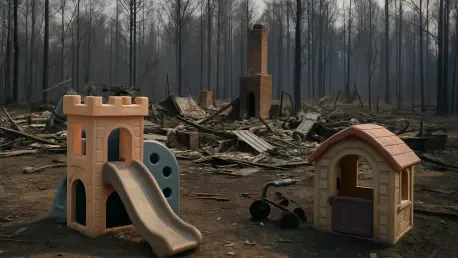
The inferno’s devastating power became a deeply personal nightmare for Alana Lewis, the dedicated founder of Auntie Lana’s Daycare, who watched in disbelief as the flames mercilessly consumed her meticulously crafted outdoor play area. The vibrant space, once filled with the laughter of children, was reduced to a ruin of melted toys and a slide that had dissolved into the artificial turf. While her overwhelming relief was that the fire struck at night, ensuring the children were safe in their homes, the emotional and financial shock was profound. Her experience was a microcosm of the wider catastrophe unfolding across the region, where the very foundation of early childhood care was being threatened by the blaze. The destruction was not just a loss of property; it represented the sudden and violent disruption of a nurturing environment that was central to the lives of many young children and their working parents, leaving a void that seemed impossible to fill in the immediate aftermath of the disaster.
The individual tragedy experienced by Alana Lewis was magnified across the entire community, painting a grim picture of systemic vulnerability. According to a stark assessment by the Pasadena Community Foundation, the Eaton Fire had either damaged or completely destroyed nearly 60 percent of all licensed child-care facilities in Altadena. For Lewis, the destruction of her outdoor space was compounded by severe interior damage from a thick, pervasive layer of soot that rendered her home uninhabitable, forcing her and her family into a prolonged and stressful period of displacement. They spent months living in hotels and with relatives, all while navigating the daunting process of costly repairs and salvaging what little remained of her day-care equipment. This deep disruption to both life and livelihood was a story repeated by dozens of other providers, highlighting the precariousness of these small businesses and the cascading effect their closure had on the local workforce, which depended on them to function.
A Systemic Failure in Disaster Relief
In the critical days following the fire, the initial wave of emergency support offered a fleeting sense of hope that quickly dissolved, proving to be a temporary solution for a long-term, complex problem. While emergency subsidies provided a crucial lifeline for the first 30 days, they masked the true scale of the recovery challenge ahead. Once this initial aid expired, providers were left to navigate a bewildering and under-resourced landscape on their own. Alana Lewis articulated a sentiment echoed by many of her peers, describing a profound feeling of being “abandoned and neglected” as she faced “mounting out-of-pocket costs” with no further assistance in sight. The gap between the immediate response and the sustained support needed for a full recovery became a chasm, revealing a critical flaw in how disaster relief systems perceive and support the child-care sector, which is often overlooked as a foundational piece of economic infrastructure.
The inadequacy of the initial response pushed many providers to the brink of financial collapse, exposing the systemic failure to support this vital sector. With their primary source of income gone, many found it impossible to cover basic operational costs like rent, let alone the staggering expenses of rebuilding. When they turned to traditional financial institutions for help, their attempts to secure small business loans were frequently denied, as their business models did not fit the conventional criteria lenders looked for. This series of rejections underscored a broader, more troubling issue: the economic contributions of child-care providers are consistently undervalued. The crisis laid bare the reality that without these caregivers, countless parents cannot go to work, yet in a moment of extreme vulnerability, the systems designed to bolster the economy failed to recognize and support them, leaving them isolated and without a viable path forward.
An Unlikely Hero Steps In
Just as hope began to fade for many, relief emerged from a source deeply embedded within the community’s educational landscape: Pacific Oaks College. A substantial grant of $45,000 from the college provided Alana Lewis with the critical funding needed to complete repairs, replace materials, and finally reopen her doors in July. Her story, however, was just one facet of a much larger, strategically coordinated recovery initiative. In a powerful collaboration with the Pasadena Community Foundation and the national nonprofit Save the Children, Pacific Oaks College successfully spearheaded a campaign that raised and distributed approximately $2 million. This fund was meticulously allocated to 43 fire-affected child-care sites, with grants ranging from $900 to $45,000, each tailored to address the unique needs of the provider, from rebuilding facilities to covering lost income and ensuring they could continue to serve their communities.
The driving force behind this remarkable intervention was Breeda McGrath, the president of Pacific Oaks College, who viewed the response not as an act of charity but as a direct fulfillment of the institution’s core identity and historical mission. Founded as a progressive preschool in the 1940s, the college evolved into a leading institution for early childhood education, with a foundational commitment to social justice, equity, and diversity. McGrath drew a direct line from this history to the present crisis, stating, “if we are not at the table to help rebuild and sustain early childhood education in our area, then we’re forgetting who we are.” This philosophy fueled a swift and effective fundraising effort. A formal proposal to the Pasadena Community Foundation was approved within two days, and McGrath quickly secured additional significant funding from Save the Children, demonstrating a multi-pronged approach to resource mobilization rooted in a deep understanding of the college’s role as a community steward.
More Than Money A Community Anchor
The college’s invaluable contribution extended far beyond writing checks, demonstrating a holistic and hands-on commitment to the recovery process. In the immediate, chaotic aftermath of the fire, Pacific Oaks transformed its campus into a vital distribution hub for essential supplies. It became a central point where providers could access critical items like air purifiers and diapers, a service that was reportedly more accessible and tailored to their specific needs than the main coordination site at the Pasadena Convention Center. Furthermore, the college deployed what President McGrath termed its “human power.” Staff members and students—many of whom were training to become the next generation of early childhood educators—volunteered their time and expertise, assisting with everything from cleanup to resource coordination. This direct involvement underscored a philosophy of making a “long-term investment” in the community, leveraging not just financial resources but also institutional knowledge and a dedicated workforce to foster genuine, sustainable recovery.
The successful intervention by Pacific Oaks College ultimately did more than rebuild damaged facilities; it brought the essential, yet often invisible, role of child-care providers into sharp focus for the entire community. Both providers like Alana Lewis and leaders like Breeda McGrath powerfully articulated how these caregivers serve as anchors of stability, enabling parents to work and study while nurturing the community’s youngest members. The fire, and the subsequent recovery, laid bare the fact that the loss of a child-care provider is a destabilizing event with repercussions that ripple through the local economy and erode social cohesion. The experience forged a new understanding and created a powerful model for the future. It demonstrated how community-focused institutions could step in to fill critical gaps in disaster planning and champion the needs of a vital but vulnerable sector, ensuring that child-care providers were rightfully recognized and brought “to the table” in all future recovery efforts.