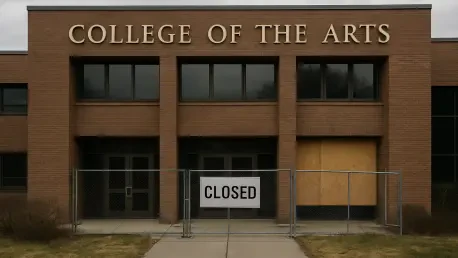

With the recent announcement that the 120-year-old California College of the Arts will close, the landscape of American higher education has been shaken once again. To understand the complex forces at play, we spoke with Camille Faivre, an education management expert who specializes in institutional strategy and sustainability. Our conversation explores the intense financial pressures on specialized colleges, the limits of fundraising as a lifeline, and the intricate process of merging two vastly different academic cultures. We also delve into the human cost for students and faculty caught in such transitions and consider what the disappearance of private arts colleges means for the creative soul of a major city like San Francisco.
Given that California College of the Arts’s tuition-driven model was deemed unsustainable amid a 30% enrollment drop, what specific financial pressures are facing similar private arts colleges? Please describe two or three alternative operational models that could help these institutions survive.
The situation at CCA is a textbook case of the perfect storm hitting specialized private colleges. When nearly 70% of your revenue is tied directly to tuition, a 30% drop in headcount over five years isn’t just a challenge; it’s an existential threat. You feel that in every budget meeting, in every canceled program. The pressure is immense. These institutions are squeezed by demographic declines—fewer high school graduates—and the staggering cost of living in creative hubs like San Francisco, which deters prospective students. At the same time, the cost of providing a top-tier arts education, with its need for studio space, specialized equipment, and low student-to-faculty ratios, continues to climb.
As for alternatives, we are seeing the primary one play out right here: absorption by a larger, well-endowed research university. Vanderbilt isn’t just buying a campus; it’s acquiring a legacy and a foothold in a new market. Another model is a radical pivot toward deep integration with industry. Instead of a traditional four-year campus experience, a college could transform into a network of studios and learning hubs embedded within the city’s tech and design firms, creating a more direct and potentially more affordable pathway to employment. A third, though difficult, path involves aggressive development of hybrid and online programs to reach a global student body, thus breaking the dependency on a physical campus in an expensive city.
Despite a significant $45 million fundraising effort, CCA could not achieve financial independence. At what point does philanthropy become an insufficient solution for an institution’s core financial problems, and what does this case signal to other colleges relying on major donor campaigns for a turnaround?
It’s a heartbreaking lesson in financial reality. You can only imagine the hope and relief that must have swept through the CCA community when they announced that $45 million fundraising milestone. It feels like a rescue. But philanthropy, even a transformative gift like the $22.5 million match from the Huangs, is ultimately a patch, not a structural repair. It can plug a deficit, fund a new building, or endow scholarships, but it cannot fix a broken business model. The moment it becomes insufficient is when the operational deficit, like the $20 million one CCA was facing, is systemic and recurring. The college’s own FAQ acknowledged that even its most generous donors understood the tuition-driven model simply wasn’t working.
This sends a chilling signal to other institutions. A major capital campaign can buy you time, but it cannot buy you a new reality. If your enrollment is in a long-term decline and your endowment—in CCA’s case, a modest $42.6 million—is too small to cushion the blows, no amount of one-time donations will make you sustainable. The core enterprise has to be viable on its own. Relying on philanthropy to solve a fundamental business model problem is like trying to fill a leaky bucket with a cup instead of fixing the hole.
Vanderbilt plans to create a new institute while preserving CCA’s archives and legacy. Can you walk me through the typical process for a major research university absorbing a specialized arts college? What are the biggest challenges and opportunities in blending these two distinct academic cultures?
This is a delicate and complex dance. The process begins long before any public announcement, with extensive due diligence. Vanderbilt would have meticulously assessed CCA’s assets, from its real estate to its academic reputation, while also examining its liabilities. The biggest challenge is the cultural integration. A major research university like Vanderbilt and a hands-on arts college operate in different universes. Their definitions of faculty productivity, student success, and institutional priorities are often worlds apart. There can be a sense of corporate takeover, and you have to work incredibly hard to avoid the feeling that a unique, creative culture is being erased.
The opportunities, however, are immense. For Vanderbilt, this is a strategic expansion into a vital innovation hub, a move that their chancellor explicitly stated will help “shape the future of higher education.” They gain a turnkey campus and a respected brand in the arts. For the legacy of CCA, this is a lifeline. Instead of vanishing like the University of the Arts in Philadelphia, its archives will be preserved, its alumni will have a home, and its most prominent research center, the Wattis Institute, will continue to operate. The goal is to create a symbiotic relationship where the creative, experimental energy of the arts college can infuse the larger university, while the university provides the financial stability and resources the college could never achieve on its own.
With the closure planned for after the 2026-27 academic year, what are the most critical steps in ensuring a smooth transition for students who won’t have graduated? Please outline the process for creating effective teach-out pathways and supporting faculty through this difficult period.
The most critical element is managing the human side of the closure with transparency and compassion. For students who won’t graduate by 2027, the priority is creating clear and guaranteed “teach-out pathways.” This isn’t just a list of suggested colleges; it’s a series of formal, legally binding agreements with other accredited institutions that ensure every single one of a student’s credits will transfer seamlessly, allowing them to complete their degree on time and without financial penalty. This requires an enormous amount of administrative work, negotiating with registrars and academic departments at partner schools. The goal is to give students a sense of certainty in a moment of profound uncertainty.
For faculty and staff, the path is even more fraught. You’re not just losing a job; you’re losing a professional home and a community. While the agreement “provides opportunities” to apply for positions at Vanderbilt, it’s explicitly not a guarantee. The institution’s first responsibility is to provide robust severance packages, career counseling, and job placement support. Most importantly, leadership must communicate with radical honesty. The shock, frustration, and disappointment that President Howse anticipated are real. Avoiding the sudden, chaotic collapse we saw elsewhere is the bare minimum; the real work is in helping the people who built the institution navigate its final years with dignity.
The closure of CCA follows that of the San Francisco Art Institute, leaving the city without a private arts college. What does this trend reveal about the viability of specialized arts education in expensive urban centers, and how might these closures reshape the city’s creative ecosystem?
This trend reveals a painful paradox: the very cities that are magnets for artists are becoming inhospitable to the institutions that train them. The viability of a standalone, tuition-dependent arts college in a hyper-expensive market like San Francisco is now deeply in question. Without a massive, multi-billion-dollar endowment, it’s nearly impossible to own the necessary real estate, pay competitive faculty salaries, and provide affordable tuition. When the San Francisco Art Institute closed in 2022, it was a major blow; CCA’s closure feels like the end of an era.
The city’s creative ecosystem will be fundamentally reshaped. These colleges are not just schools; they are cultural engines. They host exhibitions, bring in visiting artists, and most importantly, they flood the local scene with a constant stream of new talent and challenging ideas. When you remove that, you risk hollowing out the grassroots creative culture. While Vanderbilt’s new institute will certainly be a high-quality academic center, its presence will be different. It will serve about 1,000 students and likely have a different mission and culture than CCA did. The city is losing a vital part of its identity, and it’s unclear what, if anything, will emerge to fill that specific void.
What is your forecast for the future of specialized arts education in the United States?
My forecast is one of painful but necessary transformation. The model of the standalone, tuition-driven private arts college is becoming a historical artifact. We are going to see a continued wave of consolidation, with more arts schools merging with or being acquired by larger, financially robust universities, much like the CCA-Vanderbilt deal. This is a survival strategy. The alternative is outright closure. I also predict the rise of more nimble, unbundled models of arts education—less focus on a four-year residential experience and more on certificate programs, industry partnerships, and lifelong learning platforms that are more adaptable and affordable. The soul and spirit of arts education will endure, but the institutional form it takes will have to radically evolve to survive the economic realities of the 21st century.